i


The skeletal system


  • Skeletal and muscular systems


    The human skeleton is made of several bones, held together at joints.
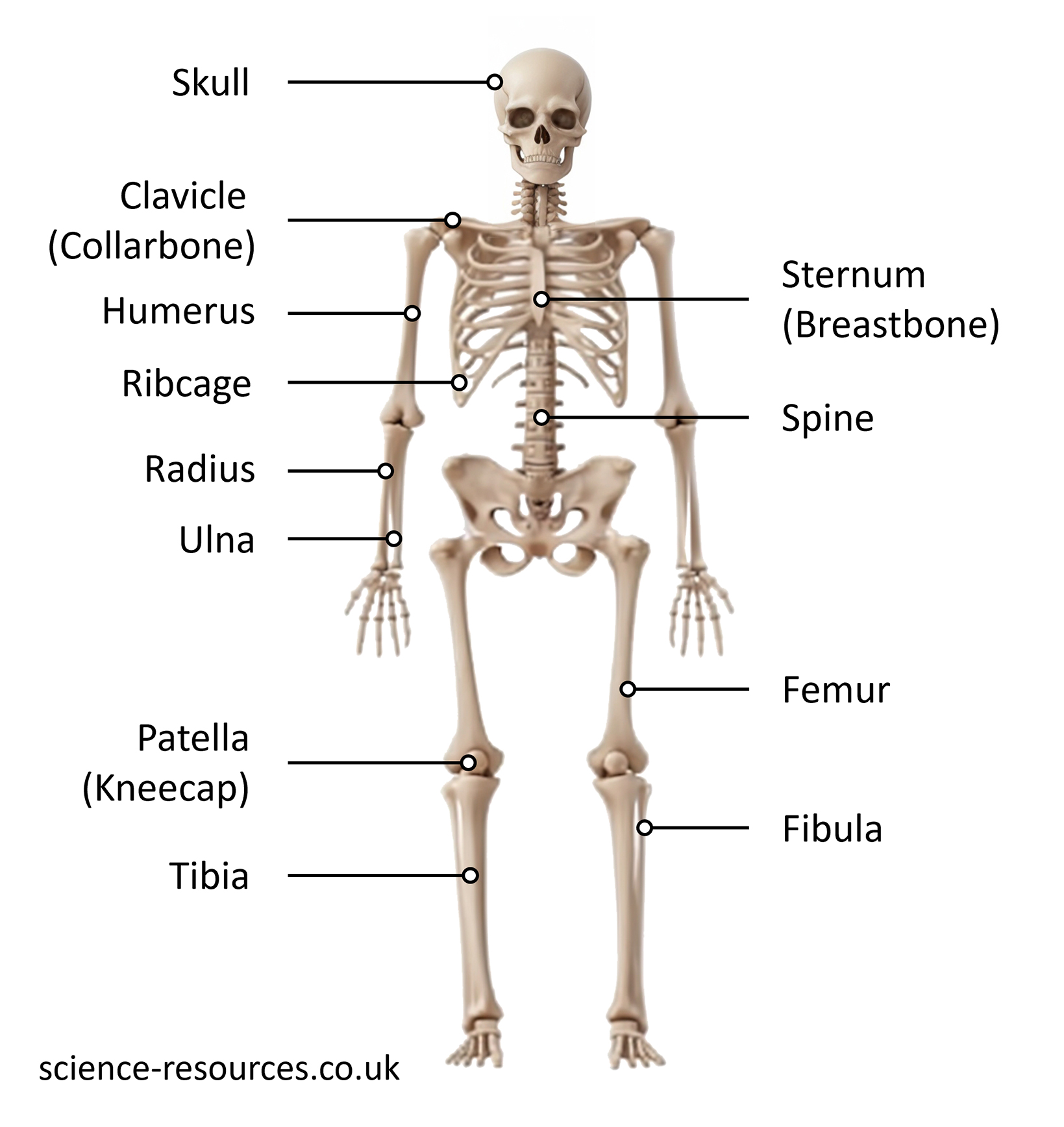


    Bone is a living tissue with a blood supply. It is constantly being dissolved and formed and can repair itself if broken. Calcium is important for this process.

  •  

  • Skeletal functions


    The skeleton has four main functions:


    • It provides support.
      • Vertebra surround the spinal cord. People have 33 at birth but 24 as adults because some join. They help people sit upright.
      • The femur, fibula and tibia are the main leg bones. They help people stand upright.

    • It protects organs from damage. For example:
      • The skull protects the brain.
      • The ribcage protects the heart and lungs.
      • The vertebrae protect the spinal cord.

    • It helps movement.
      • The skeleton has different types of joints. Some bones are rigidly joined and cannot move, like the skull bones. Some bones are flexibly joined and can move, like the shoulders, elbows and knees. The vertebrae have limited movement between them.
      • Muscles move bones by contracting and relaxing. They are attached to bones by tendons.

    • It makes blood cells.
      • Blood has different kinds of cells, such as:
        • Red blood cells, which carry oxygen in the blood.
        • White blood cells, which destroy harmful microorganisms.
      • These cells are made in the bone marrow, a soft tissue inside the larger bones. The hard part of the bone protects the bone marrow.
  •  

    🦴 Knowledge Check: The Skeletal System

    Think you know your bones from your biceps? Test your KS3 Skeletal System knowledge below!

    1. Which of the following is a function of the skeletal system?

    2. What type of joint is found at the shoulder and hip, allowing movement in almost every direction?

    3. When you bend your arm at the elbow, what is happening to your antagonistic muscle pair?

    4. Which tissue connects a muscle to a bone?

    5. Which part of the skeleton protects the heart and lungs?

    Check Your Answers
    1. Producing red and white blood cells (This happens in the bone marrow).
    2. Ball and socket joint (Hinge joints, like the elbow, only move in one plane).
    3. Biceps contract and triceps relax (This pulls the lower arm bone up).
    4. Tendon (Remember: Ligaments for Like-to-Like [bone to bone]).
    5. The Rib Cage (The cranium protects the brain; the vertebrae protect the spinal cord).


    Summary:


    • The skeleton:
      • allows movement.
      • gives support.
      • provides protection for vital organs.
      • to make blood cells
    • Skeletal muscles move the bones in the body.


    © 2012 science-resources.co.uk. All rights reserved | Design by W3layouts