The Rock Cycle
The rock cycle There are 3 types of rocks. They are: These rocks are recycled over
millions of years. They change from one to another in a slow
cycle. This is shown in the Rock Cycle below:
 The
Rock Cycle
The
Rock Cycle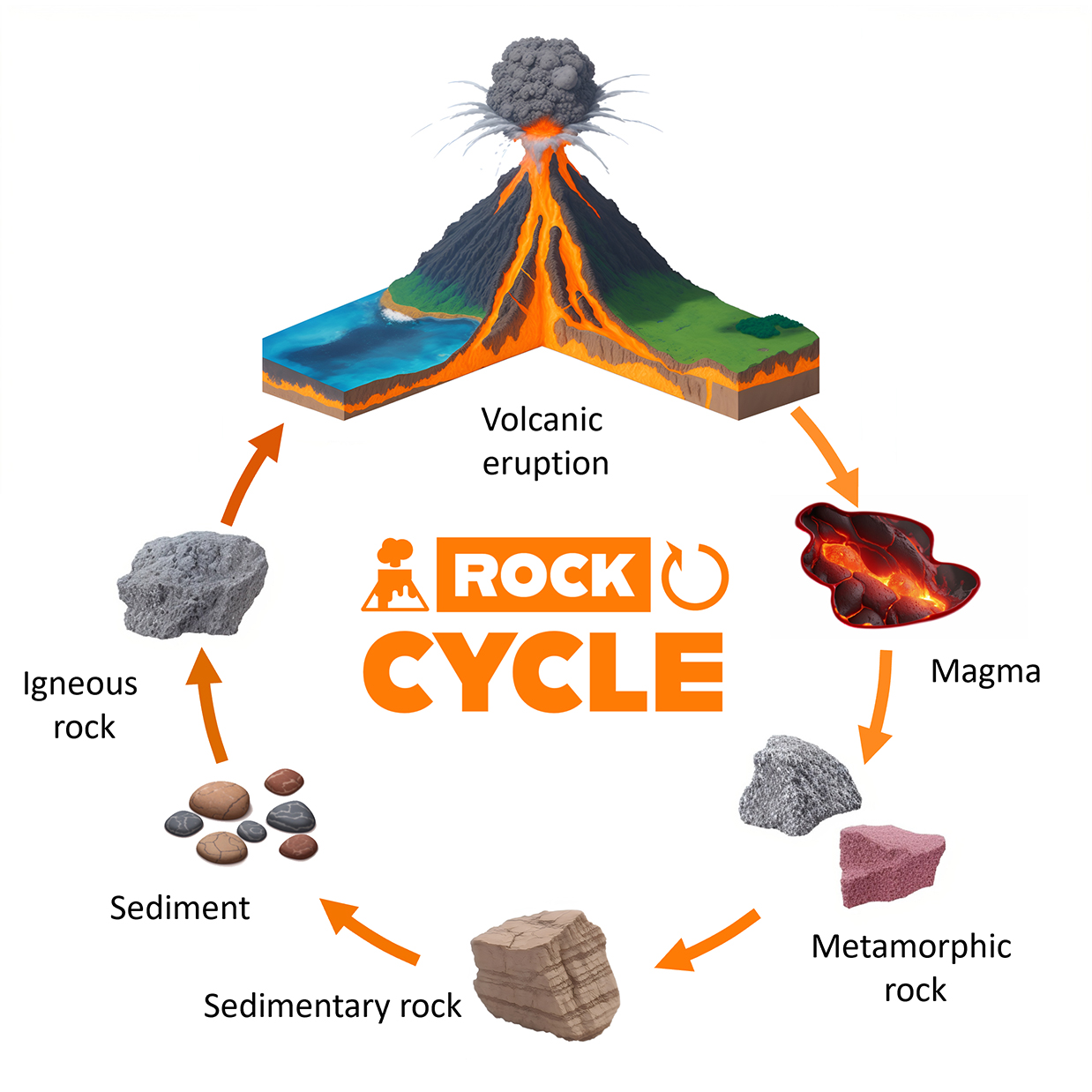
Igneous Rocks.
Igneous rocks ("igneous" as in ignite - from fire) are made when molten magma pushes up into the crust or right onto the earth's surface. It contains many different minerals in randomly arranged interlocking crystals. There are 2 types of igneous rocks:
Extrusive - molten rock comes straight out of the mouth of a volcano ("Ex-" as in "Exit"). This type of rock has small crystals due to quick cooling on the Earth's crust and beneath water. BASALT is the main example. Most ocean floors are made from basalt.
Intrusive - molten rock that never reaches the surface. This type of rock has big crystals due very slow cooling beneath the surface, like GRANITE.
Metamorphic Rocks.
Igneous and sedimentary rocks can be changed by high temperature or high pressure into much harder rocks, called Metamorphic rocks (from the Greek for 'change of shape').
This happens when movement of Earth's crust can bury rocks deep underground. As one goes deeper into the Earth's crust, the temperature and pressure gets higher and under these conditions, rocks have their mineral structure and texture changed, without actually melting.
The minerals in rocks arrange themselves into lines, resulting in band or sheets, to form metamorphic rock.
Rocks can also be 'baked' nearer the surface by molten rock known as magma. Magma rises towards the surface through faults in the Earth's crust. This happen quite often under volcanoes, the rocks near the magma get very hot. The temperatures are very high enough to change their structure.
Some examples Metamorphic Rocks.
Slate: It is formed when mudstone or clay gets moderately heated and compressed a lot. Its tiny plate-like particles align in the same direction.
For this reason, the resulting slate can easily be split along that direction into thin sheets which make ideal roofing material.
Marble: It is made when limestone is subjected to high temperature and pressure. Limestone reforms as small crystals. This results in marble having a more even texture and makes it much harder. Marble can be polished and is used as decorative stone as it has attractive patterns.
Schist: When mudstone is subjected to a very high temperature and pressure, new minerals like mica begins to form and produce layers. This creates a rock containing bands of interlocking crystals known as Schist. These bands of crystals are typical of a metamorphic rock.
Sedimentary Rocks
Sedimentary rocks form when other rocks slowly weather away. They are then carried off to another place. Eventually, they settle as sediment. As time passes, layers of sediment pile up.
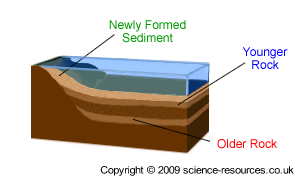
The pressure on the older, lower layers builds up. Any water in between the particles of sediment is squeezed out.
-
Fossils are not found in the other two types of rock (igneous and metamorphic) because they have been through too much heat and turmoil.
-
Fossils help us to identify rocks of the same age, because fossilised remains that are found change, due to evolution, as the time periods pass. This means that if 2 rocks have the same Fossilsthey must be from the same age.
Only Sedimentary rocks contain Fossils.
Fossils are only found in sedimentary rocks.
There are four main Sedimentary rocks.
These rocks tend to look similar to the original sediments from which they are produced. This is not surprising as very little has happened to them other than that they have been squashed together.
Sandstone
This is made from sand obviously. It looks like it as well, since all the sand particles are stuck very strongly together. There is yellow sandstone and red sandstone and these are commonly used to make buildings.
Limestone
This is made from seashells. It is predominantly calcium carbonate and is grey/white in colour. The original shells are mostly crushed but there are still many fossilised shells to found in limestone.
Mudstone or shale
This stone was made from mud which really means much finer particles than sand. It is dark grey in colour and tends to split into the original layers very easily.
Conglomerates
This can be comparedwith man made concrete, containing pebbles set into cement of very fine particles.
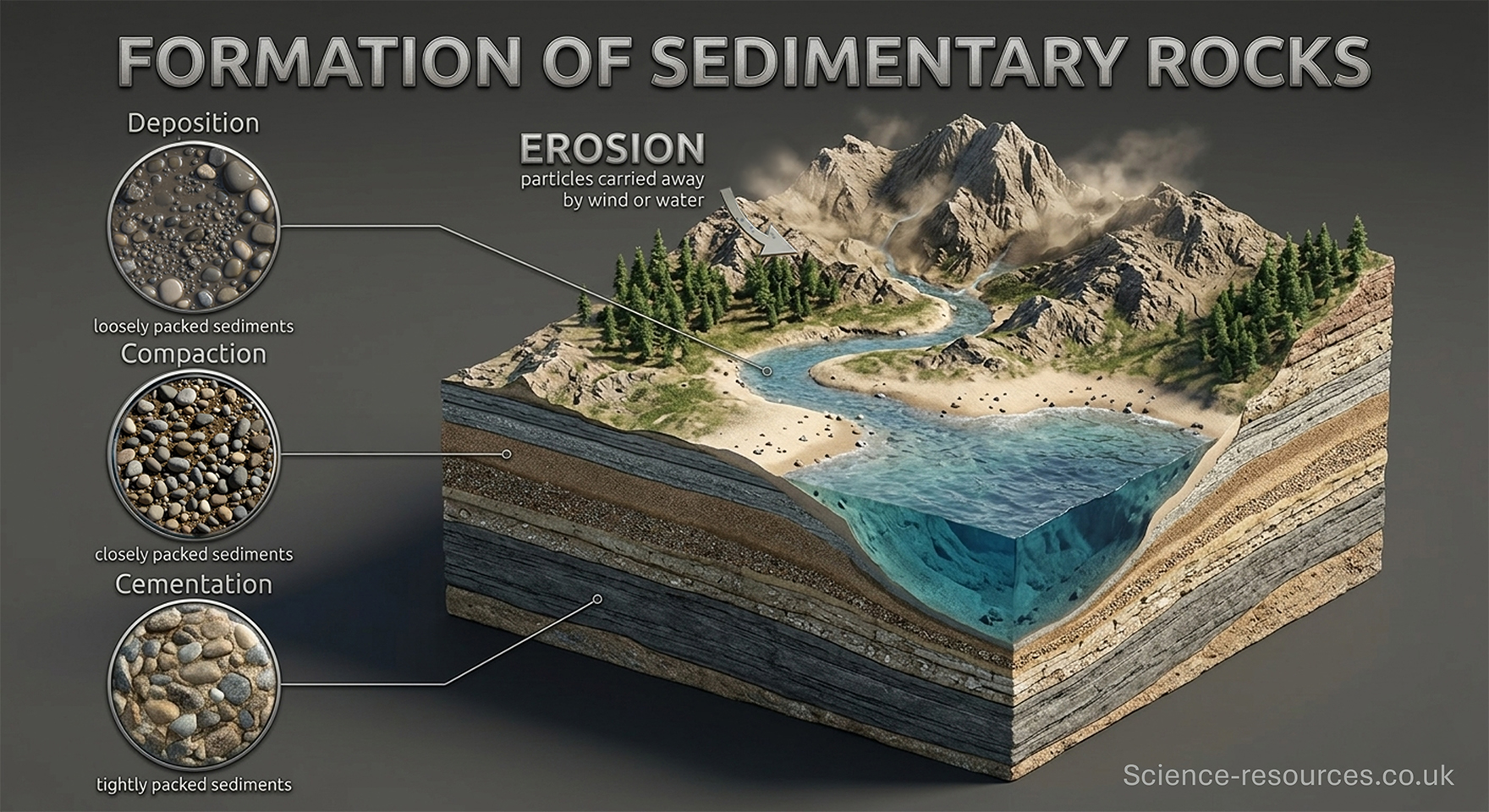 Formation of Sedimentary Rocks
Test your knowledge on the three main types of rocks and how they are linked through geological processes. 1. What process causes rocks to break into smaller pieces known as sediment? 2. Which type of rock forms directly from the cooling of magma or lava? 3. Metamorphic rocks are created when existing rocks are changed by which two factors? 4. In which type of rock are you most likely to find fossils? 5. What happens to rock when it is pulled deep underground and becomes extremely hot?💎 Knowledge Check: The Rock Cycle
Click to Reveal Answers
2. Igneous (Formed from cooled molten rock).
3. Heat and Pressure (Conditions that change rock without melting it).
4. Sedimentary (Formed in layers where organic remains can be trapped).
5. It melts into magma (Extreme heat deep in the Earth turns solid rock back into liquid).
Tags:Rock cycle, Igneous, Metamorphic, Sedimentary, Rock cycle ks3