Ceramics
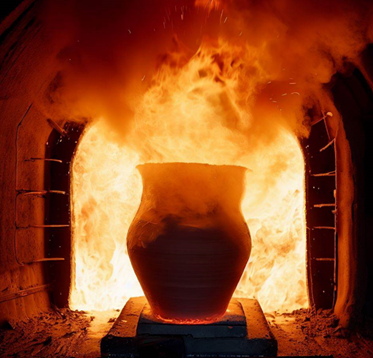
What are ceramics? The firing process has three stages: Clay is heated to very high temperatures in a kiln.
Ceramics are hard and strong materials. They are made by heating a soft material in a very hot oven called a kiln. The kiln can change its temperature for different kinds of clay and can go up to more than 1300 °C.
The soft materials can be shaped before they are heated. Clay is one example of a soft material.
When the soft materials are heated, they become harder materials that we call ceramics.
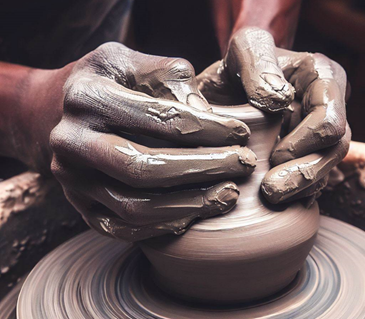
Clay is shaped on a potter’s wheel.
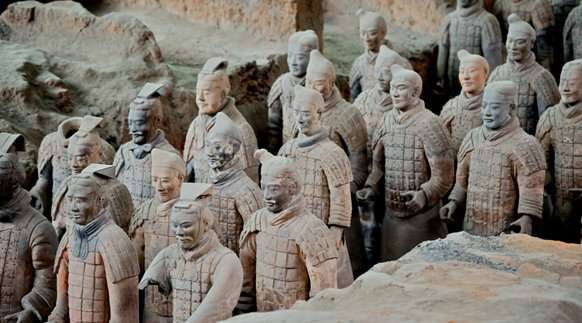
Properties of ceramics Uses of ceramics: The Terracotta Army Source: kevinmcgill from Den Bosch, Netherlands - KAM_5111
Common properties of ceramics include:
Ceramics have a wide range of uses including:
Test your knowledge on the properties and science of ceramic materials based on the guide. 1. Which of the following is a key physical property of most ceramics? 2. What happens to clay when it is heated to a high temperature in a kiln? 3. Ceramics are described as insulators. This means they are very poor at: 4. Why do ceramics have high melting points? 5. Glass is a type of ceramic. What is the main raw material used to make most glass? Summary: 🏺 Knowledge Check: Ceramics
Click to Reveal Answers
2. Chemical reactions occur (The heat permanently changes the clay's structure).
3. Conducting heat and electricity (They lack free electrons to carry energy).
4. Strong chemical bonds (A lot of energy is needed to break the bonds in the lattice).
5. Sand (silica) (Sand is melted and cooled to produce glass).