Evaporation
What is evaporation? Using evaporation to separate a solution A solution is placed in an evaporating dish and heated with a Bunsen burner.
Evaporation is when a liquid changes into a gas slowly, without reaching its boiling point.
Evaporation can happen at any temperature, but boiling only happens at a specific temperature for each liquid.
Evaporation can be used as a separation method to separate components of a mixture with a dissolved solid in a liquid. The liquid is evaporated, meaning it is converted from its liquid state to gaseous state. This often requires heat. Once the liquid is completely evaporated, the solid is all that is left behind.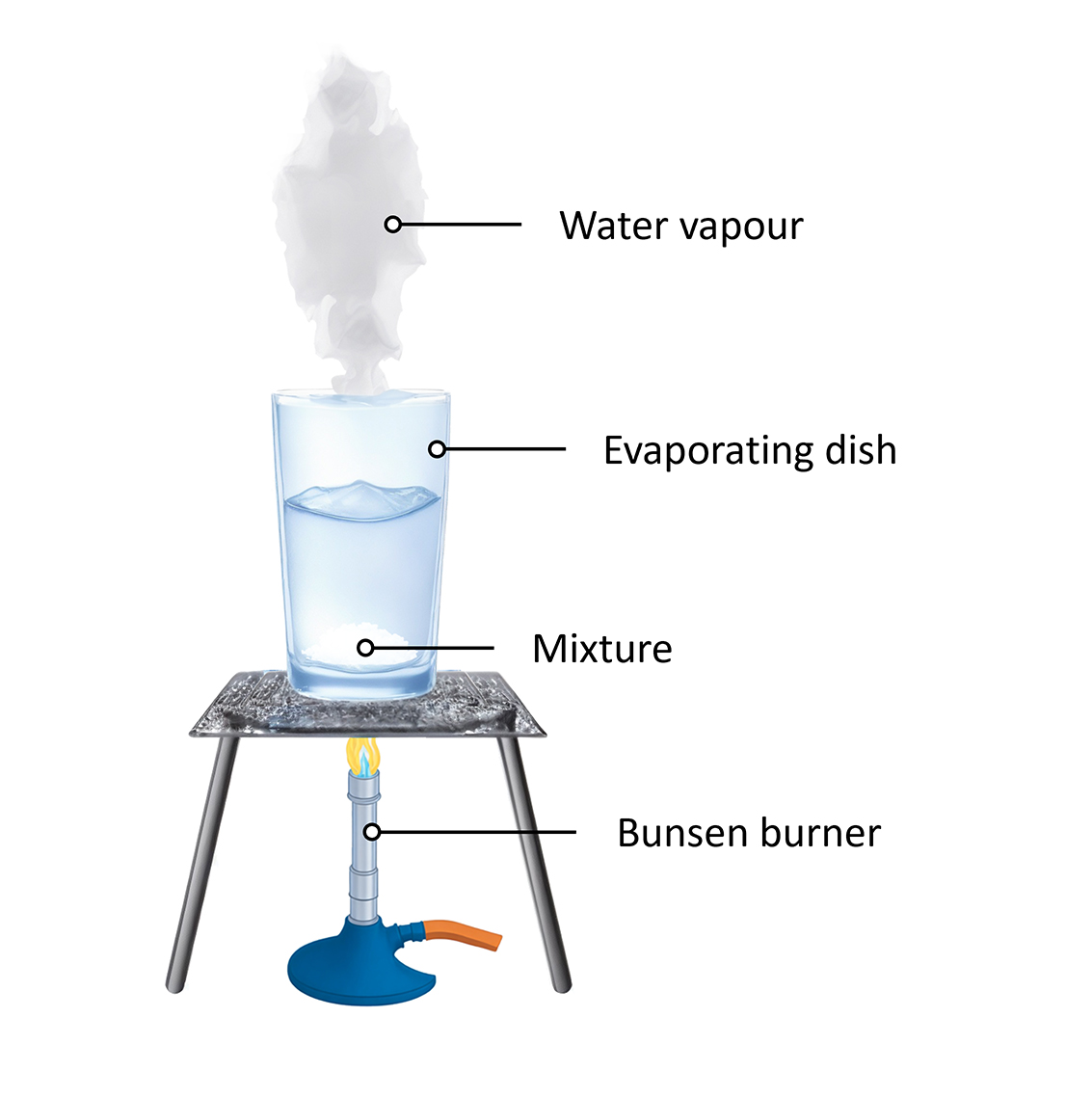
Crystallisation
Crystallisation is a way of separating a solid solute from a solution by letting the solvent (water) evaporate slowly over time.
Crystallisation makes the solute form bigger crystals, because the slower the water evaporates, the more time the solute has to arrange itself into a regular pattern.
These are the steps for crystallisation:
Test your understanding of how evaporation works as a separation technique. 1. Evaporation is a technique used to separate: 2. During evaporation, what happens to the liquid solvent? 3. Why does the evaporating dish have a wide, shallow shape? 4. Which of these is a common substance obtained using evaporation? 5. In a school lab, what is usually used to provide the heat for evaporation? Summary: 🧪 Knowledge Check: Evaporation
Click to Reveal Answers
2. Turns into a gas and escapes (The heat causes the solvent to change state and leave the solid behind).
3. To provide a large surface area (A wider surface allows more molecules to escape as gas at once).
4. Copper sulphate crystals (Crystallisation occurs as the liquid solvent is removed).
5. A Bunsen burner (This provides the thermal energy needed to speed up the process).