Filtration
What is filtration?
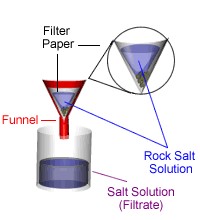
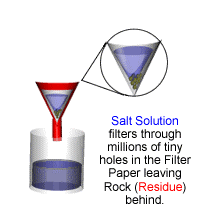
Filtration is a way of separating a solid that does not dissolve in a liquid. When a mixture of rock salt and water is filtered:
The rock salt remains in the filter paper (it is called the residue) the water goes through the filter paper (it is called the filtrate).
What is filtration used for? How does filtration work?
If a substance doesn’t dissolve in a solvent, it is called insoluble. For example, sand does not dissolve in water, meaning it is insoluble.
Filtration can be used to separate an insoluble solid. For example, water or salty water are liquids, and sand or stones are solids that do not dissolve in them.
When you filter a mixture of water and sand, the sand is left on the filter paper, this is the residue. the water goes through the filter paper, this is the filtrate.
Filtration works by using filter paper with many small holes that are too small to see. The liquid and any solutes that are dissolved in it can go through the holes in the filter paper. If the liquid has a solid that does not dissolve in it and has big particles, these big particles cannot go through the holes in the filter paper.
How well do you understand the process of separating insoluble solids from liquids? Test yourself below. 1. Filtration is specifically used to separate which type of substance from a liquid? 2. What is the name of the solid material that gets left behind on the filter paper? 3. Which piece of equipment is used to hold the filter paper during the process? 4. What is the 'filtrate' in a filtration experiment? 5. Which of the following mixtures could be separated using filtration? Summary: 🔬 Knowledge Check: Filtration
Click to Reveal Answers
2. Residue (The particles that are too large to pass through the filter paper).
3. Filter funnel (It directs the filtrate into the collection flask).
4. The liquid that passes through (The clear liquid collected after filtration).
5. Sand and water (Sand is insoluble, whereas salt and sugar dissolve).