i


Structure of the Earth


Structure of the Earth


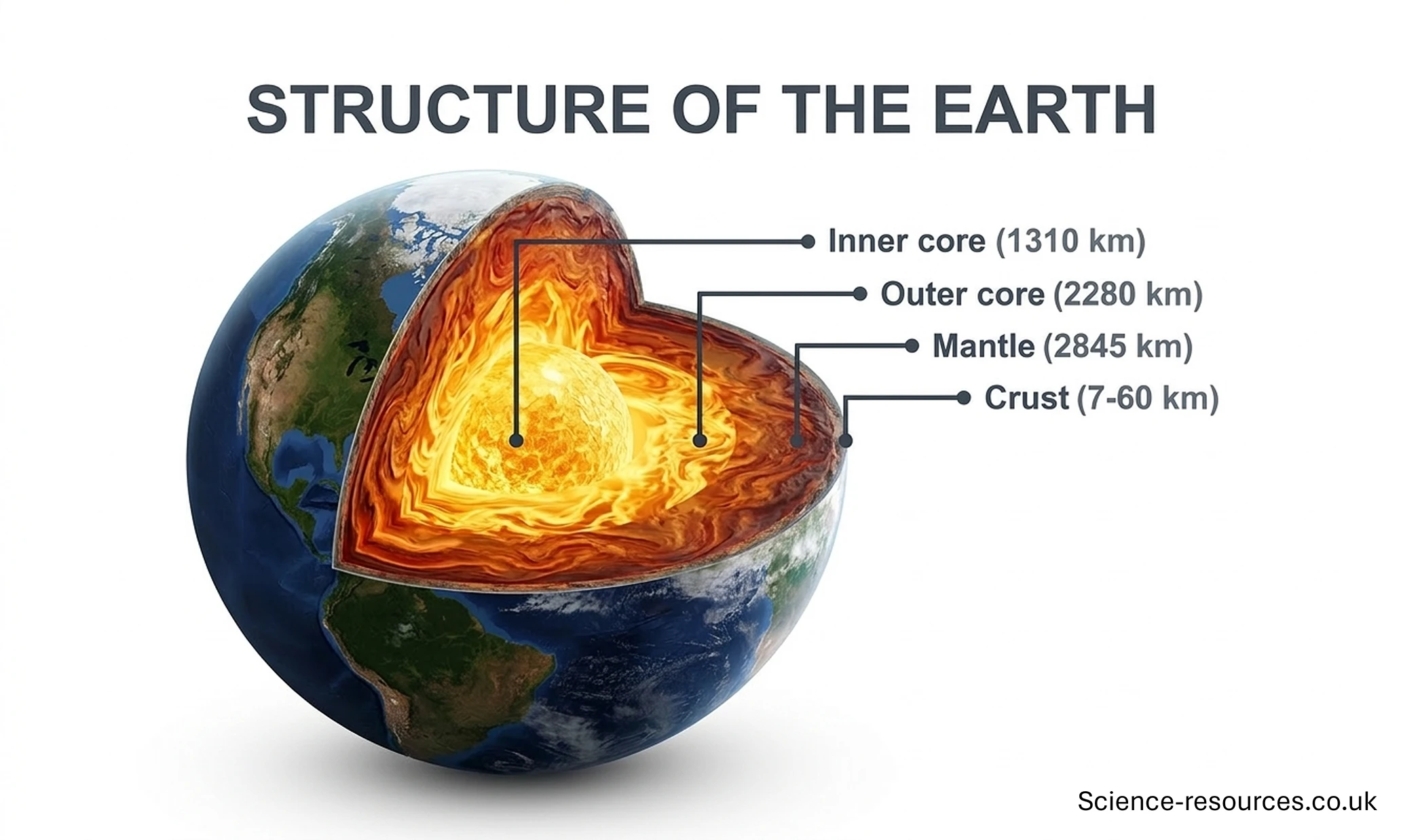
A scientific illustration shows a three‑dimensional view of Earth with a large wedge removed to reveal the planet’s internal layers. The outer surface displays oceans and landmasses. Inside the cutaway section, four distinct layers are shown in bright colours with labels and distance measurements.
The crust, the thinnest outer layer, is depicted in a dark brown colour with a label indicating a thickness of 7–60 km. Beneath it, the mantle is shown as a thick, swirling orange‑red layer labelled 2,845 km deep. Further inward, the outer core appears as a vivid, molten orange region labelled 2,280 km deep. At the centre, the inner core is represented as a bright yellow sphere, labelled 1,310 km deep. Black lines connect each label to the corresponding layer. At the top of the image, the text “STRUCTURE OF THE EARTH” appears in bold capital letters.

Structure of the Earth – Cross Section Diagram


  • The Earth is a sphere-shaped planet with three layers inside.

  • The layers are:
    • the crust (rocky)
    • the mantle (soft)
    • the core (metal).

  • The core has two parts: the inner core (solid) and the outer core (liquid)

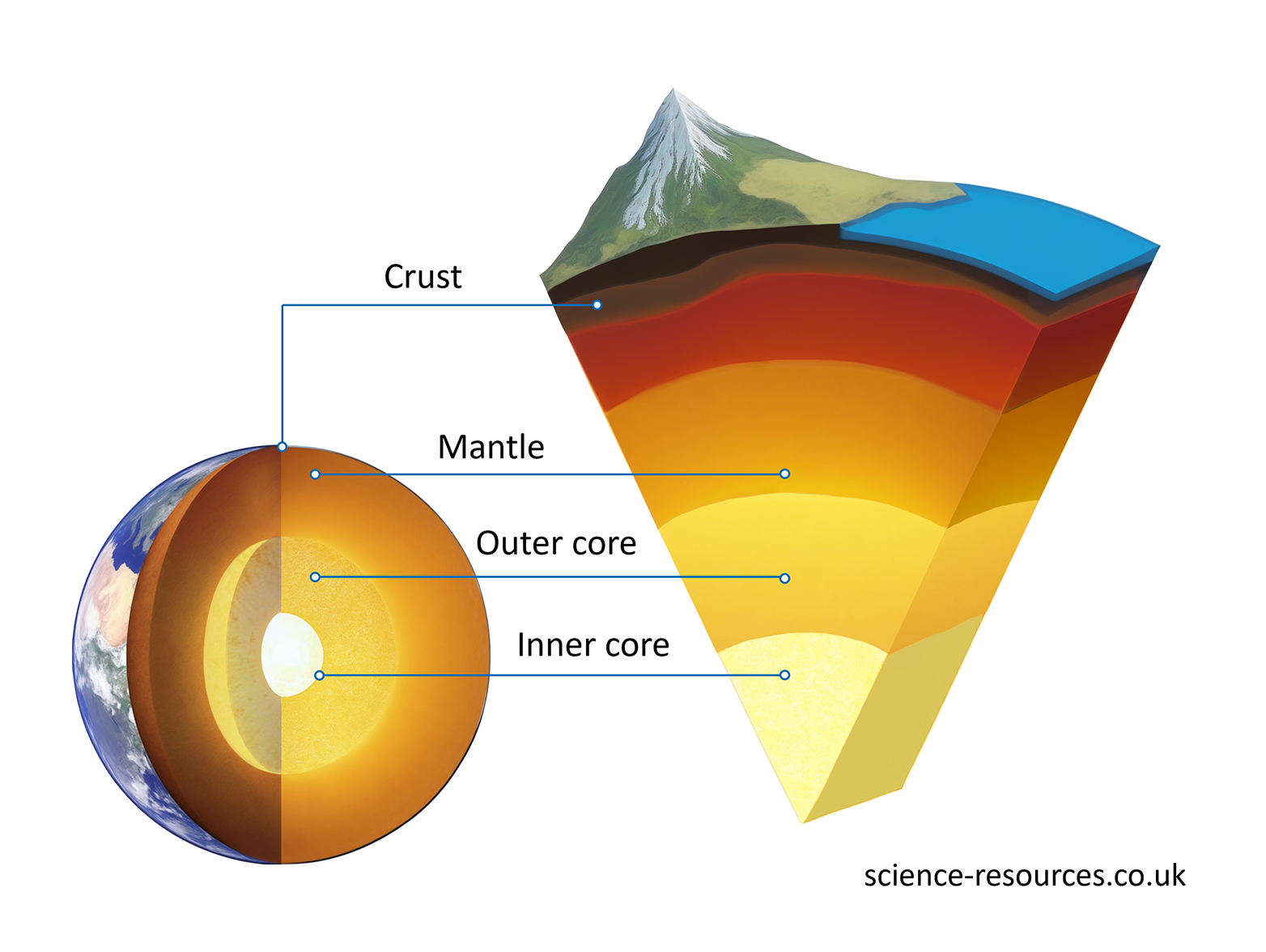
This image shows a diagram of the layers of the Earth, with labels indicating the crust, mantle, outer core, and inner core. The diagram also shows a realistic view of the Earth’s surface with continents and oceans.


Elements in the Earth


Human activities use a wide range of elements, including:

  • Hydrogen (H) and oxygen (O) found in water
  • Iron (Fe) used for building materials and in car bodies


All these elements can be found in the crust, the atmosphere and the oceans, which all form part of the Earth’s structure. We can use some of these things for our daily life, but we have to be careful not to use them all up.


The Crust


The top layer is the crust. It is like a big puzzle of land pieces called plates. The plates move slowly because the layer below them is soft and flows. The crust has many rocks that have different things in them, like oxygen, silicon, iron, and aluminium.
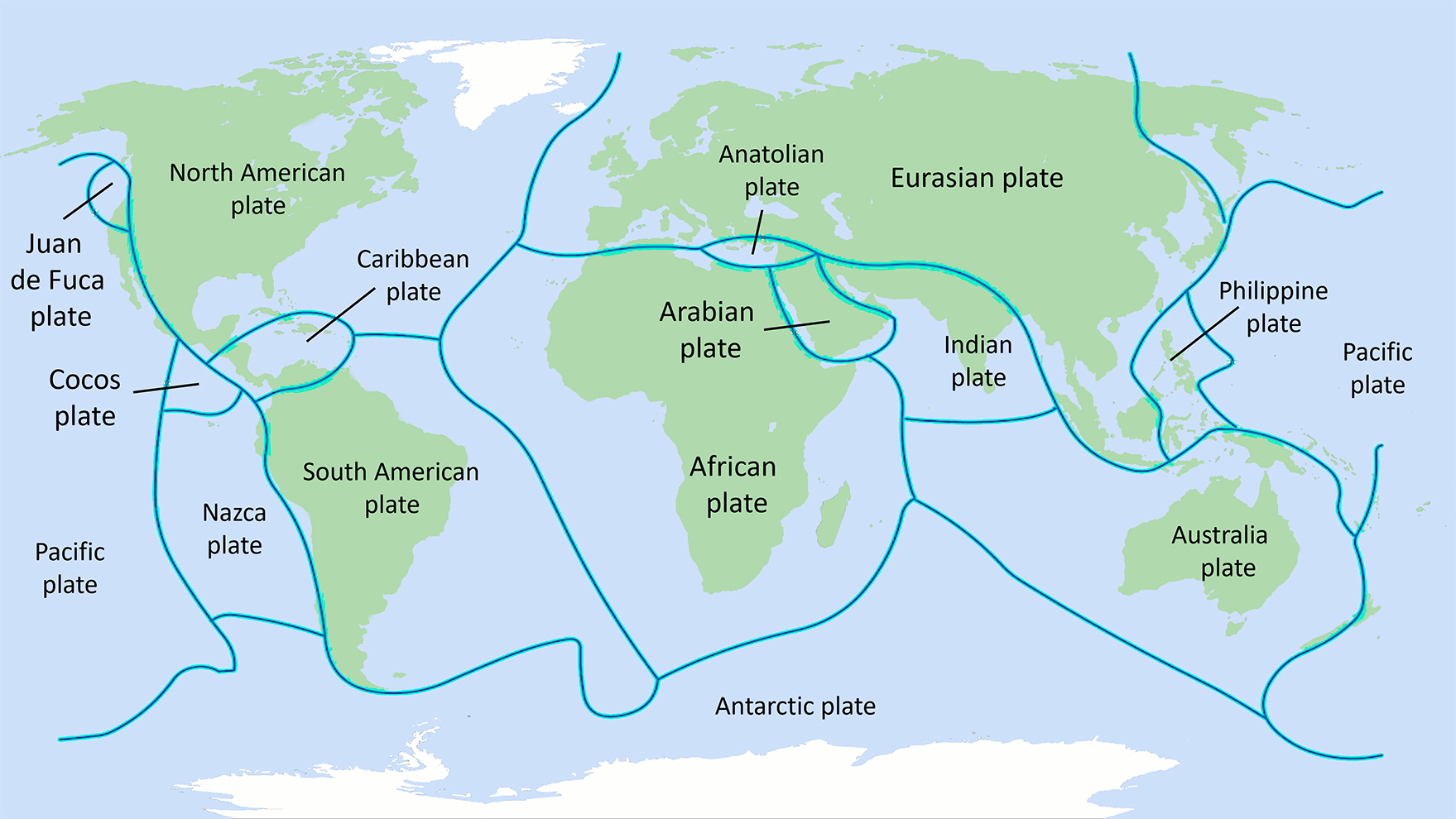
 

This image shows a map of the world with the major tectonic plates outlined and named. Tectonic plates are large pieces of the Earth’s crust that move and interact with each other, causing earthquakes, volcanoes, and mountain formation. The map also shows the boundaries between the plates, which can be convergent, divergent, or transform.


The Mantle


The middle layer is the mantle. It is thick and soft like a liquid. We cannot get anything from the mantle because it is too deep and hot.


The Core


The bottom layer is the core. It is made of metal, mostly iron and nickel. The core has two parts: the inside part is hard and the outside part is liquid. The core makes the Earth magnetic, which means it has a north and a south pole. We cannot reach the core because it is too deep and hot.


🌍 Knowledge Check: Structure of the Earth

Test your knowledge on the layers of our planet and the atmosphere based on the lesson content.

1. Which layer of the Earth is described as being semi-solid and able to flow very slowly?

2. What is the approximate percentage of Oxygen in the Earth's atmosphere?

3. Why is the Inner Core solid even though it is the hottest part of the Earth?

4. Which two metals primarily make up the Earth's core?

5. How thick is the Earth's crust beneath the continents?

Click to Reveal Answers
1. The Mantle (It is a thick layer of semi-solid rock).
2. 21% (Nitrogen is 78%, Oxygen is 21%).
3. Extreme pressure (High pressure keeps the inner core solid despite high temperatures).
4. Iron and Nickel (The core is made of these dense metals).
5. Up to 70km (Oceanic crust is thinner at 5km, continental crust is thicker).


Summary:


  • The Earth has three layers: the core (metal), the mantle (rock), and the crust (hard).
  • Different parts of the Earth have different things in them, like iron, nickel, and oxygen.
  • The crust is broken into big pieces called plates that move slowly because of the mantle underneath.


© 2012 science-resources.co.uk. All rights reserved | Design by W3layouts