Rock types
Types of rocks There are three kinds of rocks on Earth: igneous, metamorphic, and sedimentary. They are different because they are made in different ways.
The Earth’s outer layer is called the crust, and it is made of rocks. Rocks are hard things that have different kinds of minerals in them. Minerals are natural substances that have different kinds of atoms in them.
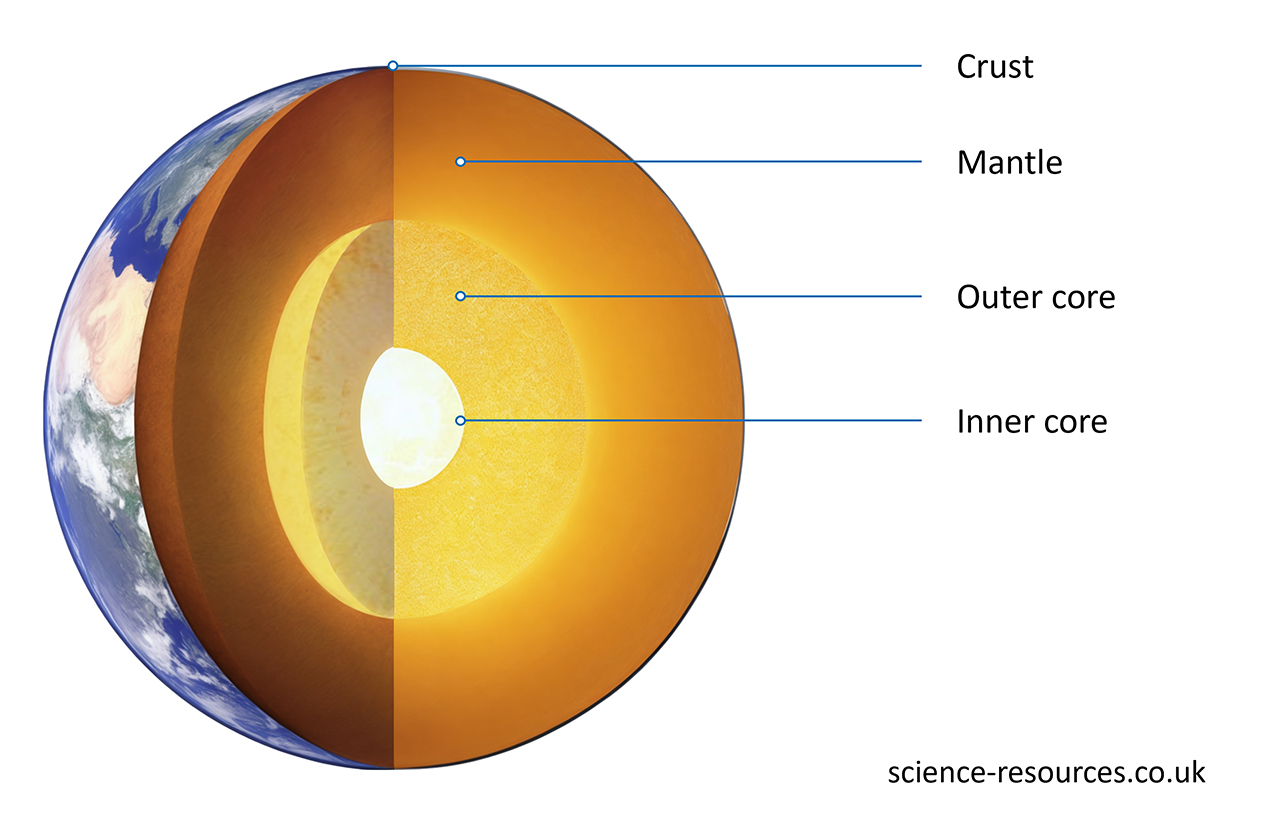
Let’s look at these in more details: Igneous Rocks The Earth is very hot inside, so some rocks are liquid there. We call this liquid rock magma. Sometimes, magma comes out of the Earth through volcanoes. We call this lava. When lava cools down, it makes igneous rocks. Igneous rocks have crystals that fit together like a puzzle. The crystals can be big or small, depending on how fast the magma cools down. There are two kinds of igneous rocks: extrusive and intrusive. Extrusive igneous rocks Intrusive igneous rocks Sedimentary rocks Metamorphic rocks
Igneous rocks are made from melted rock that becomes hard when it cools down.
Extrusive igneous rocks are made from lava that cools down quickly on the surface. They have very small crystals that you can’t see without a microscope. Obsidian is an example of an extrusive igneous rock. It is black and shiny.
Intrusive igneous rocks are made from magma that cools down slowly underground. They have big crystals that you can see with your eyes. Granite is an example of an intrusive igneous rock. It has different colours and is good for making kitchen counters.
Sedimentary rocks are made of layers of different things. The bottom layers are older than the top layers.
Some examples of sedimentary rocks are chalk, limestone, shale, and sandstone. They are made from pieces of other rocks that stick together.
Sedimentary rocks have layers that you can see in this picture:
Sedimentary rock showing different layers within the rock There are five steps to make a sedimentary rock:
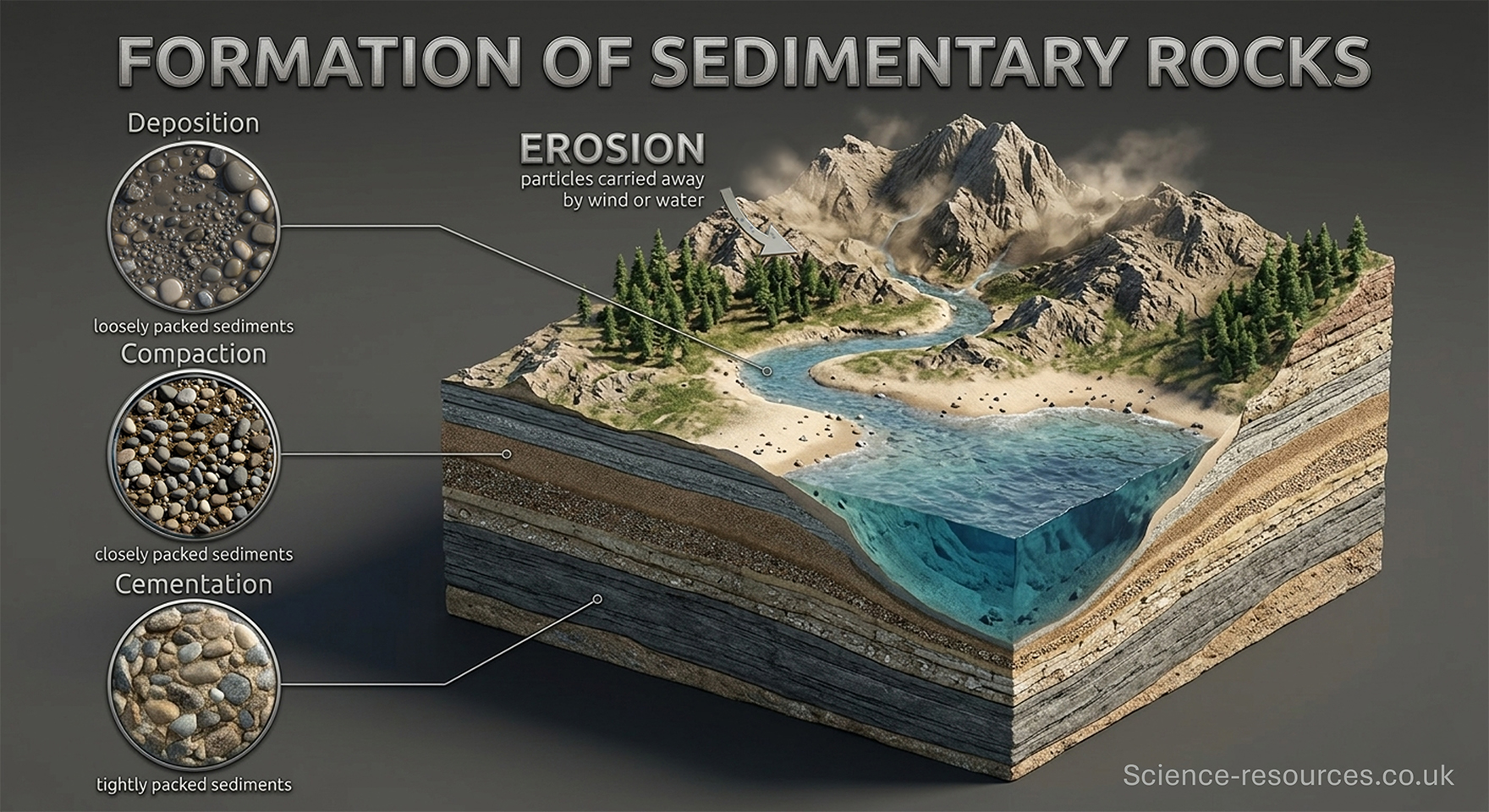 Formation of Sedimentary Rocks
Metamorphic rocks are made from other rocks that change because of heat and pressure.
The rocks that change can be sedimentary rocks or igneous rocks. Sometimes, metamorphic rocks can also change into other metamorphic rocks.
There are three steps to make a metamorphic rock:
Test your knowledge on the three main types of rocks and how they are formed. 1. Which type of rock is formed from the cooling of molten rock (magma or lava)? 2. Why do intrusive igneous rocks, like granite, have large crystals? 3. Sedimentary rocks are the only rock type that might contain which of the following? 4. Which rock is a metamorphic rock formed from limestone? 5. What two factors change existing rocks into metamorphic rocks? Summary: Earth has three kinds of rocks: igneous, metamorphic, and sedimentary. 🪨 Knowledge Check: Rock Types
Check Your Answers
2. Slow cooling underground (Slow cooling allows larger crystals to grow).
3. Fossils (Sedimentary rocks are the only type where fossils may be found).
4. Marble (Limestone changes into marble under heat and pressure).
5. Heat and pressure (These factors change existing rocks without melting them).
They are made differently: