What would Earth be like without its magnetic field?
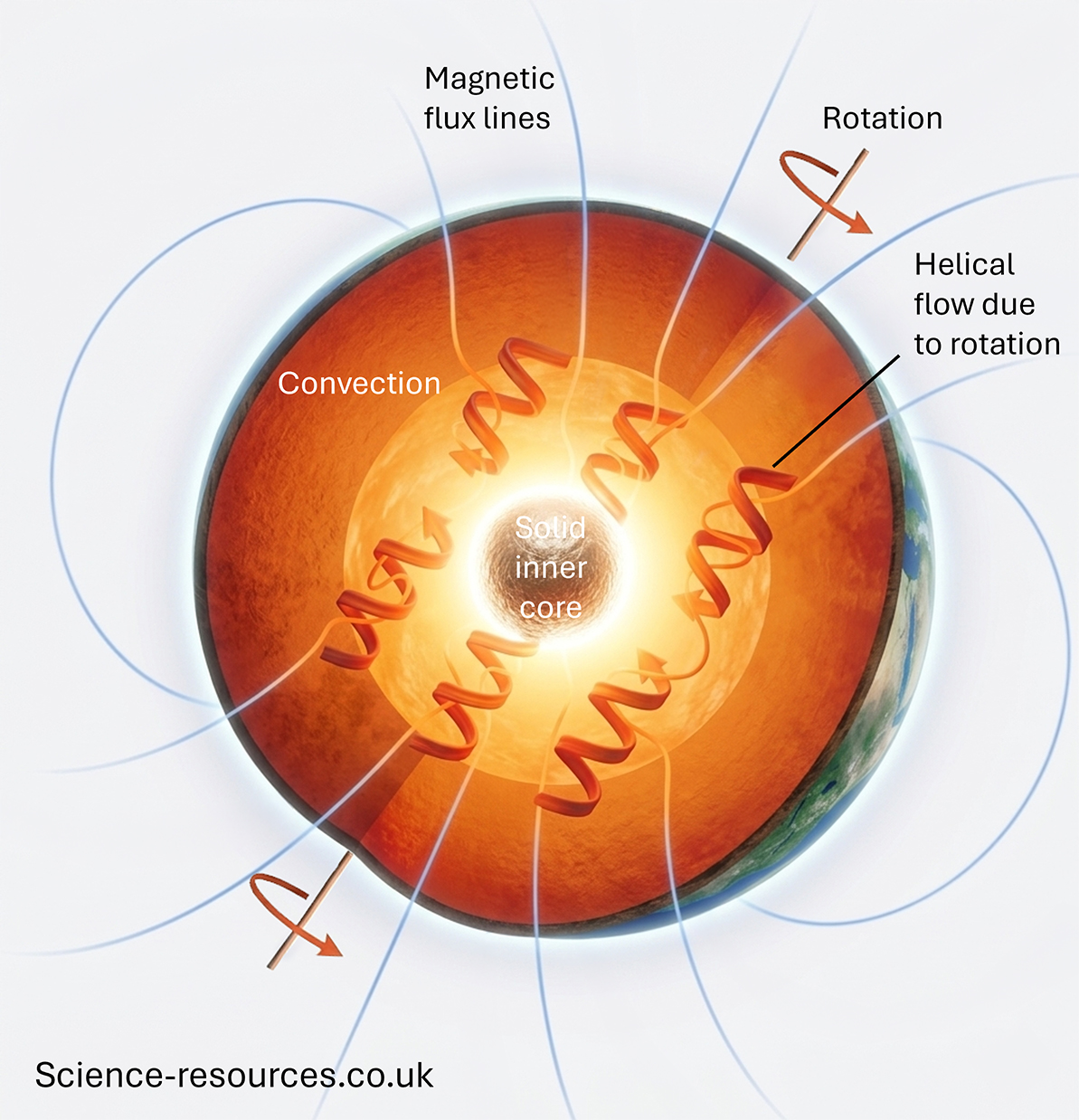
Earth’s magnetism is made deep inside the planet. The outer core is full of very hot, melted iron. This iron swirls around as Earth spins, and this movement creates Earth’s magnetic field. The magnetic field is strongest near the magnetic poles. The space around Earth that is controlled by this magnetism is called the magnetosphere. Earth’s Geodynamo: Convection, Rotation, and Magnetic Field Generation Earth’s magnetic field helps protect us. But what would happen if it disappeared? The Sun sends out charged particles and radiation all the time. This is called the solar wind. Usually, Earth’s magnetic field pushes most of these harmful particles away, and our atmosphere stops the rest from reaching the ground. Without the magnetic field, Earth would get much more radiation. This could damage living things. It could also slowly wear away our atmosphere, which helps keep Earth warm and safe. Scientists think this is what happened on Mars, which used to have a magnetic field but lost it. The Earth’s Magnetic Field
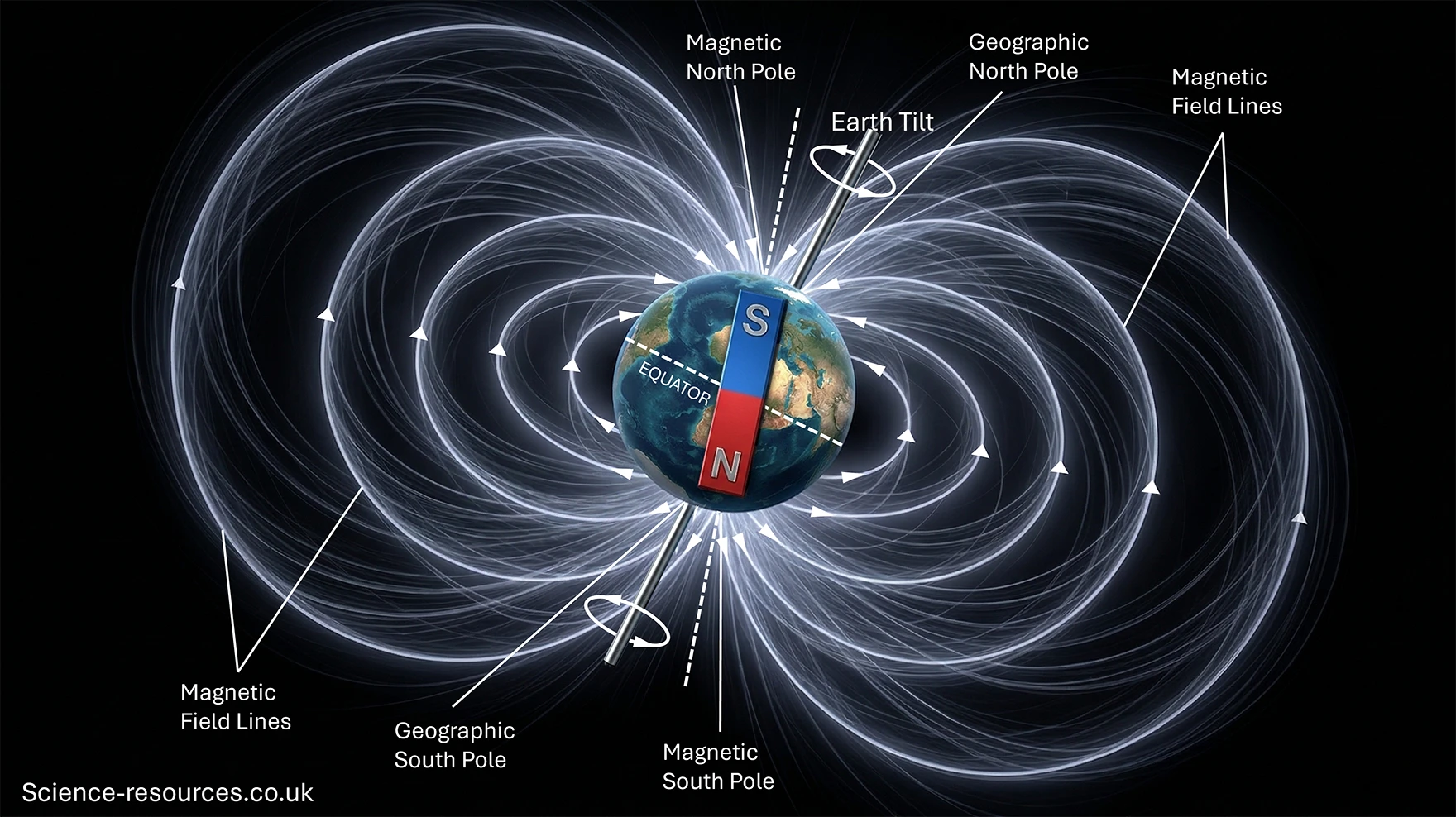 Diagram of Earth’s magnetic field and magnetic poles
Earth has a magnetic field, even though we cannot see it. You can imagine Earth working a bit like a giant bar magnet, with a magnetic north pole and a magnetic south pole. These magnetic poles are not in exactly the same place as the North and South Poles that appear on a map, and they even move over time. 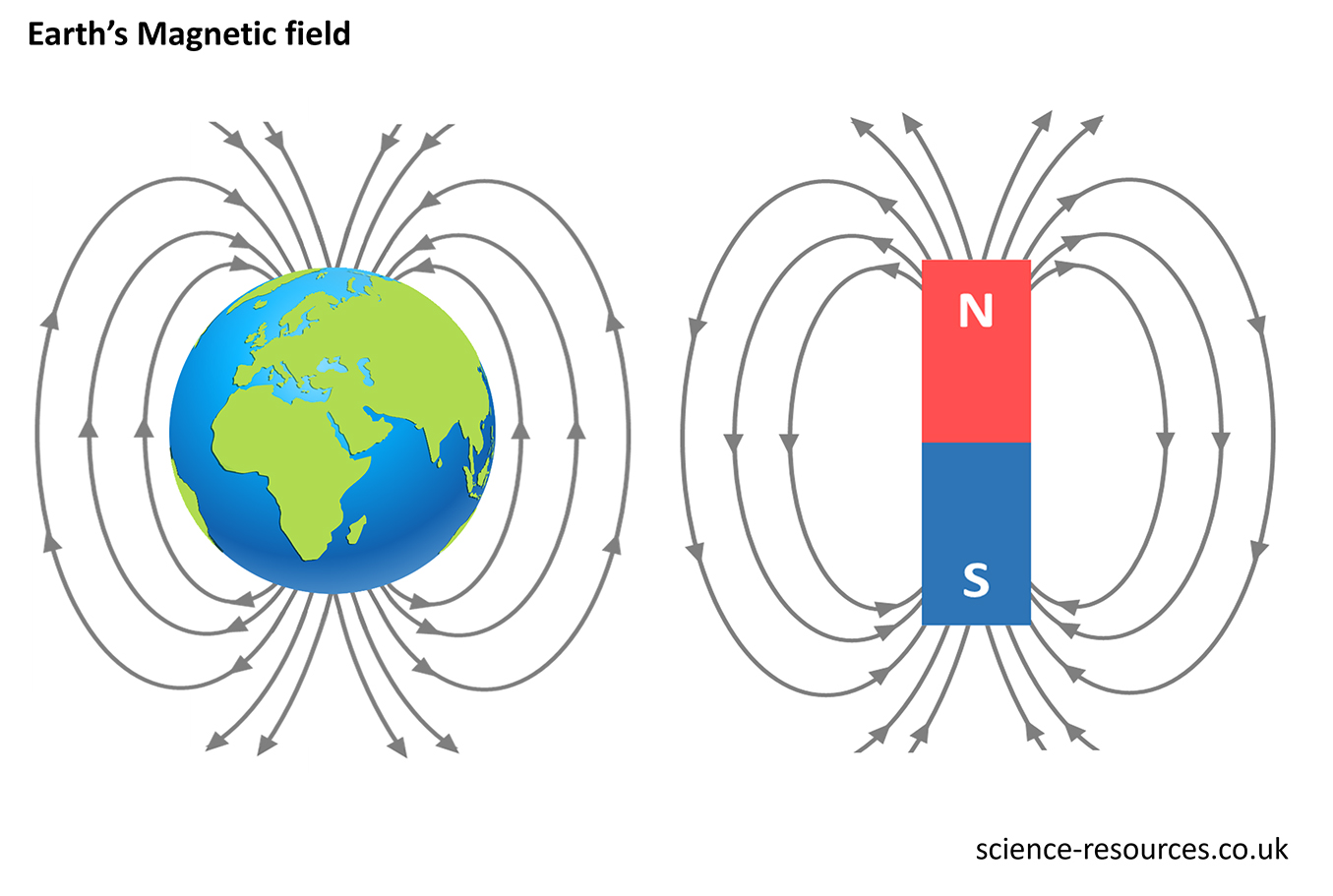
What would Earth be like without its magnetic field?
More radiation would reach Earth
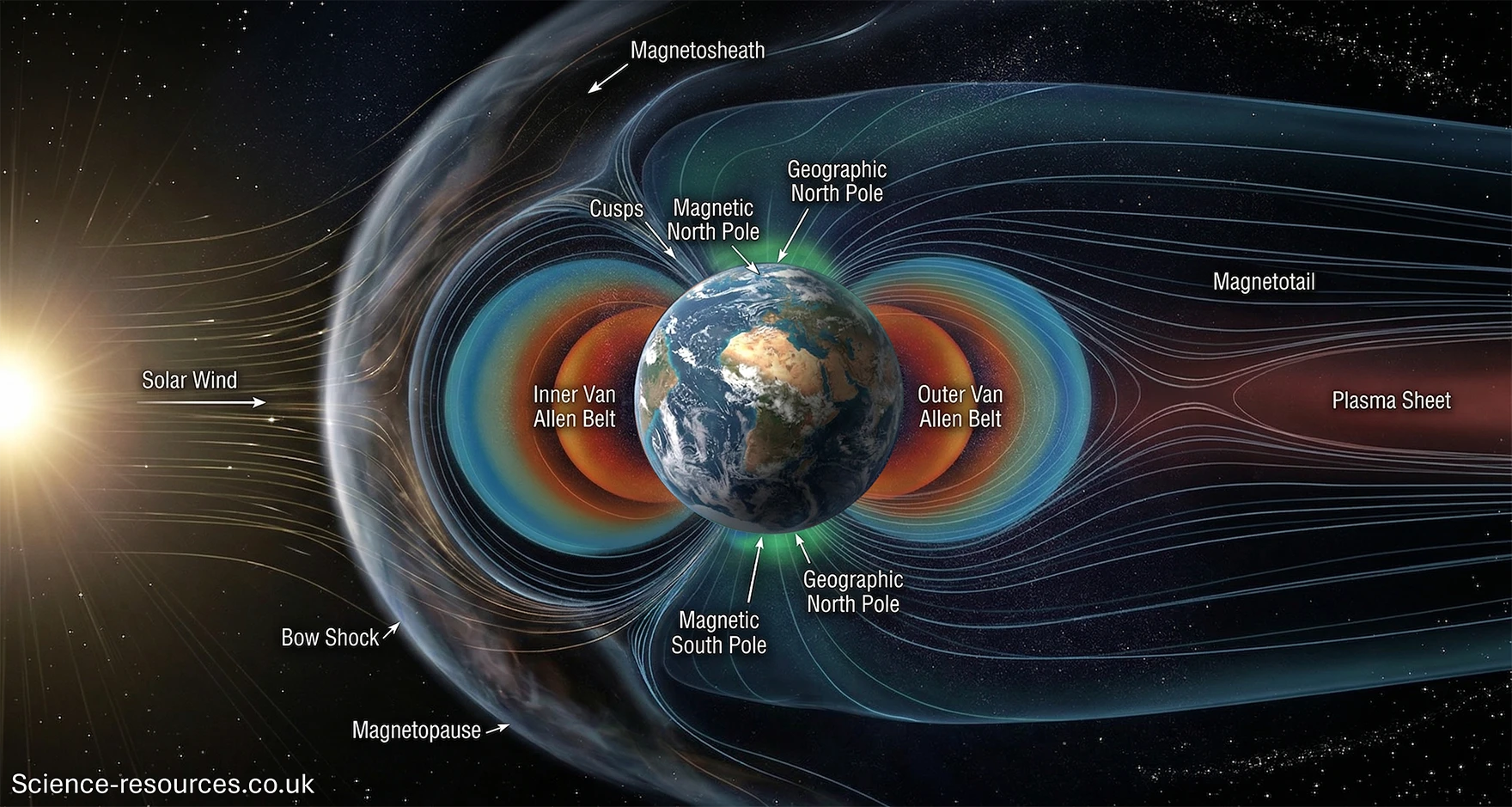 A diagram (not to scale) of how the Earth’s magnetic field acts as a barrier against solar wind.
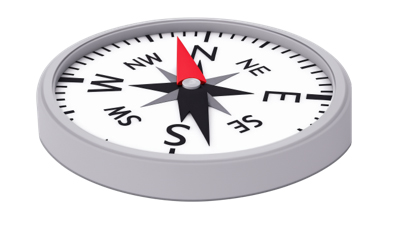
A compass works because the little metal needle inside it is a tiny magnet. It turns to point towards Earth’s magnetic north pole. This helps people find direction when they are walking, sailing, or flying. If Earth had no magnetic field, compasses would not point anywhere useful. They would simply stop working. The Northern Lights and Southern Lights are beautiful glowing colours in the sky. They happen when particles from the Sun are guided towards Earth’s magnetic poles. When these particles hit gases high in the sky, they make them glow green, purple, or blue. Without the magnetic field, the particles would not be guided towards the poles, so these amazing lights would not appear. Sometimes the Sun sends out very strong bursts of particles called solar storms. These can disturb Earth’s magnetic field. When this happens, electricity can surge through power lines and damage them. In the past, solar storms have caused power cuts and problems with radios and satellites. Earth’s magnetic field helps reduce this damage. Without it, technology like GPS, satellites, power grids, aeroplane communication, and even mobile signals would be at much greater risk from solar storms.
Compasses would not work
No Northern Lights or Southern Lights
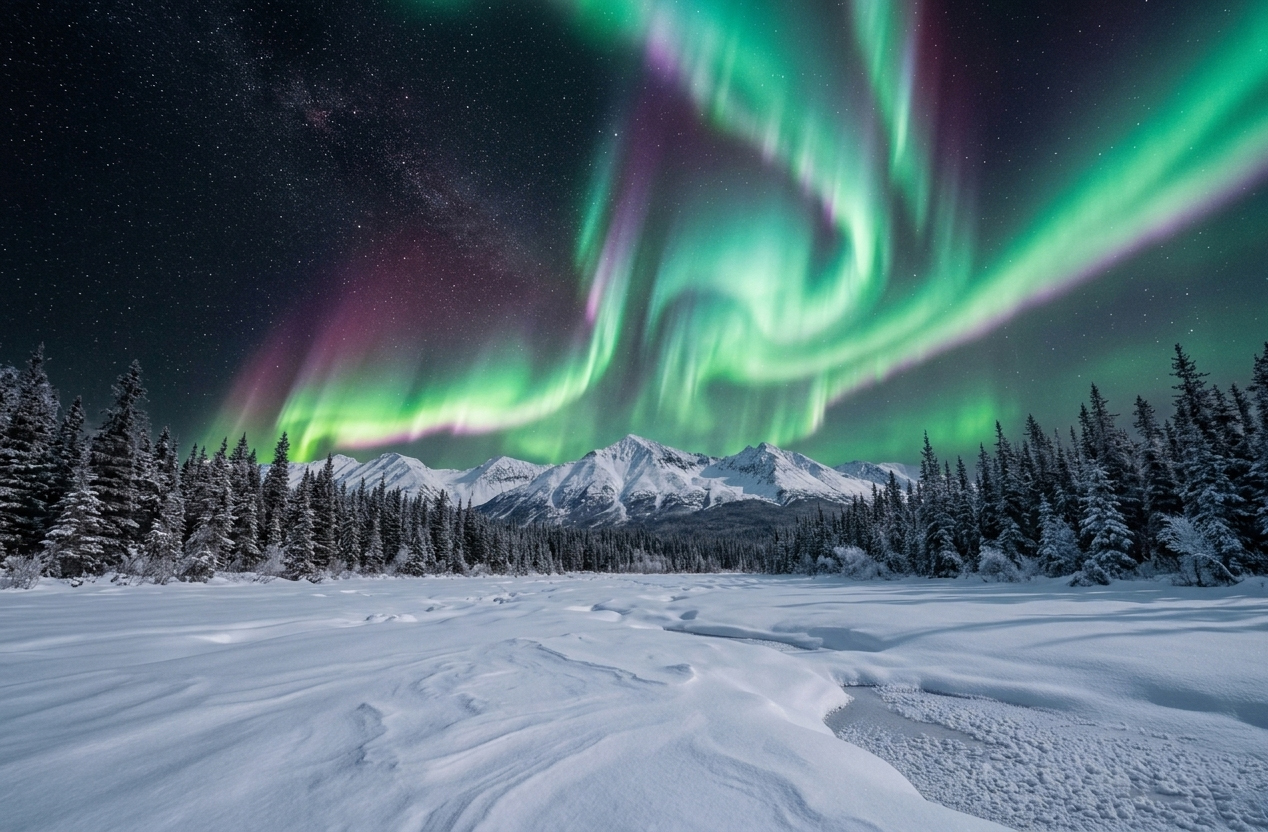 Northern Lights
Technology could break more easily
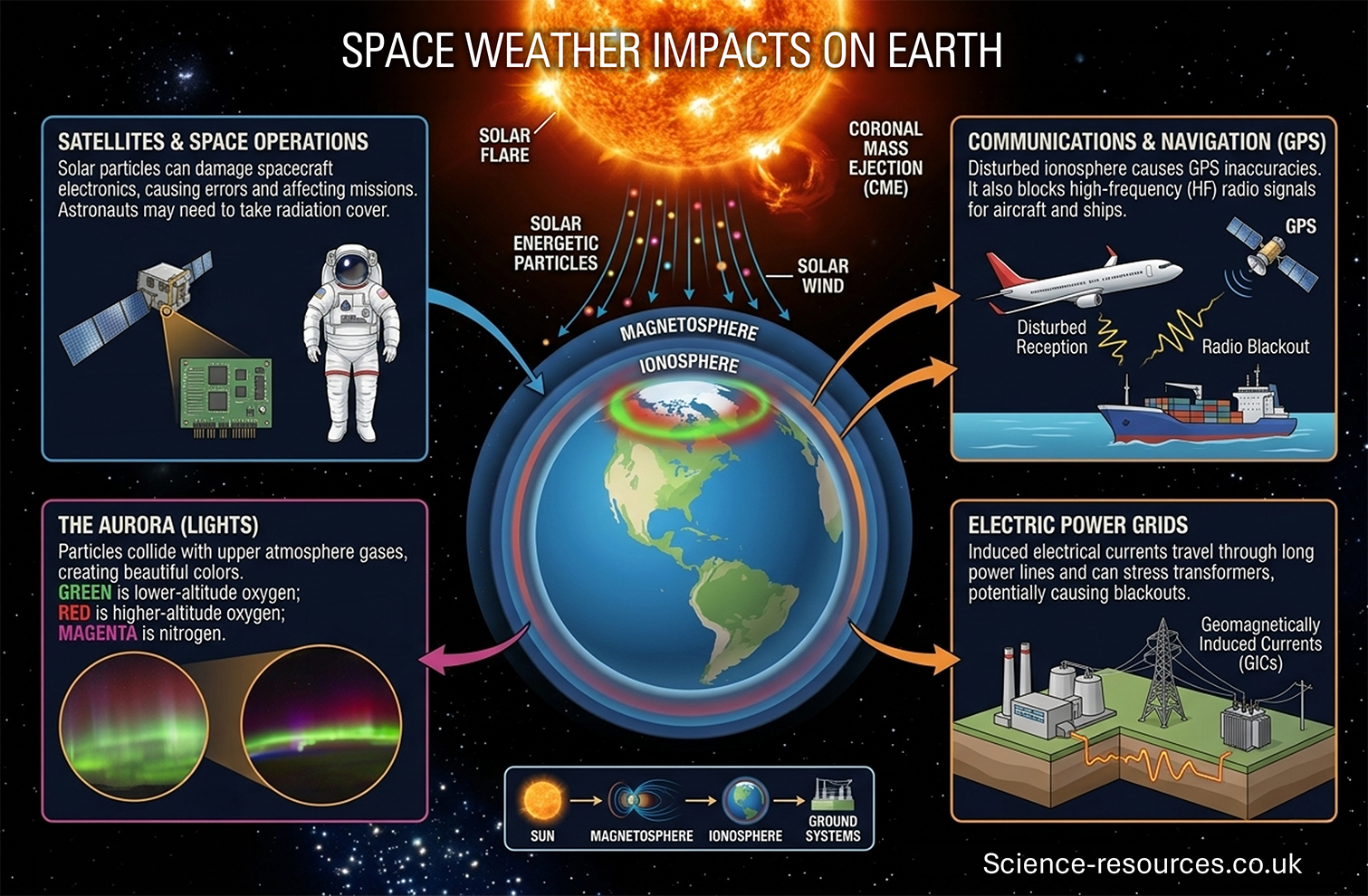 Impacts of space weather on Earth’s technology and environment
Test your understanding of Earth's magnetism, compasses, and the difference between geographic and magnetic poles. 1. Which part of the Earth is responsible for generating its magnetic field? 2. Why does the North pole of a compass needle point towards the Earth's geographic North? 3. What happens to the strength of the Earth's magnetic field as you move further away from the planet? 4. Which of these is a major benefit of the Earth's magnetic field? 5. What would happen to a compass needle if the Earth did not have a magnetic core? Summary: Earth’s magnetic field: 🔬 Knowledge Check: Earth's Magnetic Field
Click to Reveal Answers
Without it, life on Earth would be much more difficult and possibly even dangerous.