Van de Graaff Generator
Van de Graaff Robert J. Van de Graaff was an American physicist who, in 1929, invented a device called the Van de Graff generator. You may have seen, or even used, a Van de Graaff generator in the classroom at school. It is an electrostatic generator which uses an acrylic roller and rubber belt to amass very high voltages which are accumulate in a hollow metal sphere. How a Van de Graaff generator works
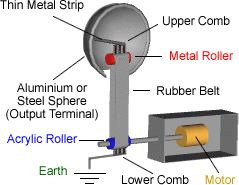
You may also be interested in: Test your understanding of static electricity and the components of the Van de Graaff generator. 1. What subatomic particles are moved by the belt to create a static charge on the dome? 2. Why must the person standing on the insulator stand still while touching the dome? 3. Which component of the generator is responsible for carrying the charge from the base to the top? 4. What scientific principle explains why a person's hair stands up when they are charged? 5. A spark is seen when an earthed conductor is brought near the dome. What is actually happening?
how static electricity works
how lightning works
🔬 Knowledge Check: Van de Graaff Generator
Click to Reveal Answers
2. To prevent the charge from leaking away (The insulator keeps the electrons on the person).
3. The moving rubber belt (It acts as the transport for the charges).
4. Like charges repel each other (Each hair has the same charge and pushes away from the others).
5. Electrons are jumping through the air (The sudden movement of charge creates the spark).
Tags: what is static electricity; how does static electricity work; uses of static electricity; what is static electricity; earthing; charging by induction; friction; how does a Van de Graaff Generator work, How does the Van de Graaff Generator work