Balanced forces
Balanced forces Assuming that the forces acting on the truck are balanced:
When an object has two forces acting on it that are equal in size but opposite in direction, we say that the forces are balanced.
This is related to the First Law of Motion by Isaac Newton. This law says that an object will keep doing what it is doing, either staying still or moving with the same speed and direction, unless an unbalanced force changes its motion.
This means that if the forces on an object are balanced, the object will not change its speed or direction.
We can use a truck as an example to understand Newton’s first law: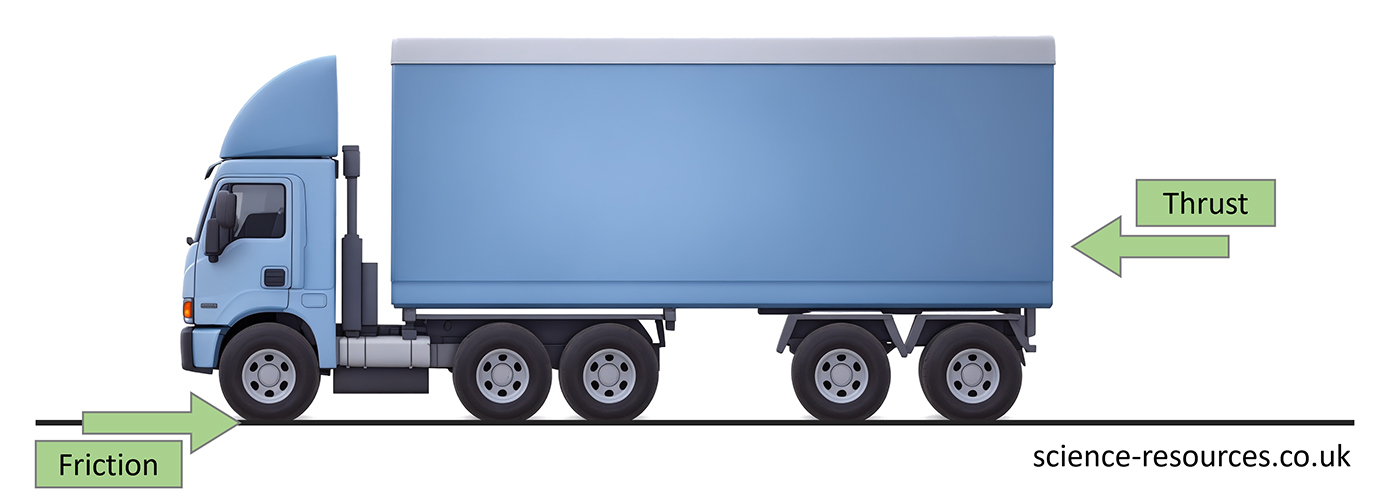
Force Diagrams The diagram above shows that the two arrows have the same length. This means that the cat has two forces that are equal (but in opposite directions).
We can use arrows to show the direction and the size of the force on an object. This is called a force diagram.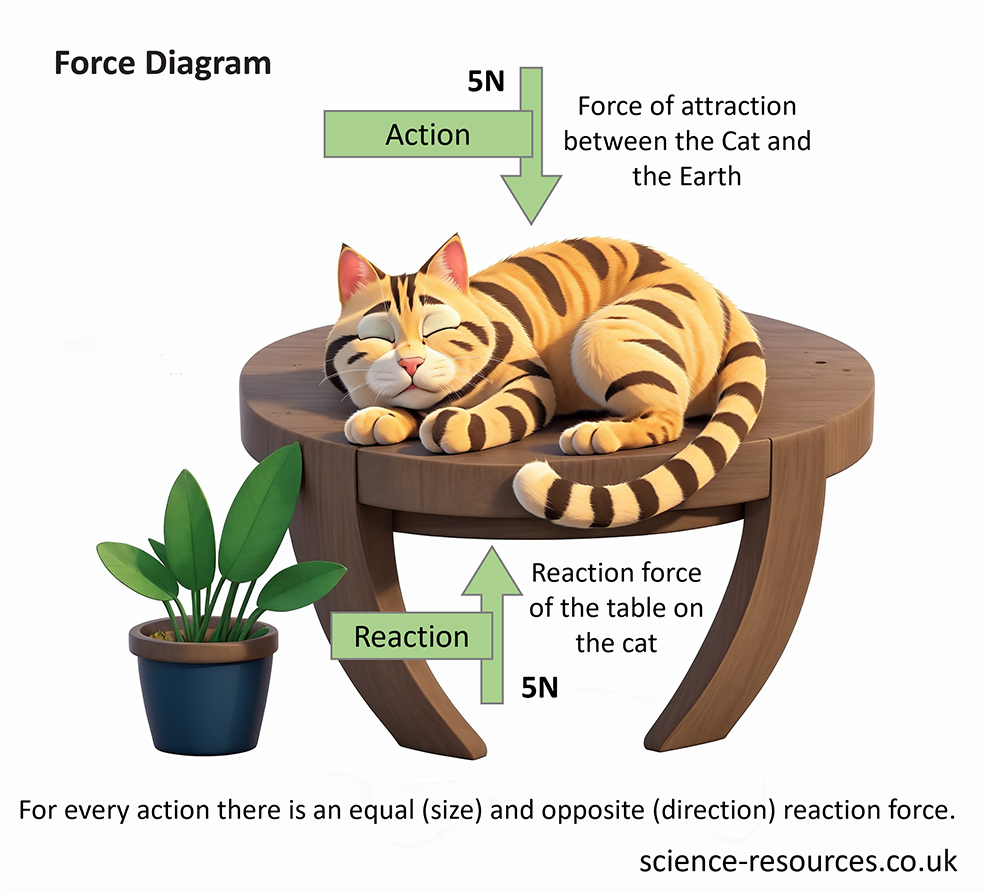
The length of the arrow shows the size of the force. When the forces are balanced, the total force is zero. This total force is called the resultant force.
Test your understanding of how forces affect the motion of objects based on the lesson content. 1. If the forces acting on a stationary object are balanced, what will the object do? 2. Which of the following describes 'unbalanced forces'? 3. If an object is moving at a constant speed in a straight line, what can we say about the forces acting on it? 4. What is the 'resultant force' when two equal forces act on an object in opposite directions? 5. What three things can change when an unbalanced force acts on an object? Summary: 🔬 Knowledge Check: Balanced Forces
Click to Reveal Answers
2. Forces that are not equal in size (Unbalanced forces result in a net or resultant force).
3. The forces are balanced (Constant velocity implies no resultant force).
4. Zero (Opposite and equal forces cancel each other out).
5. Speed, direction, or shape (These are the physical effects of an unbalanced force).