Frictional forces
What are frictional forces? Friction But friction can also be unhelpful: Limiting the amount of friction Examples of frictional forces
Moving objects face forces that act against them, except when in a vacuum such as in space. These are frictional forces and act in the opposite direction to the movement. Frictional forces make it harder for objects to move. Frictional forces are greater on rough surfaces than on smoother surfaces.
Friction is a contact force, it acts against a moving object.
Sometimes, friction can be helpful:
We can reduce the amount of friction using lubricants such as motor oil. This can stop metal parts from rubbing and wearing out. Modern taps use moving parts made from a low friction plastic called PTFE instead of rubber or brass.
Air resistance and drag Professional cyclists have specially designed helmets and bikes that are designed to cut through the air easily. This helps the cyclist go as fast as possible.
Drag is the force that slows down an object when it moves through a fluid (like water or air). The object feels more drag when it moves faster. When the fluid is air, we call drag air resistance.
We can make the object more streamlined to reduce air resistance. This means the object has a shape that cuts through the air easily. This lets the object go faster with the same push force. Cyclists and Formula 1 racers try to reduce air resistance. They make their cars, helmets and bikes streamlined so they can go as fast as possible.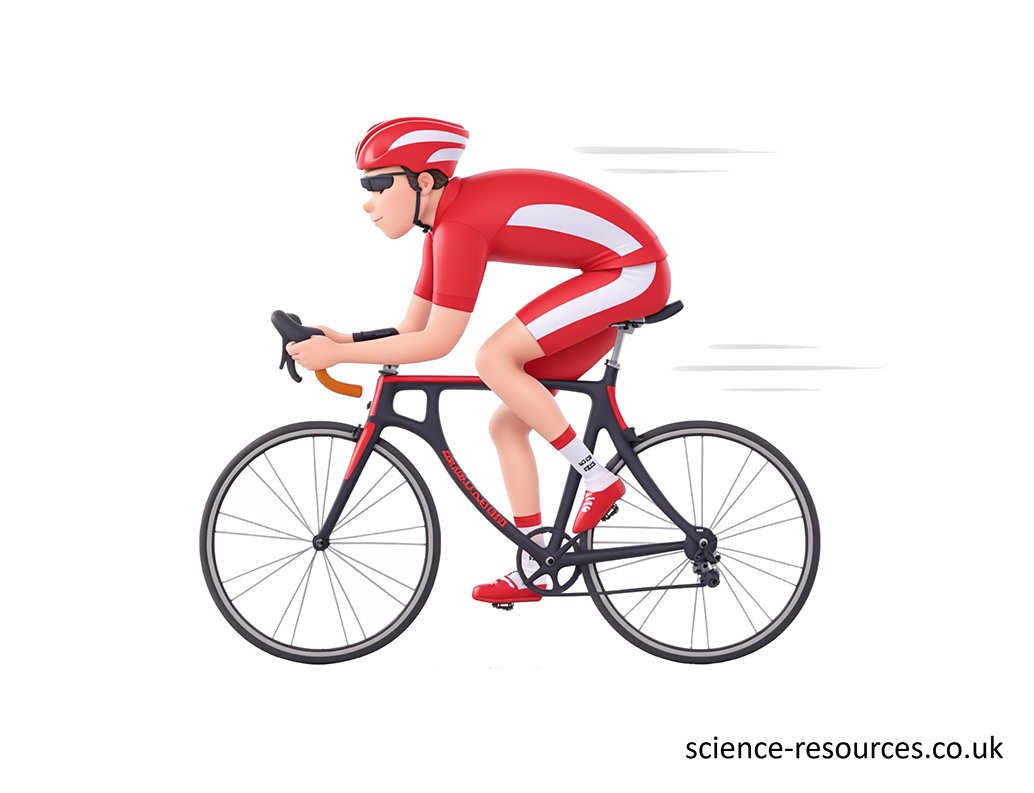
Test your understanding of friction, air resistance, and drag based on the lesson content. 1. In which direction does friction always act? 2. What happens to the frictional force as a surface becomes rougher? 3. Which of these is a common way to reduce friction between moving machine parts? 4. Why are racing cars and planes designed with streamlined shapes? 5. What is another name for the frictional force experienced by an object moving through air or water? Summary: 🧪 Knowledge Check: Frictional Forces
Click to Reveal Answers
2. The frictional force increases (Rougher surfaces create more resistance when rubbing together).
3. Using a lubricant like oil or grease (Lubrication smoothes the contact between surfaces).
4. To reduce drag and allow them to travel faster (Streamlining helps air or water flow smoothly around an object).
5. Drag (This term covers both air and water resistance).