The Sun
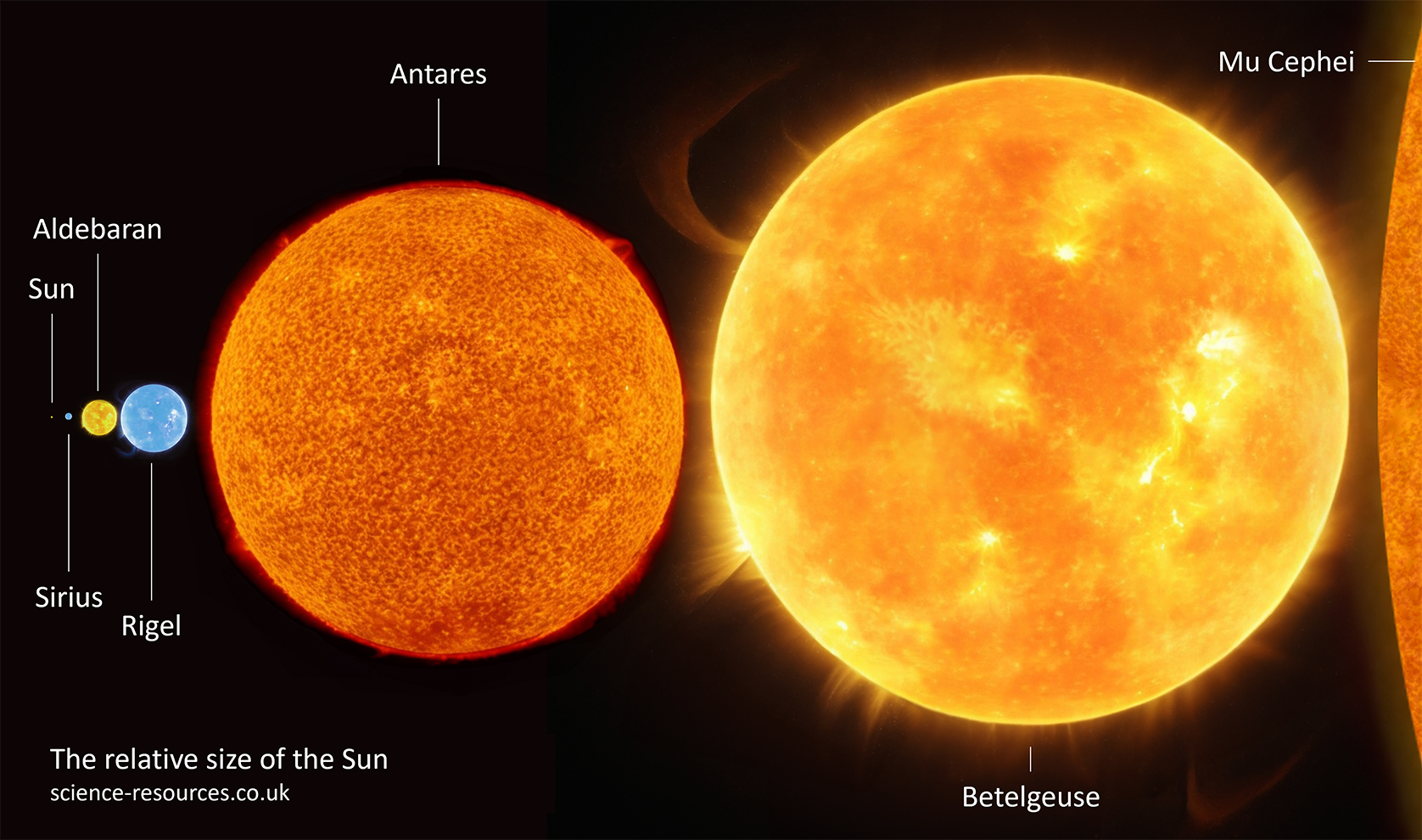
Stars The actual number of stars in the night sky is much more than you could ever see. The European Space Agency (ESA) estimate that there are about 100 billion stars in the Milky Way alone. According to Brian Greene (theoretical physicist), if you were to hold your thumb up to the night sky at arms length, you are estimated to be covering around 10 million galaxies. The Sun In this image, our Sun is just a tiny dot compared to the giant and supergiant stars.
When you look at the night sky, you can see many thousands of stars with just your eyes. You can see even more with a pair of binoculars or a small telescope.
Different types of star differ a lot in brightness, size, mass and colour. Each star goes through various stages that change their properties, as they move through their lifecycle.
The Sun is our closest star and a type of star called a yellow dwarf. It is at the centre of our solar system. The Sun looks bigger and brighter than other stars because it is much closer to us, even though it is only a medium sized star. The largest stars are more than 100 times as massive as the Sun, and the smallest stars are less than one tenth as massive as the Sun.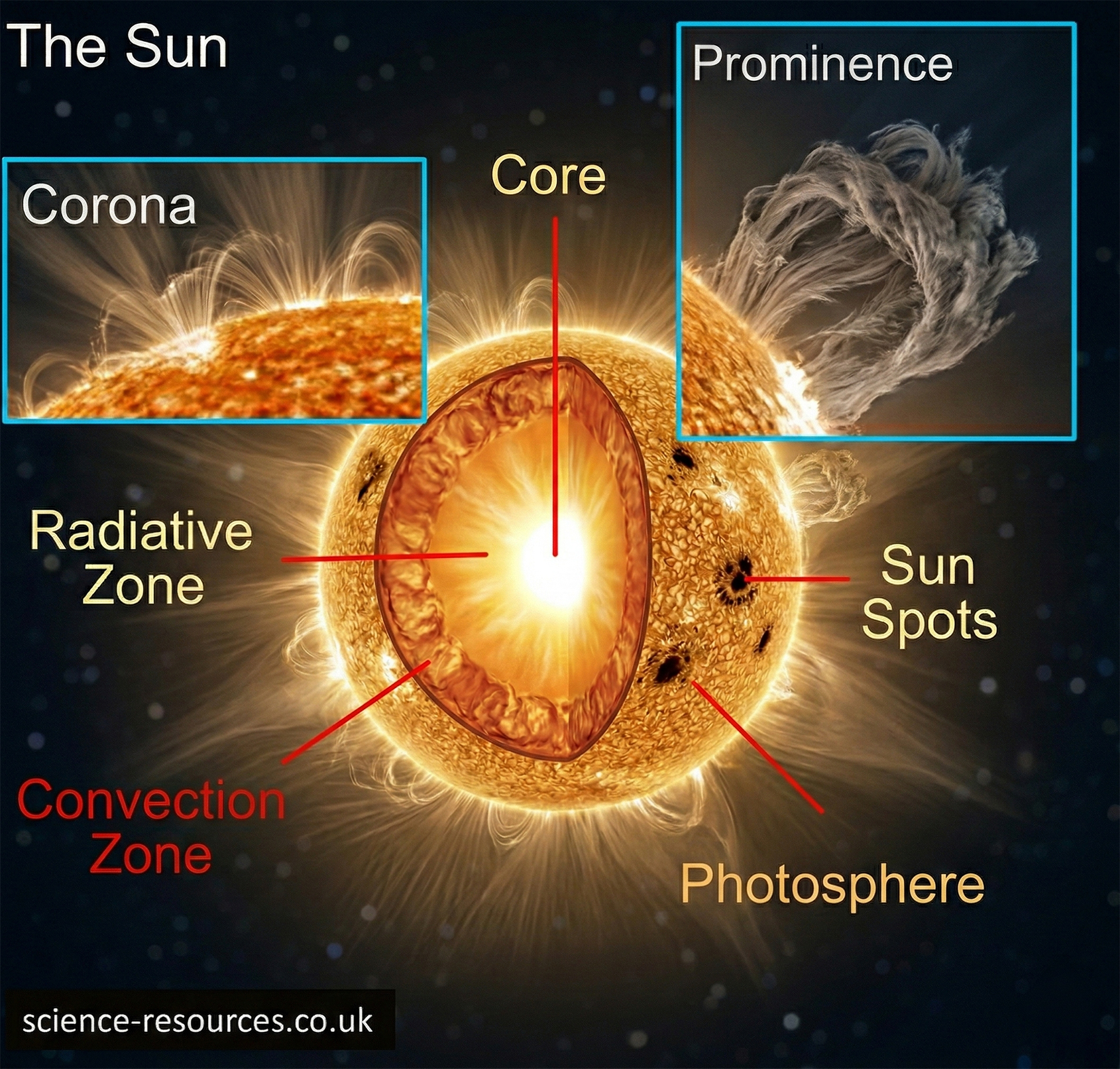
Galaxies The Milky Way Galaxy The Milky Way is just one of many millions of galaxies in the Universe. Some of the galaxies are so far away that they appear in the sky as small fuzzy points of light.
The Sun is one of about 100 billion stars in our galaxy, the Milky Way. The Milky Way is a type of galaxy that has a spiral shape, like the one shown in the image below.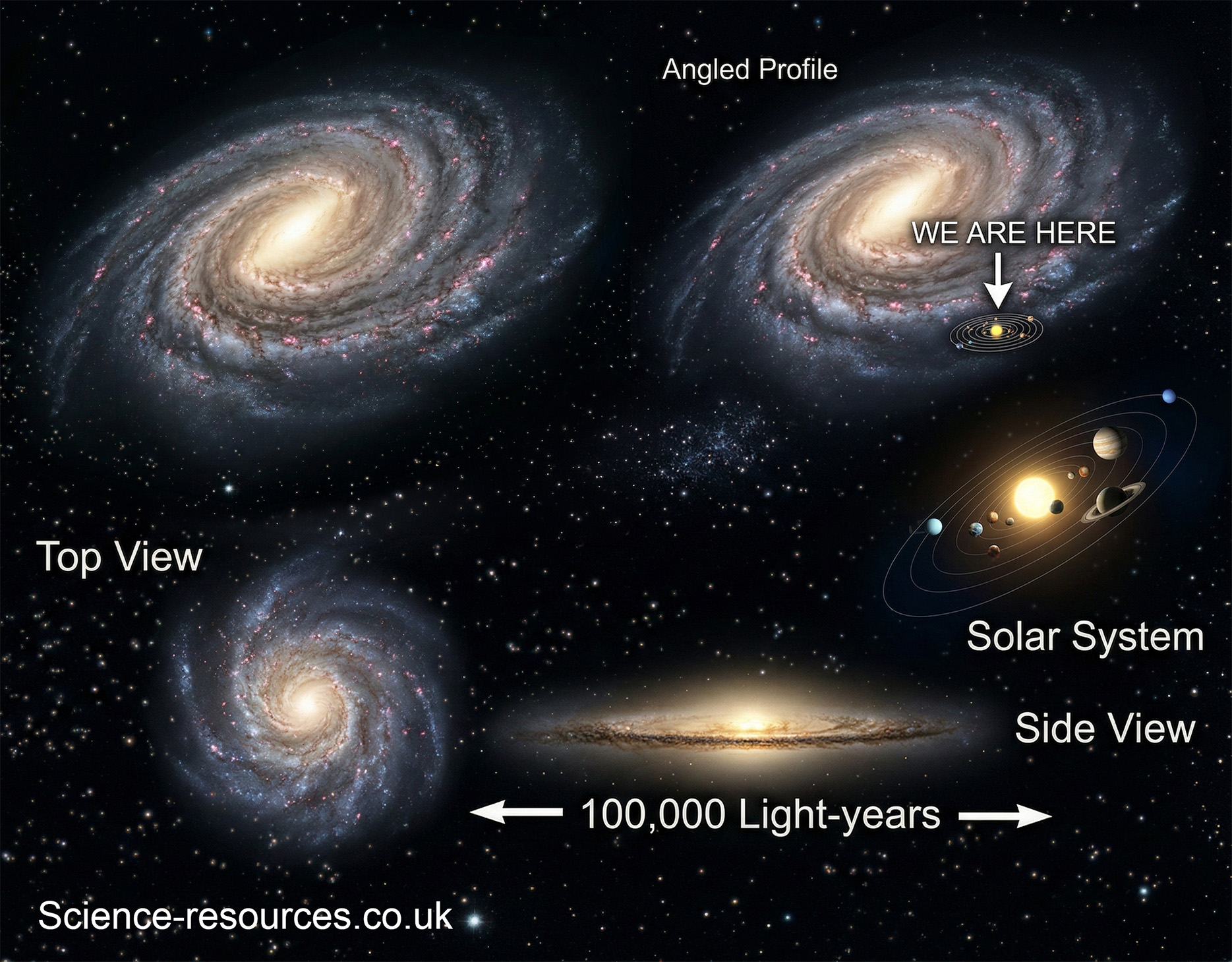
Test your knowledge of the Sun's structure and the phenomena that occur on its surface. 1. In which part of the Sun does nuclear fusion take place to produce energy? 2. What is the outermost layer of the Sun's atmosphere called? 3. Which phenomena appear as darker, cooler regions on the Sun's surface due to magnetic activity? 4. What is the primary fuel that the Sun uses for nuclear fusion? 5. What is the name of the visible surface of the Sun that we see from Earth? Summary: ☀️ Knowledge Check: The Sun
Click to Reveal Answers
2. The Corona (The outer atmosphere that extends millions of kilometres into space).
3. Sunspots (Cooler patches caused by magnetic fields inhibiting convection).
4. Hydrogen (Hydrogen nuclei fuse to create helium, releasing energy).
5. The Photosphere (The layer from which light is emitted).