The Water Cycle
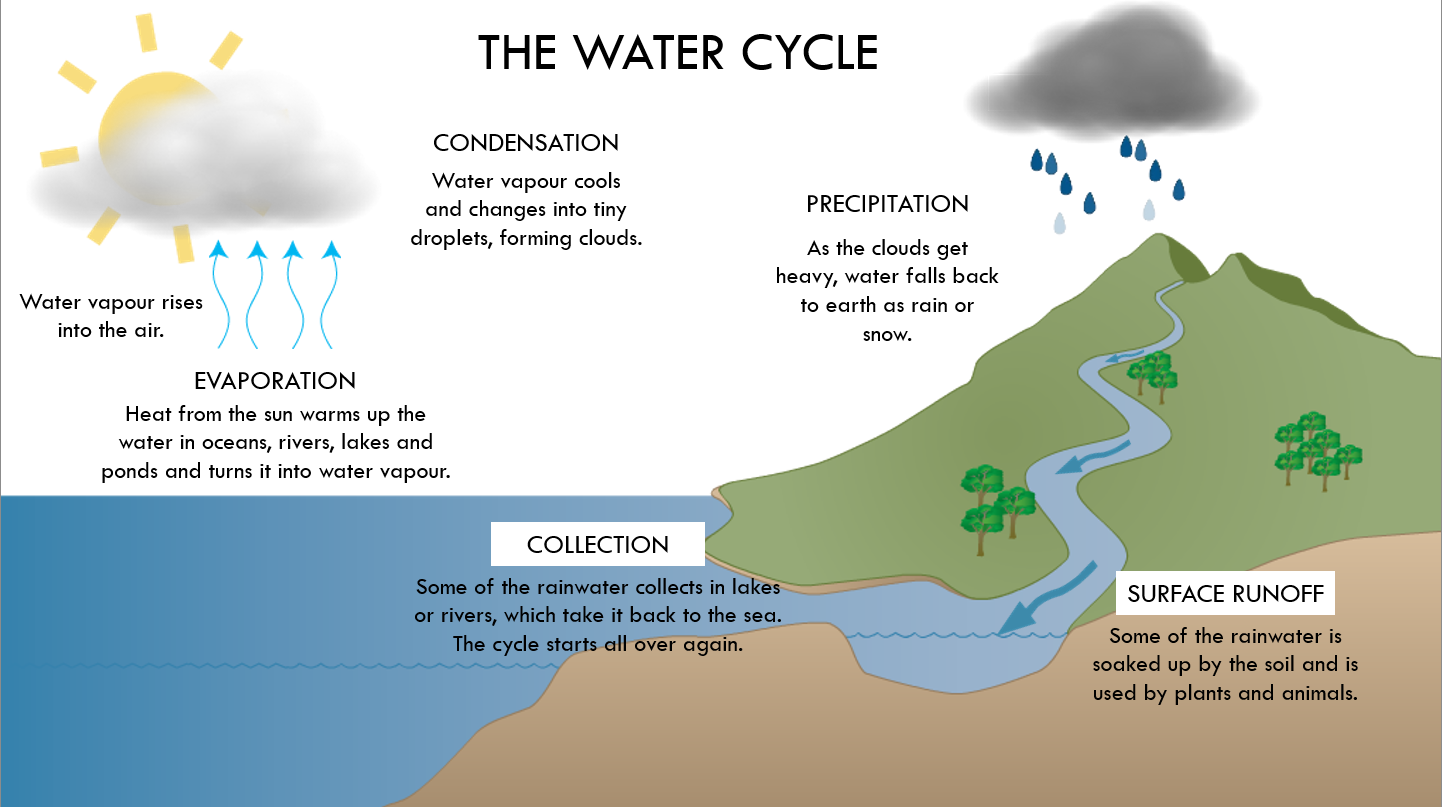
Water on Earth is constantly moving in a continuous loop called the Water Cycle. The water cycle is the journey water takes as it travels from the ground up into the sky and then back down to Earth again. Take a look at the different stages of the water cycle by clicking on the labels.
Learn the key steps in the water cycle for Key Stage 2 science.
Heat from the Sun warms up liquid water in oceans, lakes, and rivers, turning it into an invisible gas called water vapour.
Plants take up water through their roots. Water travels up through stems to leaves, where extra moisture evaporates into the air as water vapour.
As water vapour rises into the cold upper atmosphere, it cools down and turns back into tiny liquid droplets, clumping together to form clouds.
When cloud droplets grow heavy, gravity pulls them down to Earth as rain, snow, sleet, or hail.
Rainwater runs off hills and mountains into streams and rivers, flowing back down to oceans and lakes where it collects to start the cycle again.
Some fallen rain soaks deep into soil and porous rock (infiltration). This underground water slowly flows through rocks back towards rivers and seas.
Master these important science terms!
The process where liquid water turns into an invisible gas called water vapour when heated by the Sun.
The process where gaseous water vapour cools down and turns back into liquid water droplets to form clouds.
Water falling from clouds down to Earth as rain, snow, sleet, or hail.
The release of water vapour into the air through microscopic pores on plant leaves.
Precipitation that flows over the surface of the ground into streams, rivers, and oceans.
Water can exist as a solid (ice/snow), liquid (water), or gas (water vapour).
The Water Cycle Interactive Explorer
Stages of the water cycle
State: Liquid ➔ Gas
How the Water Cycle Works
Evaporation
Transpiration
Condensation
Precipitation
Collection & Runoff
Groundwater
KS2 Science Water Cycle Quiz
Loading question...
Vocabulary
Evaporation
Condensation
Precipitation
Transpiration
Surface Runoff
States of Matter