Growth Hormones in Plants
Plants do not have a
sophisticated responsive system, like the nervous system in animals. Therefore, they can't respond as quickly as animals. They react to stimuli much more
slowly. Their reactions are controlled by hormones called AUXINS. Auxins are produced in the tips of root
and shoot. The Auxins dissolve in water and are then
transported throughout the plant. These then stimulate cell growth at the
roots and shoots in the elongation region, which is just behind the
tips. Auxins also
regulate flowering and ripening of fruit. The effect
of Auxins can be demonstrated by removing the tip of shoots.
If no Auxins available, then the shoot may stop growing. Shoot
tips also produce growth inhibitor for side shoots. If the
tips are decapitated, it results in a lot of side shoots, because
there is a lack of inhibitor substance. Farmers/gardeners
often clip the tops of hedges to promote bushier hedges. Auxins control the way plants grow. They promote growth in the shoots but in fact inhibit growth in the roots. The shoot of the plant always grow towards light. This is due to the fact that leaves need light
to make the food needed for plants to grow. See photosynthesis. Growing towards the
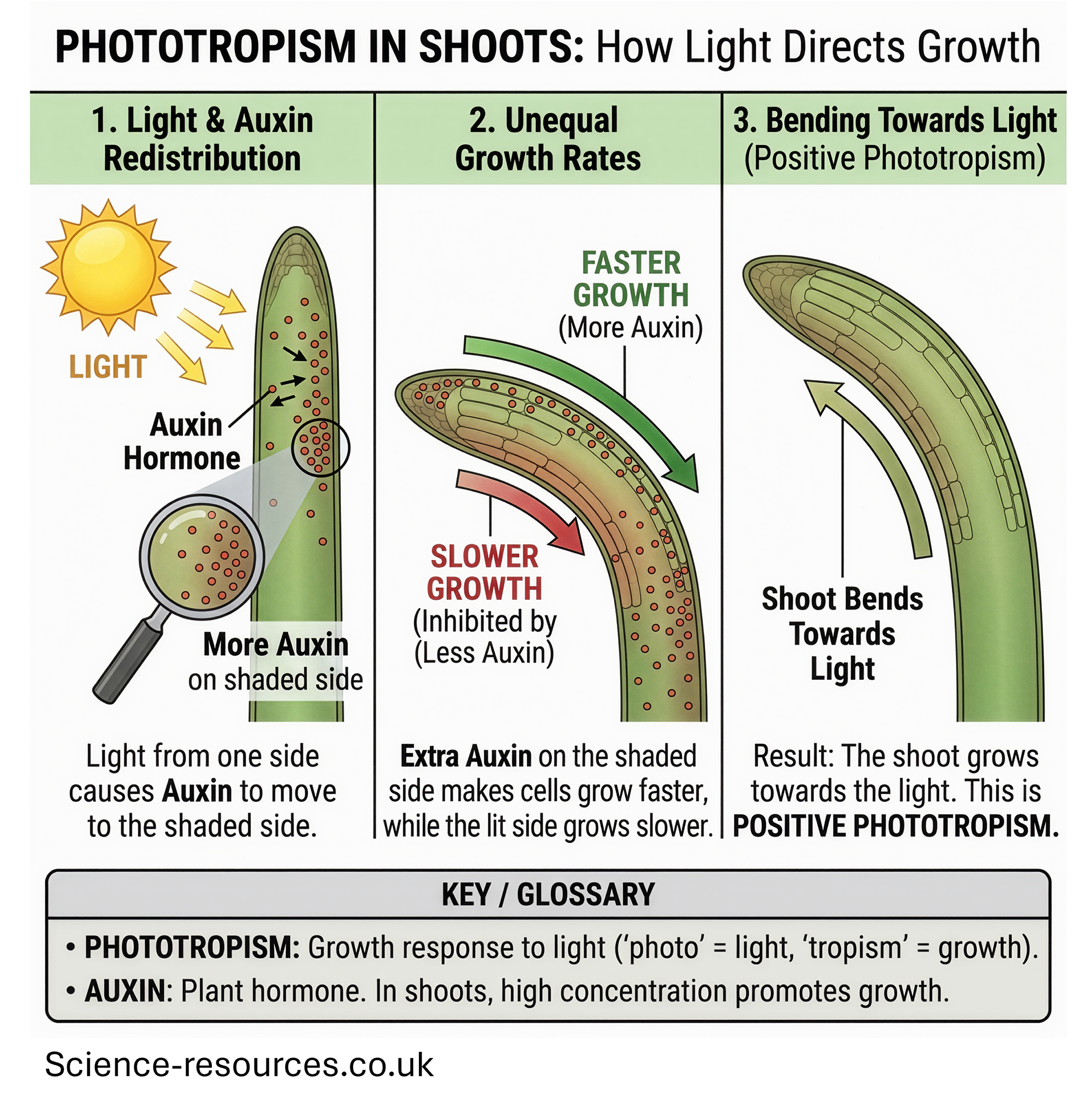
light is called PHOTOTROPISM.
'Photo' means light and 'tropism' means growth. When a shoot tip is subjected to light, it
provides more Auxins to the shaded side than the side facing the light. This results in the shoot to grow faster on the shaded
side and the tip bends towards the light. How sunlight affects shoot growth in plants. However,
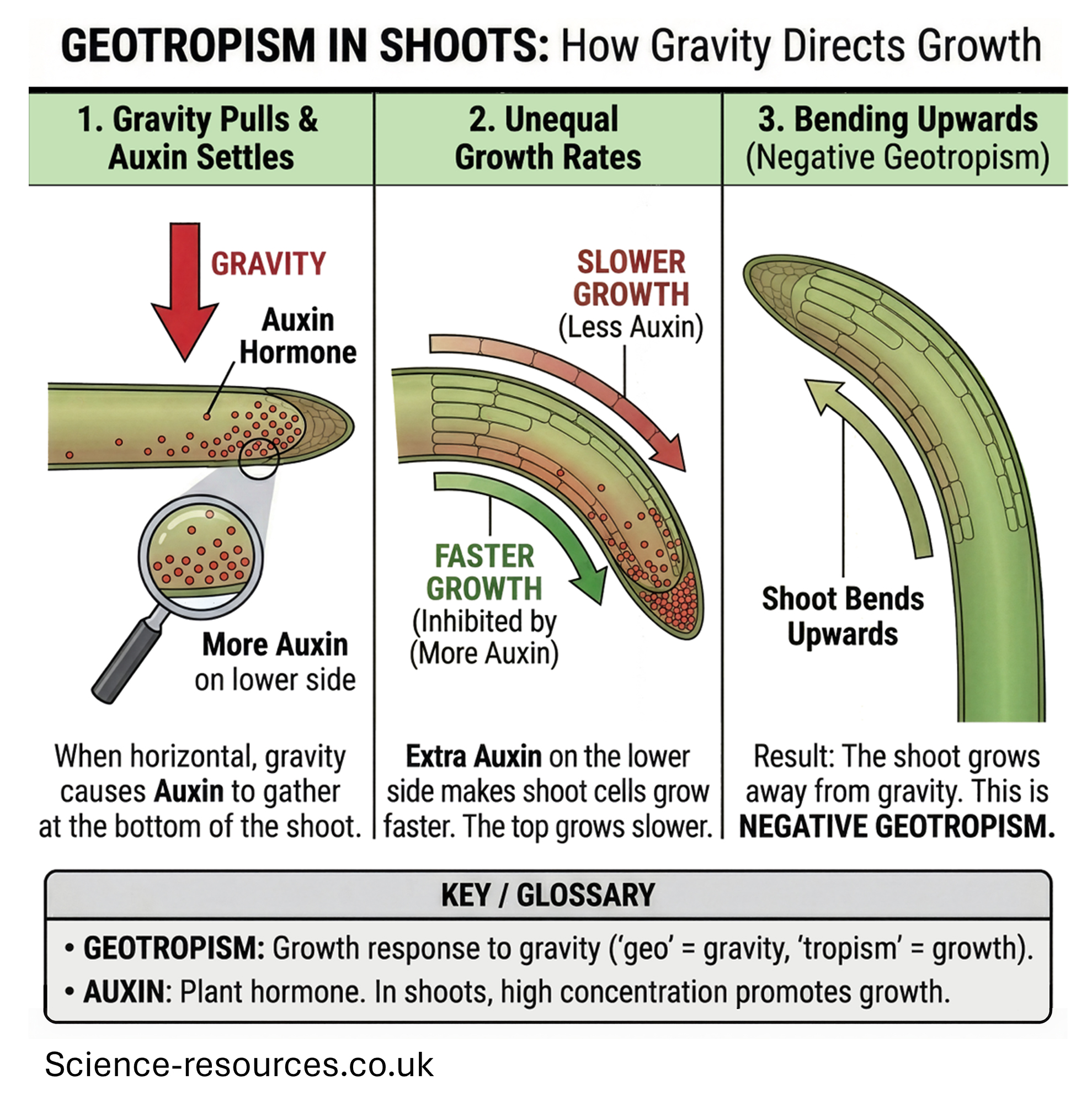
when shoot happens to grow on
its side, the gravity leads to uneven allocation of Auxins
in the tip. The lower side ends up with more
Auxins. Hence the lower side grows
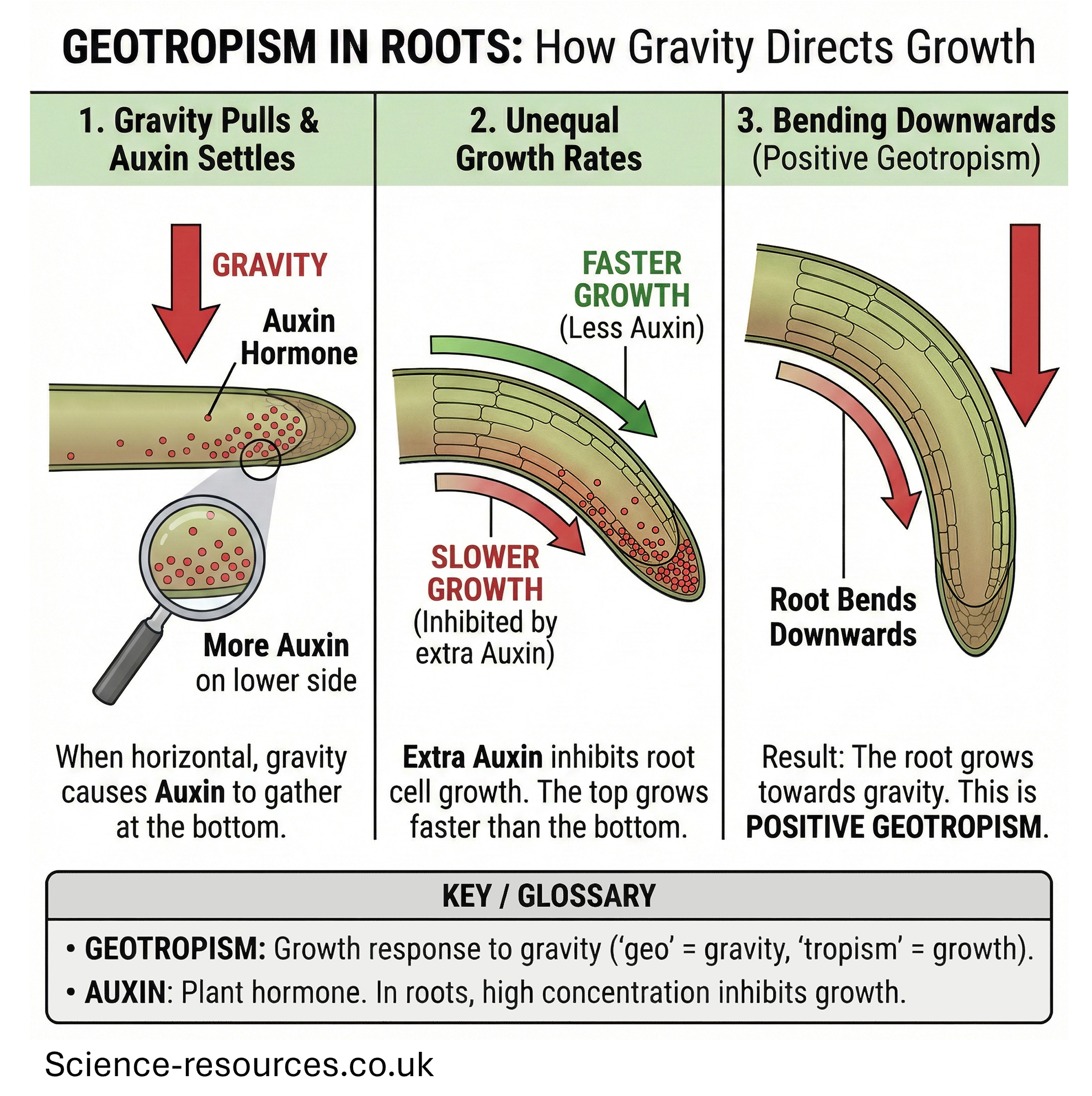
faster, thus bending the shoot upwards. How gravity affects shoot growth in plants. Growth of roots is affected by GRAVITY. They bend
towards gravity. Growing
towards gravity is known as GEOTROPISM.
'geo means gravity and 'tropism' means growth. When a root grows on its side, more Auxins are
found on the lower side.
However, extra Auxins in fact inhibit
growth, thus causing the upper side to grow faster
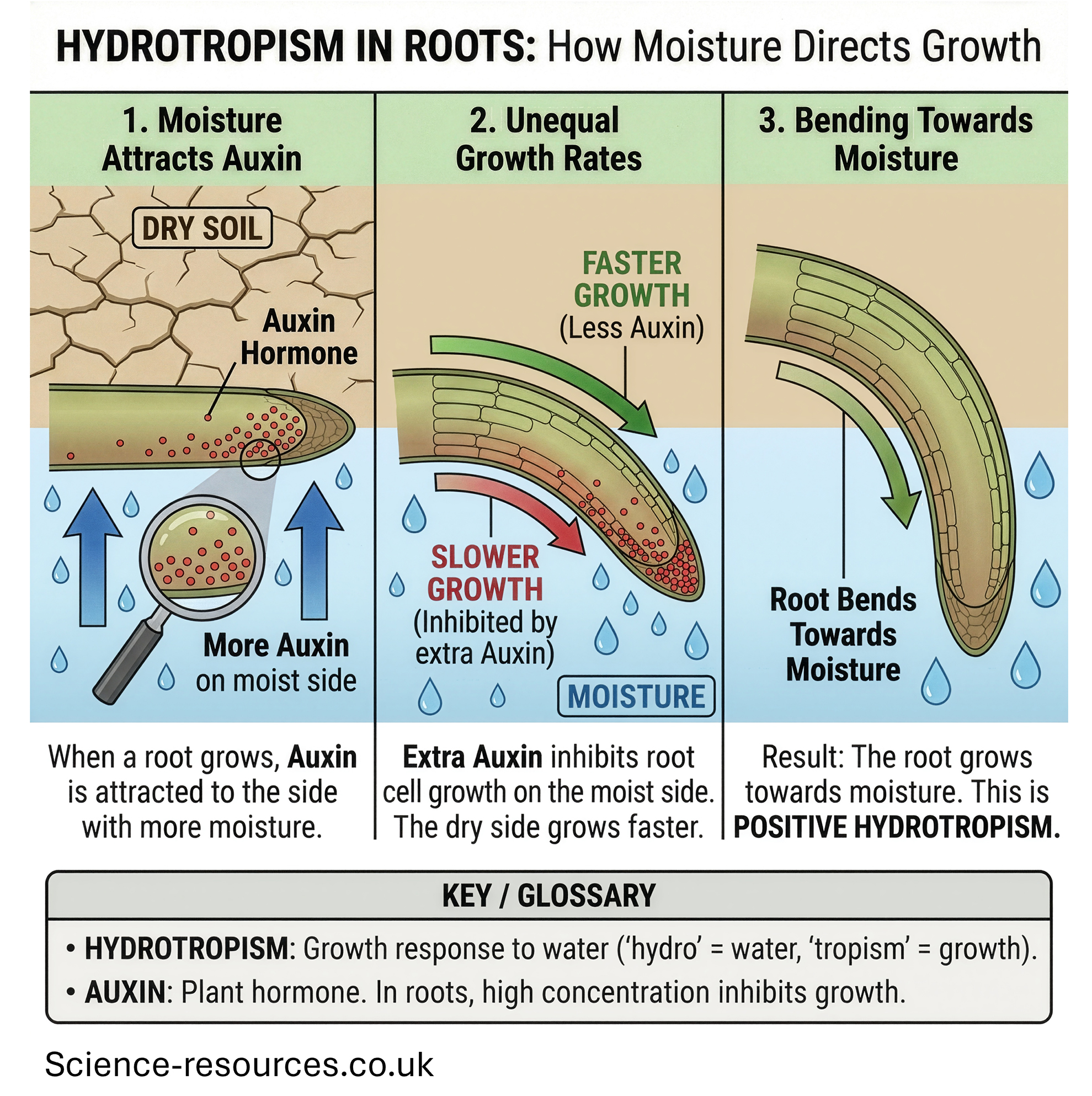
resulting it to bend downwards. How gravity affects root growth in plants. Root growth is also affected by MOISTURE. The moist
side of root will attracts more
Auxins then the dry side. The growth of the moist side is thus color="#49872E">inhibited and causing the root to grow towards the moisture. How moisture affects root growth in plants. Shoot:
Roots:
Plant Hormones Simulator
Click here to try our new plant hormone simulator.

Using Plant Hormones
Plant hormones are used commercially to
produce food that is more convenient to us. For example:
Growing
Seedless Fruit - we can use
synthetic growth hormones (Auxins) to trick plants into making
fruit that we enjoy. Normally, plants produce fruit when
they pollinated by insects, with inconvenient seeds in the middle
of the fruit. If the plants don't get pollinated, the fruit
and seed is not produced.
Using synthetic Auxins it is possible to
over come this problem. If Auxins are applied to unpollinated
flowers the plant will produce a seedless fruit, which is more
convenient to eat.
Ripening
Fruit - Auxins can also be used to control the ripening of
fruit. This can be done whilst the fruit is still attached
to the plant or during transport to the food stores.
This is useful to the farmers for a
number of reasons. They can pick the fruit whilst it is still
unripe. Fruit is then easy to handle, and doesn't get
damaged. During transportation the fruit then can be sprayed
with ripening hormones so that it is perfect as it reaches the
supermarkets.
Making
more Plants From Cuttings - For a plant to produce more young plants
naturally, it can take many years. Cutting shoots off plants
and dipping them in Auxins can speed up this process. Gardeners
use Auxins, known as rooting powder, to make new plants.
Getting
Rid of Weeds - Many of the weeds found on a lawn or a
field have broad leaves compared to grass which has thin narrow
leaves. Selective weedkillers have been developed from
Auxins which only affect the broad leaved plants. The
hormones accelerates the growth to an extent that it kills the
weed whilst leaving the grass alone.
Test your understanding of auxins, phototropism, and geotropism based on the webpage information. 1. What is the name of the chemical hormone that controls plant growth? 2. In a plant shoot, where do auxins tend to accumulate when light shines from one side? 3. What effect do auxins have on the cells in a plant shoot? 4. Geotropism is a plant's response to which stimulus? 5. How does a high concentration of auxin affect the growth of plant roots? 🔬 Knowledge Check: Plant Growth Hormones
Click to Reveal Answers
2. On the shaded side (Light causes auxins to move to the side away from the light).
3. Cause cells to elongate (This leads to unequal growth and bending).
4. Gravity (Also known as gravitropism).
5. Inhibits growth (Unlike in shoots, auxins slow down growth in root cells).