Food energy
What is food energy? How much energy do we need? Food groups
Food has chemical energy that is transferred to the consumer when they consume it. The consumer uses the energy from the food to stay alive and perform their activities. The food intake of each consumer varies depending on their energy expenditure. The energy in food originates from plants and animals that produce or store it.
We use joules (J) or kilojoules (kJ) to measure energy. Another way to measure food energy is with kilocalories, or just calories. One calorie equals 4.2 J. Different animals have different energy needs. For example, an elephant needs about 200,000 kJ of energy every day, while a cat only needs about 800 kJ. How much energy a human needs depends on many factors, such as their age and activity level. A person who does a lot of physical exercise, like an elite athlete, would need more energy than an average person. A pregnant woman would also need more energy to help her baby grow. A 13-year-old girl usually needs about 9,000 kJ of energy every day, and a 13-year-old boy usually needs about 10,000 kJ of energy every day.
Different food groups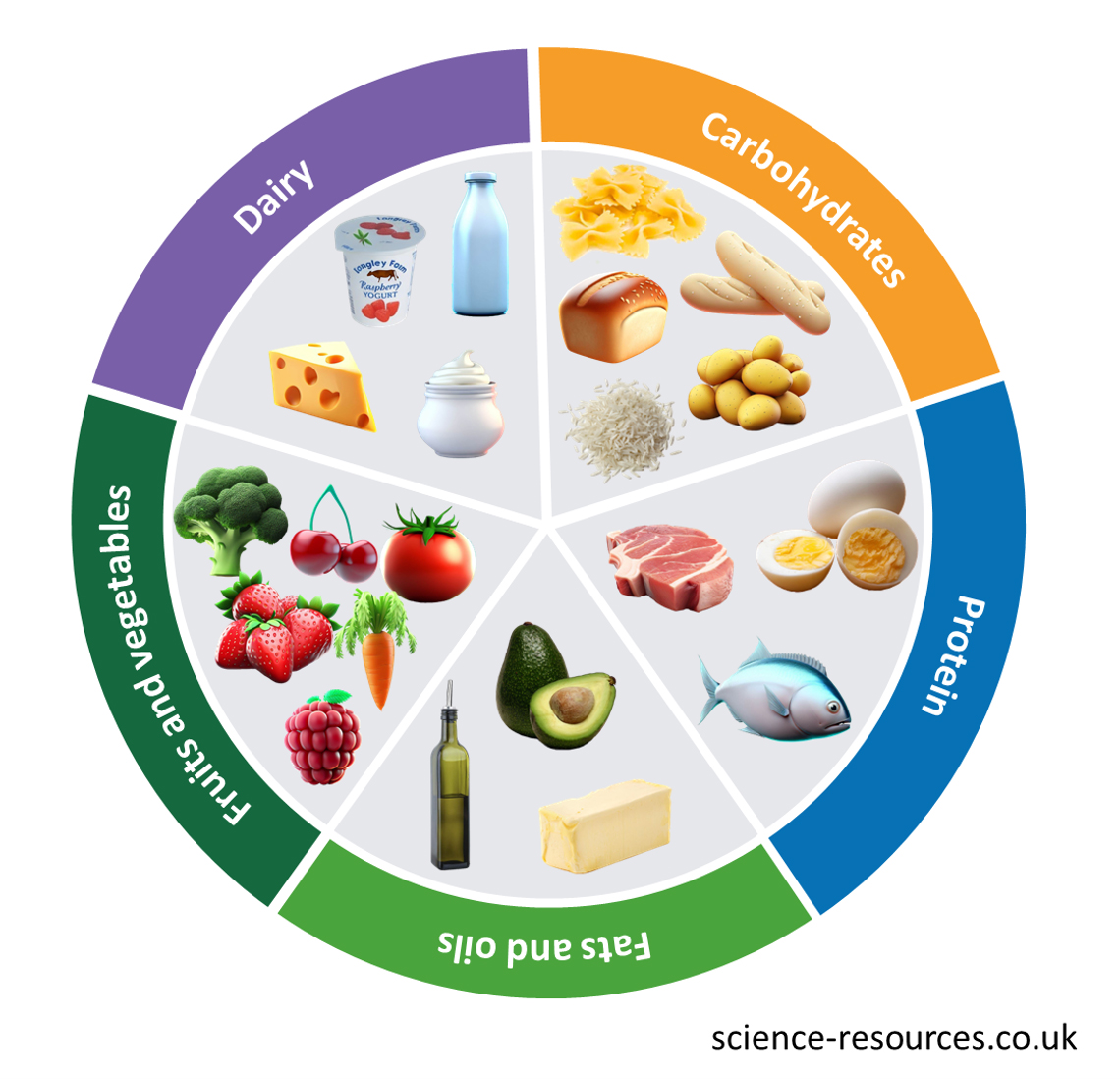
There are 5 main food groups:
Do you know your Joules from your Kilojoules? Test your understanding of energy in nutrition below. 1. How many Joules (J) are in 1 Kilojoule (kJ)? 2. In a calorimetry experiment, the energy from burning food is transferred to: 3. Which of the following groups generally requires the MOST energy per day? 4. Which food group is the most energy-dense (contains the most kJ per gram)? 5. If a student's experiment shows less energy than the food label says, what is the most likely scientific reason? Summary: ⚡ Knowledge Check: Food Energy
Check Your Answers
2. A measured volume of water (We measure how much the water temperature rises).
3. A professional athlete (High physical activity increases metabolic demand).
4. Lipids (Fats) (They provide roughly double the energy per gram compared to carbs).
5. Energy lost to surroundings (A common error in school calorimetry is heat escaping into the air).