Exploring obesity and starvation
What makes a healthy diet? If your diet is unbalanced, it can lead to health complications, such as obesity, malnutrition and starvation. Malnutrition Starvation
A healthy diet contains:
If you don’t take in enough vitamins and minerals, you could end up with diseases such as scurvy which is caused by lack of Vitamin C. Some early symptoms of malnutrition include:
Starvation is caused by not taking in enough energy and nutrients over a prolonged period. It is the most extreme form of malnutrition. In humans, prolonged starvation can cause physical problems such as sever weight loss, muscle loss, dry skin and hair, infertility and fatigue. Both obesity and starvation can cause death.
Obesity For example, if a person has a mass of 60 kg and a height of 1.65 m: A person is overweight if their BMI is between 25 kg/m² and 30 kg/m². A person with a BMI over 30 kg/m² is said to be obese. People with obesity have a very high BMI (above 30 kg/m²). Obesity can cause serious physical problems such as pain in the joints, heart disease, high blood pressure and difficulties with breathing. Health problems related to obesity
A person is said to be obese if they have such a high excess of body fat that their health might be affected.
Body mass index (BMI) is a measure of body fat based on the height and weight of an individual. We can calculate a person’s BMI using the following formula:
BMI = mass (kg) ÷ height² (m²)
BMI = 60 kg ÷ 1.65²
BMI = 22 kg/m²
In the above example, the person can be described as being a healthy weight.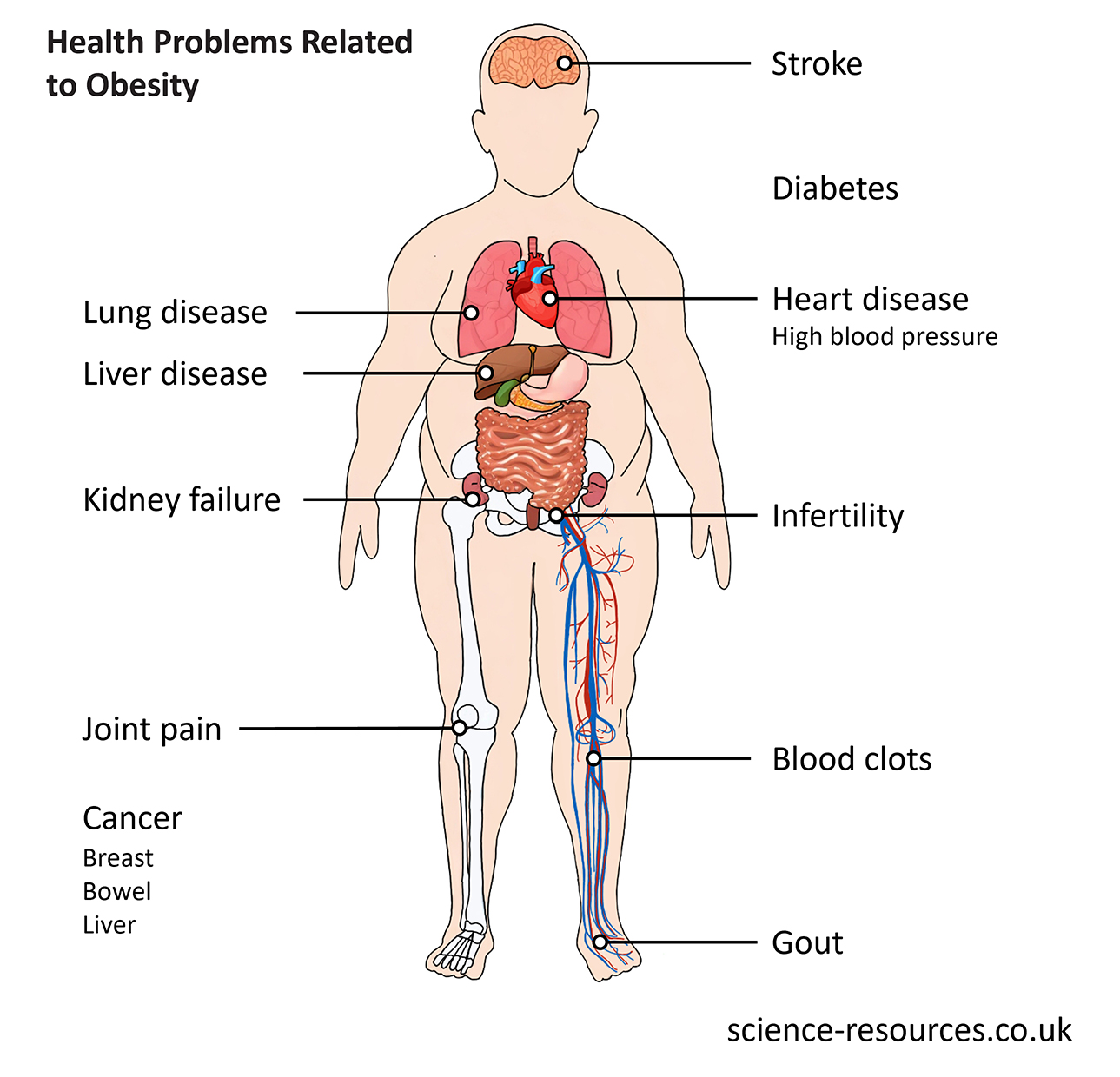
Test your understanding of obesity, starvation, and how an unbalanced diet affects the body. 1. Which term describes a diet that does not provide the correct balance of nutrients? 2. If a person consumes more energy than they use up through activity, what happens to the extra energy? 3. Which deficiency disease is caused by a lack of Vitamin C? 4. What is a common health risk associated specifically with obesity? 5. Rickets is a condition that affects bone development. Which two nutrients are usually lacking? Summary: 🍎 Knowledge Check: Nutrition & Health
Check Your Answers
2. Stored as fat (The body keeps this as an energy reserve).
3. Scurvy (Common in sailors historically who didn't have fresh fruit).
4. Type 2 Diabetes (Also heart disease and high blood pressure).
5. Vitamin D and Calcium (Essential for strong, healthy bones).