i


Plate Boundaries


Earth Structure


The Earth's Surface 


It is thought that the crust, underneath the oceans as well as the continents, together with the upper part of the mantle is divided into huge 'rafts' called plates. The movement of the plates will be explained below.


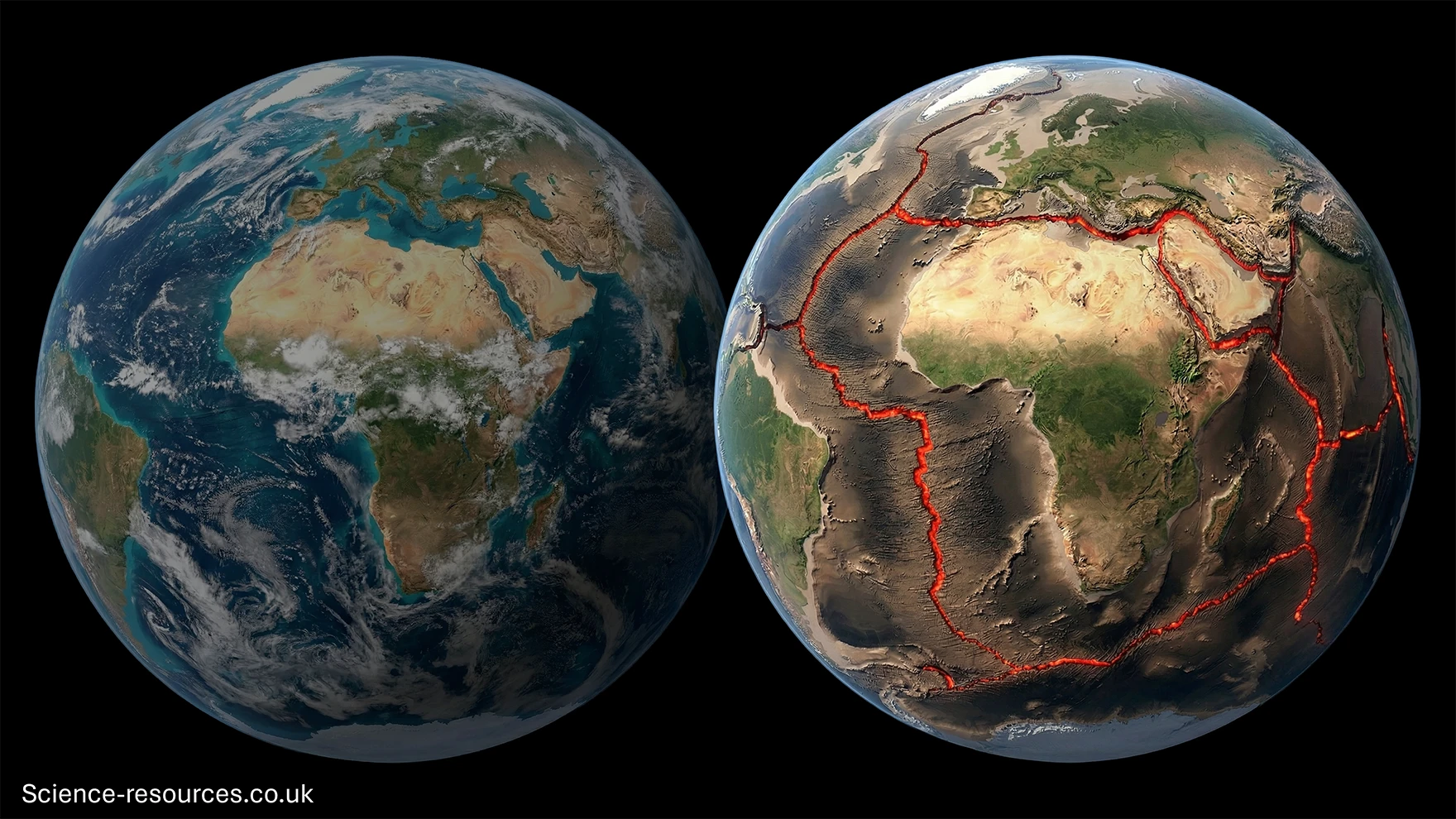
A widescreen image showing two globes of Earth side by side against a black background. Both globes display Africa at the centre, with parts of Europe, the Middle East, and the surrounding oceans visible.
The globe on the left shows Earth with natural satellite imagery only. Continents appear in realistic colours, including sandy deserts across northern Africa, green regions around central Africa, and cloud formations swirling over the Atlantic Ocean. Ocean surfaces show varying shades of blue, and the planet is lit from the upper left, creating gentle shading on the right side.
The globe on the right uses the same satellite base imagery but includes bright red lines marking tectonic plate boundaries. These red lines trace the edges of the African Plate and surrounding plates, running through the Atlantic Ocean, the Mediterranean region, the East African Rift area, and the Indian Ocean. The shading and terrain textures are more pronounced, highlighting mountain ranges, ridges, and ocean floor features.
The two globes together illustrate the difference between a natural, unmarked Earth view and a geological map emphasising global tectonic structure.Side-by-side comparison of Earth with and without tectonic plate boundaries


Amongst these plates there are 8 major ones and assortment of smaller ones.  The major plates include the following:


1. The African plate
2. The Antarctic plate
3. The Indoaustralian plate
4. The Eurasian plate
5. The Nazca plate
6. The North American plate
7. The Pacific plate
8. The South American plate
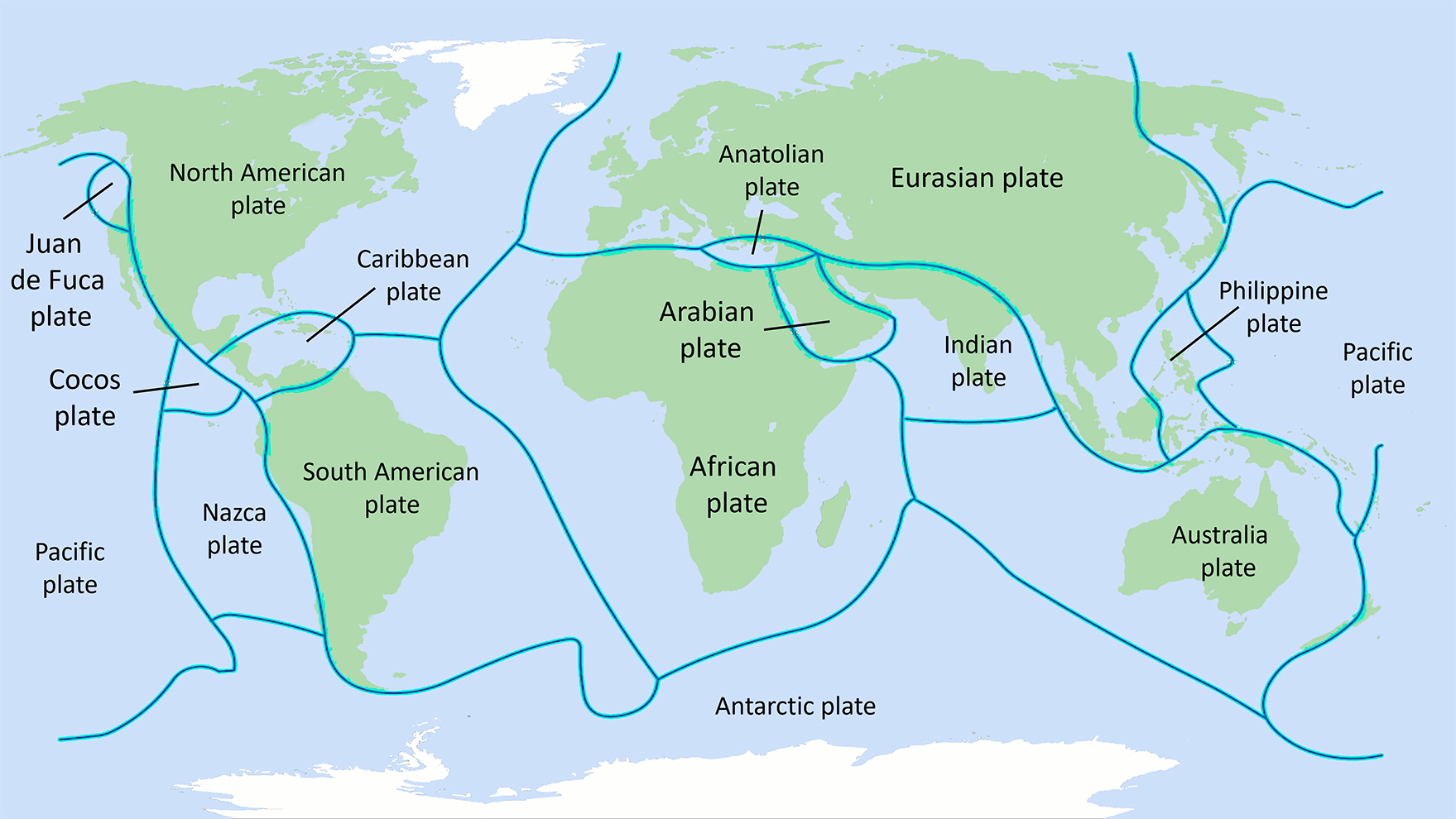
 

The diagrams below indicates the different plates on the world map which shows that the plates are capped by both the oceanic and continental crust.  Most volcanoes are found around and along the plate edges.


A simplified world map with continents shown in light green and oceans in pale blue. The map is overlaid with bold turquoise lines marking tectonic plate boundaries. Each plate is labelled in black text. The North American Plate covers most of North America, while the Eurasian Plate spans Europe and much of northern Asia. The African Plate sits centrally over the African continent, with the South American Plate covering South America and the Antarctic Plate across Antarctica. The Pacific Plate is shown as a large region in the Pacific Ocean, bordered by looping boundary lines.
Smaller plates are also labelled, including the Juan de Fuca Plate off the west coast of North America, the Cocos Plate west of Central America, the Nazca Plate west of South America, the Caribbean Plate between North and South America, the Arabian Plate in the Middle East, the Indian Plate south of Asia, the Philippine Plate east of Asia, the Anatolian Plate in the eastern Mediterranean area, and the Australian Plate covering Australia and surrounding ocean.
The turquoise boundary lines weave across the oceans and continents, illustrating constructive, destructive, and conservative plate margins. The overall image is a clean, schematic reference map intended to show the location and extent of the world’s major tectonic plates.World map of major tectonic plates and plate boundaries


There are 3 types of plate movements.
 

  • Constructive - plates separating

  • Destructive - plates colliding

  • Conservative - plates sliding past each other.


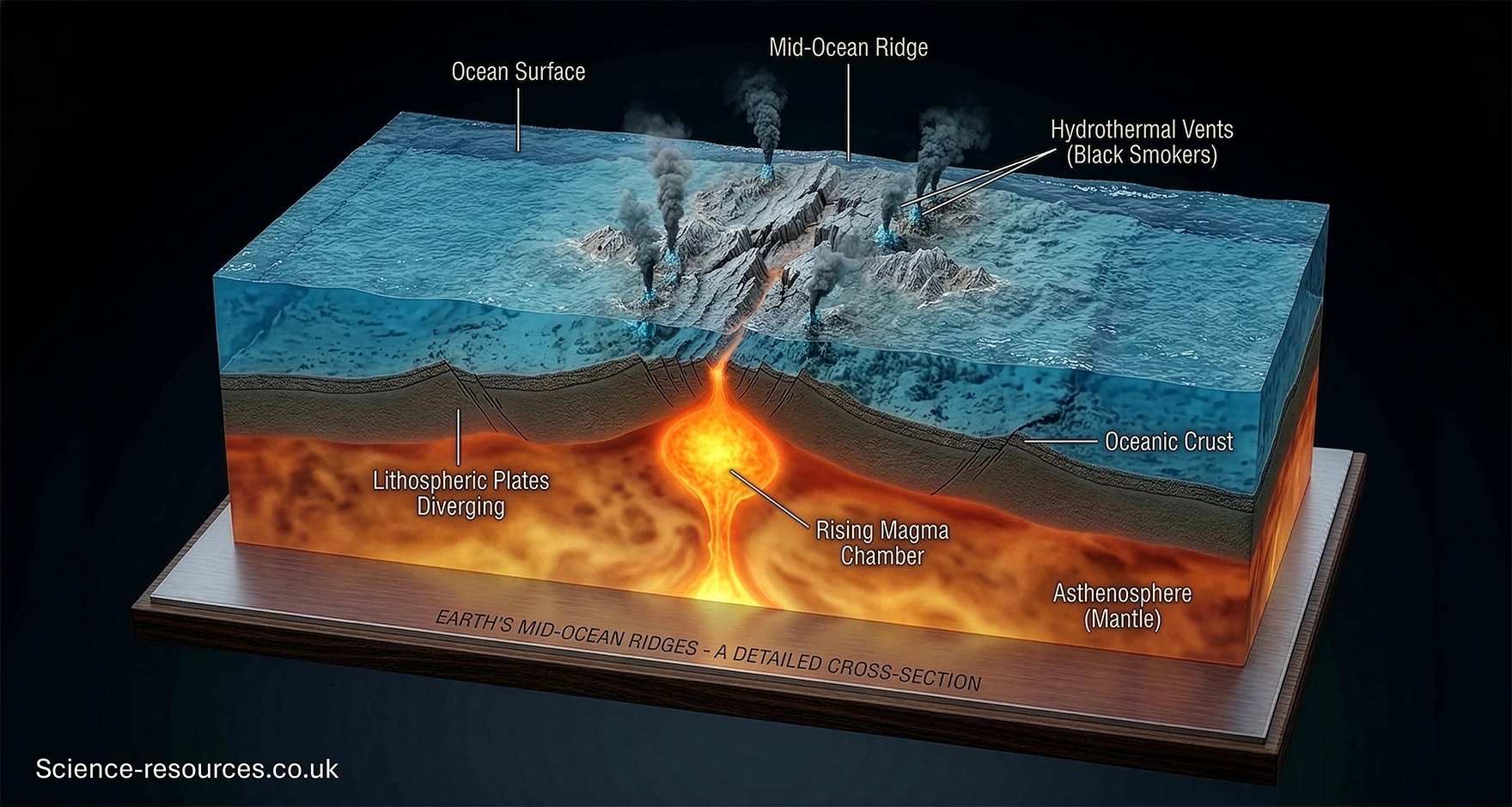
Constructive plate movement - This happens when tectonic plates move apart, magma rises up to bridge the gap and produces new crust made of igneous rock, basalt.  sometimes magma comes out with great force producing undersea volcanoes.  This is quite evident in the middle of Atlantic Ocean. 


The so called Mid-Atlantic ridge runs the whole length of the Atlantic and actually cuts through the middle of Iceland, which is why they have hot underground water.


A detailed 3D scientific cross‑section model shows the structure of a mid‑ocean ridge beneath the ocean. The top of the model displays the blue ocean surface with gentle texture suggesting water. Below the surface, the seafloor is shown as uneven, rocky terrain forming a long ridge running horizontally across the image. Dark grey hydrothermal vents, labelled Hydrothermal Vents (Black Smokers), release streams of dark smoke‑like plumes into the surrounding water.
The central part of the ridge is labelled Mid‑Ocean Ridge, positioned where the two sides of the oceanic crust pull apart. The crust itself is shown as a layered, textured region labelled Oceanic Crust. Beneath the crust are two diverging slabs labelled Lithospheric Plates Diverging, sloping downward on either side of a central vertical gap.
In the middle of the cross‑section is a bright orange and yellow glowing area labelled Rising Magma Chamber, representing hot molten rock moving upward from deeper layers. This magma plume originates from a wider, deeper orange region at the base of the block labelled Asthenosphere (Mantle). The mantle layer contains swirling patterns that give the impression of intense heat and movement.
At the bottom front edge of the model is a label reading Earth’s Mid‑Ocean Ridges – A Detailed Cross‑Section.  The overall image illustrates how magma rises at a divergent plate boundary to form new oceanic crust and hydrothermal vent systems.Cross-section diagram of a mid-ocean ridge and rising magma
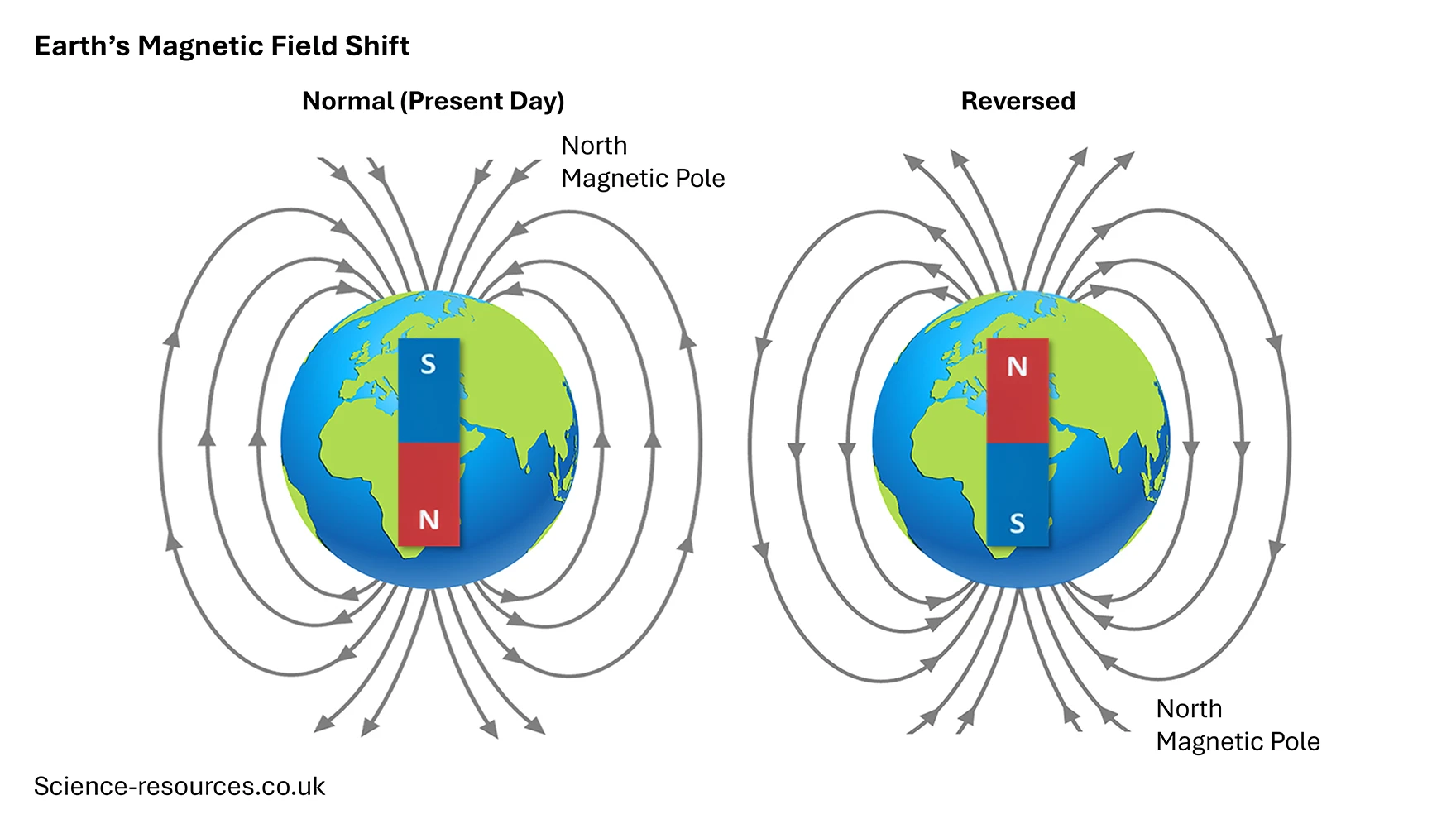


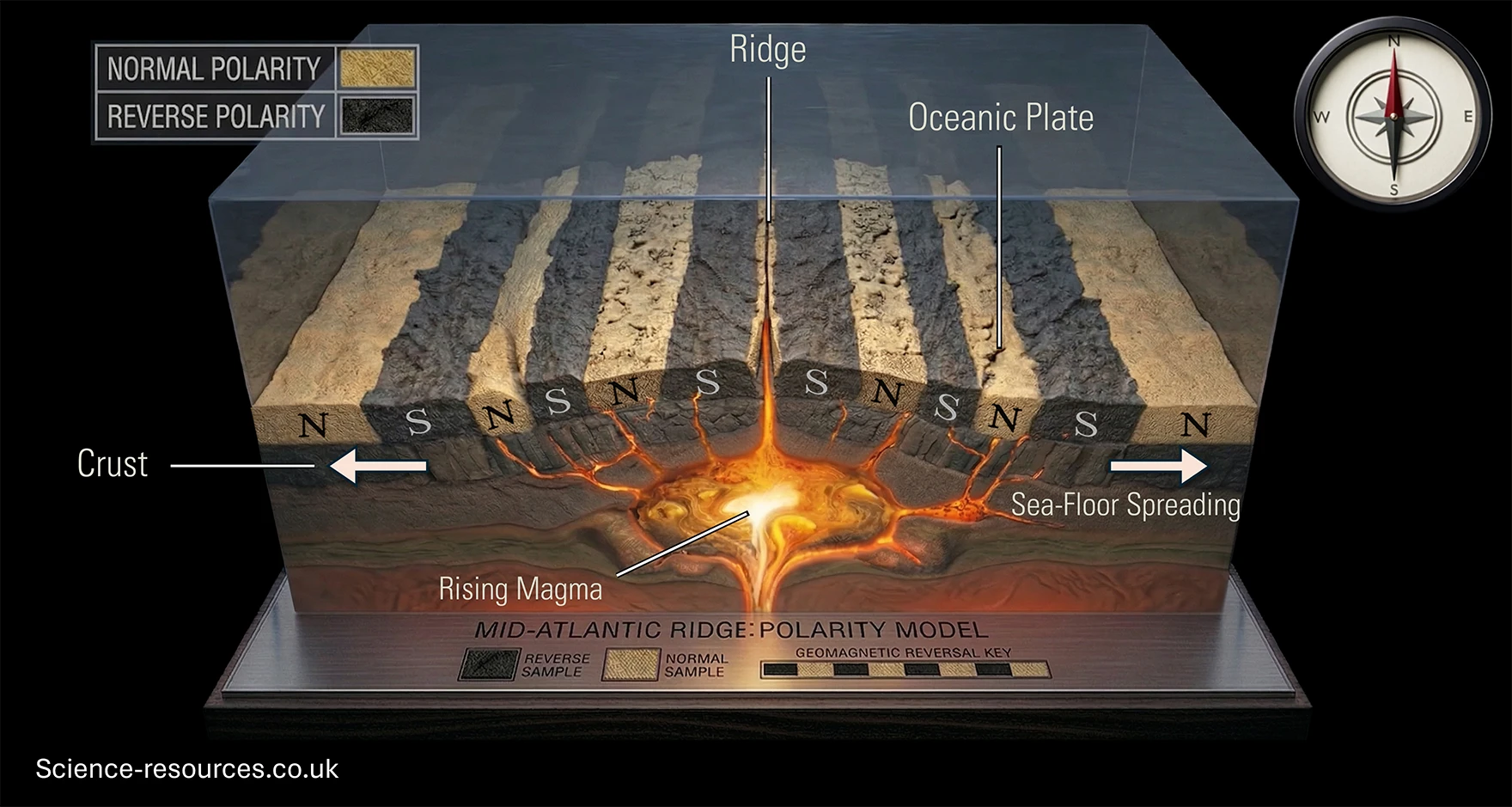
As the magma rises up through the gap it forms ridges, and underwater mountains, resulting in symmetrical pattern either side of the ridge, thus providing strong evidence for the theory of continental drift (see animation above).  The most convincing evidence, however, comes from the magnetic direction of the rocks.  As the liquid magma erupts out of the gaps, the iron particles in the rocks tend to align themselves with the Earth's magnetic field and as it cools they set in position


A scientific diagram compares the Earth’s magnetic field in its normal present-day configuration with a reversed polarity state. The illustration shows two globes side by side against a white background.
On the left, the “Normal (Present Day)” Earth is depicted with the geographic continents clearly visible. A vertical bar magnet is positioned through the centre of the globe, with the blue “S” (south magnetic pole) at the top and the red “N” (north magnetic pole) at the bottom. Curved grey magnetic field lines arc outward from the magnetic south near the top of the globe, loop around in symmetrical curves, and converge again at the magnetic north near the bottom. An arrow near the top labels the “North Magnetic Pole”.
On the right, a second Earth is labelled “Reversed”. In this version, the bar magnet is flipped so that the red “N” is at the top and the blue “S” is at the bottom. The grey magnetic field lines reverse direction accordingly, emerging from the top and curving around the planet before entering at the bottom. The “North Magnetic Pole” label is placed near the lower pole of the reversed magnet.
Both diagrams include consistent colour schemes, with blue oceans, green and yellow landmasses, and grey arrows showing the flow of magnetic field lines.

Earth’s magnetic field shift: Normal and reversed polarity diagram


A detailed cross‑section diagram shows a mid‑ocean ridge where new oceanic crust forms. At the centre of the image, a vertical channel of bright orange and yellow rising magma pushes upward through the crust. Above this channel is the ridge, marked with a vertical label. On both sides of the ridge, two oceanic plates move apart, indicated by large horizontal white arrows pointing outward.
The top layer of the diagram displays alternating coloured bands that run parallel to the ridge. These bands represent magnetic polarity reversals. Each band is labelled either N or S, indicating normal or reverse magnetic polarity. A small legend in the upper left corner shows two boxes: one light yellow for normal polarity and one grey for reverse polarity.
Beneath the surface bands, the crust is shown as a brown layer that extends outward on both sides. The lower section of the diagram shows glowing red and orange magma beneath the crust. A label reading Rising Magma points to the central upwelling.
A compass graphic in the top right corner shows cardinal directions with the needle pointing north. Text on the base of the diagram reads Mid‑Ocean Ridge: Magnetic Striping Diagram. Mid-ocean ridge magnetic striping and sea-floor spreading diagram


Every 500,000 years or so the earth's magnetic field tend to switch direction.  This means the rock on either side of the ridge has bands of alternate magnetic polarity.  This pattern is found to be Symmetrical either side of the ridge (see animation below).


Mid-Atlantic Ridge


Destructive plate movement - This occurs when plates move towards each other.  Different types of collision may take place at these boundaries.  Oceanic and Continental plates or two continental plates can collide with each other.


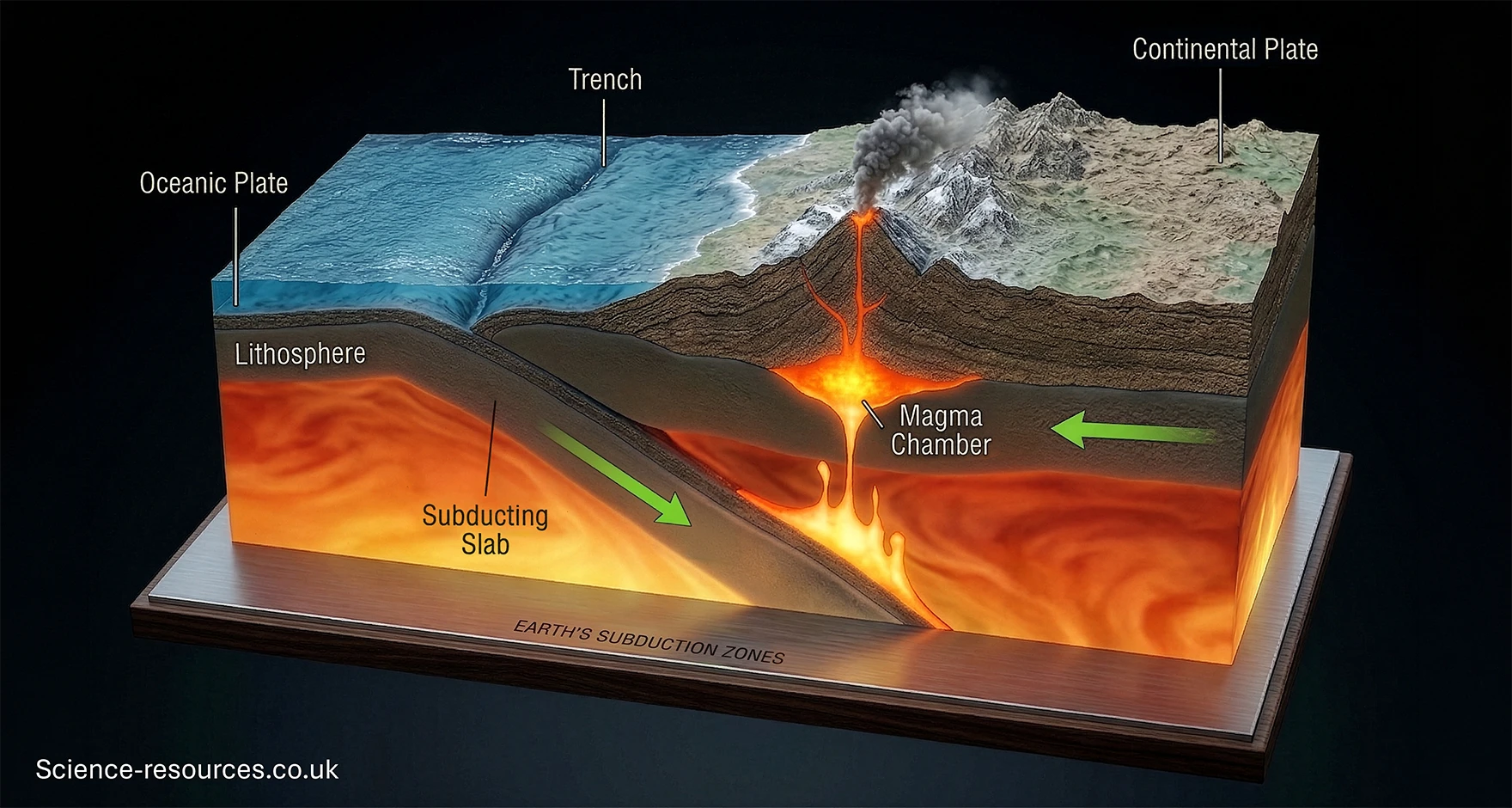
Oceanic and Continental plates colliding:  Since the oceanic plate is more dense, it is always forced underneath the continental plate.  This is called subduction (see animation below).  As the oceanic plate is pushed down a deep trench is formed. The plate melts and creates pressure in the surrounding area due to all the melting rock.  The resulting molten rock finds its way to the surface and volcanoes form. 


A 3D scientific cross‑section model illustrates a subduction zone where an oceanic plate descends beneath a continental plate. The model sits on a wooden base with the label Earth’s Subduction Zones along the front edge. The background is black, which makes the geological features stand out clearly.
On the left side of the model, a blue ocean covers the Oceanic Plate, shown as a solid block of dark, layered rock beneath the water. At the boundary between the oceanic and continental plates is a deep, narrow depression labelled Trench.
The oceanic plate slopes downward into the Earth along a diagonal path labelled Subducting Slab, with a large green arrow indicating its direction of movement. Above the subducting slab lies a layered zone labelled Lithosphere, separating the surface from deeper layers.
On the right side of the model, the Continental Plate forms a rugged landscape with mountains, valleys, and a smoking volcanic vent. Beneath the volcano is a bright orange and yellow region labelled Magma Chamber, where molten rock is rising toward the surface. A second green arrow points from the magma chamber upward toward the volcano, indicating the vertical movement of molten material.
Below the entire structure is a broad glowing layer of swirling orange, representing deeper hot mantle material that interacts with the descending slab and helps generate magma. The overall diagram visually explains how an oceanic plate sinks beneath a continental plate, forming a trench, driving magma formation, and creating volcanic activity above the subduction zone.Cross-section diagram of a subduction zone


Earthquakes also happen as the two plates slowly grind past each other.  The continental crust is not destroyed.  It is simply compressed, folded into anticlines and synclines and thickened to form a fold mountain range similar to the Andes in South America.


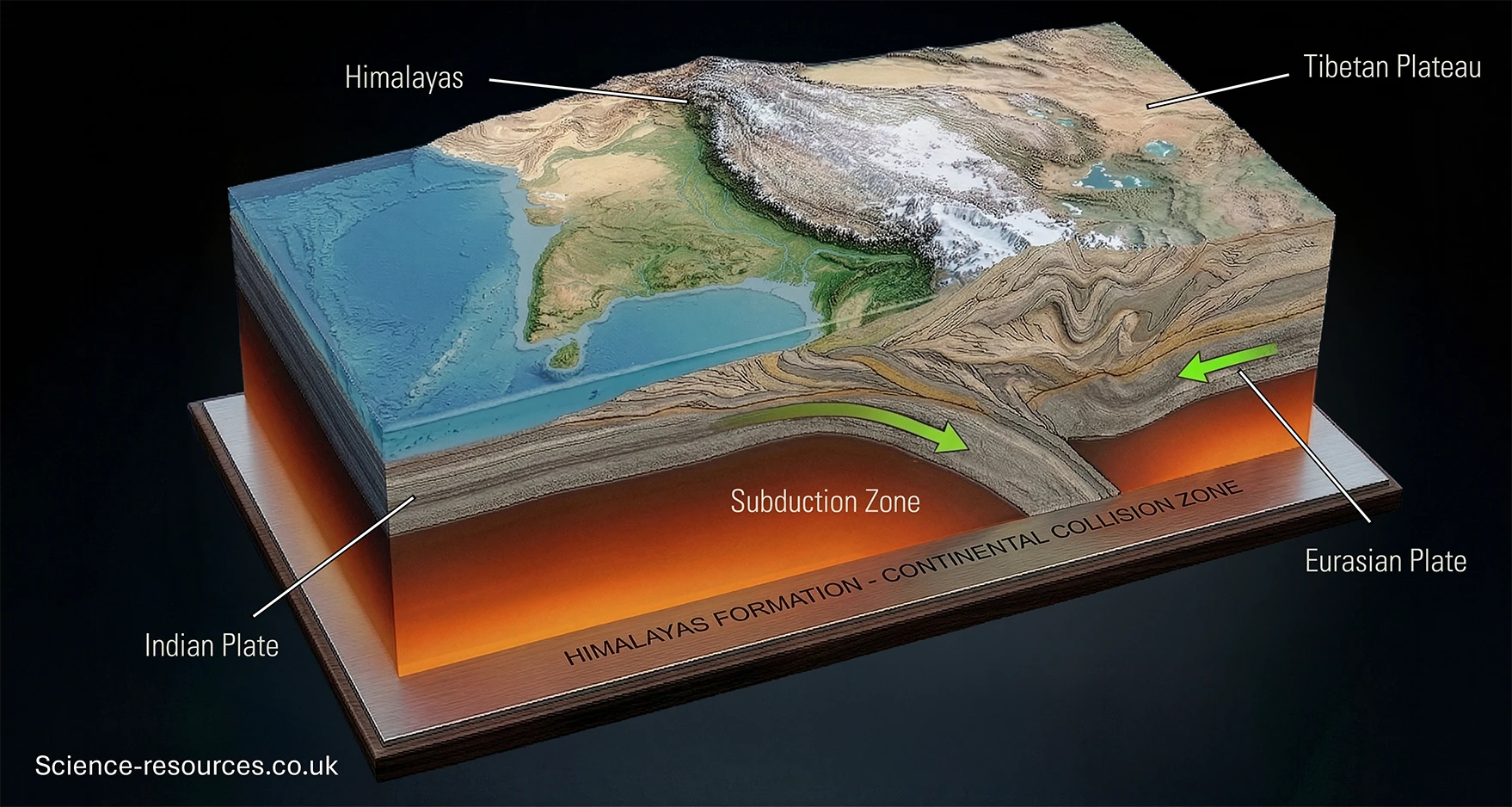
Two continental plates colliding:  When two continental plates collide head on, neither of them is subducted.  Instead the sediment layers laying between the two continent land masses get squeezed.  The effect is to form fold mountains similar to the Himalayas.  This type of fold mountain range has no volcanoes or deep focus earthquakesIndia, in fact detached it self from Africa and piled into the bottom of Asia.  It is still doing so, pushing the Himalayas up and up.  This means Mount Everest is getting taller by a few centimeters every year as India continues to push up into the continent of Asia.


A high‑resolution 3D geological model shows how the Himalayan mountain range formed through the collision between the Indian Plate and the Eurasian Plate. The model is displayed as a rectangular block with the upper surface representing satellite‑style terrain and the lower interior revealing cross‑sections of the Earth’s crust and mantle.
The top surface shows the green lowlands of northern India rising sharply into the jagged, snow‑covered Himalayas, which run horizontally across the centre of the model. To the north, a pale, dry, elevated region represents the Tibetan Plateau.
The interior of the block reveals folded and compressed rock layers. The Indian Plate is shown on the left, coloured in warm brown tones and angled downward beneath the Eurasian Plate on the right, illustrating a clear subduction zone in the centre. The Eurasian Plate displays tightly folded, uplifted strata that rise toward the Himalayas above. Two large green arrows show the direction of plate movement: the Indian Plate pushing northward and the Eurasian Plate resisting, causing crustal shortening and uplift. A glowing orange lower layer represents hotter, deeper mantle regions.
Text labels point to major features, including “Indian Plate,” “Subduction Zone,” “Himalayas,” “Tibetan Plateau,” and “Eurasian Plate.” At the base is the caption: “Himalayas Formation – Continental Collision Zone.”

Himalayan mountain formation


India


Conservative plate movement


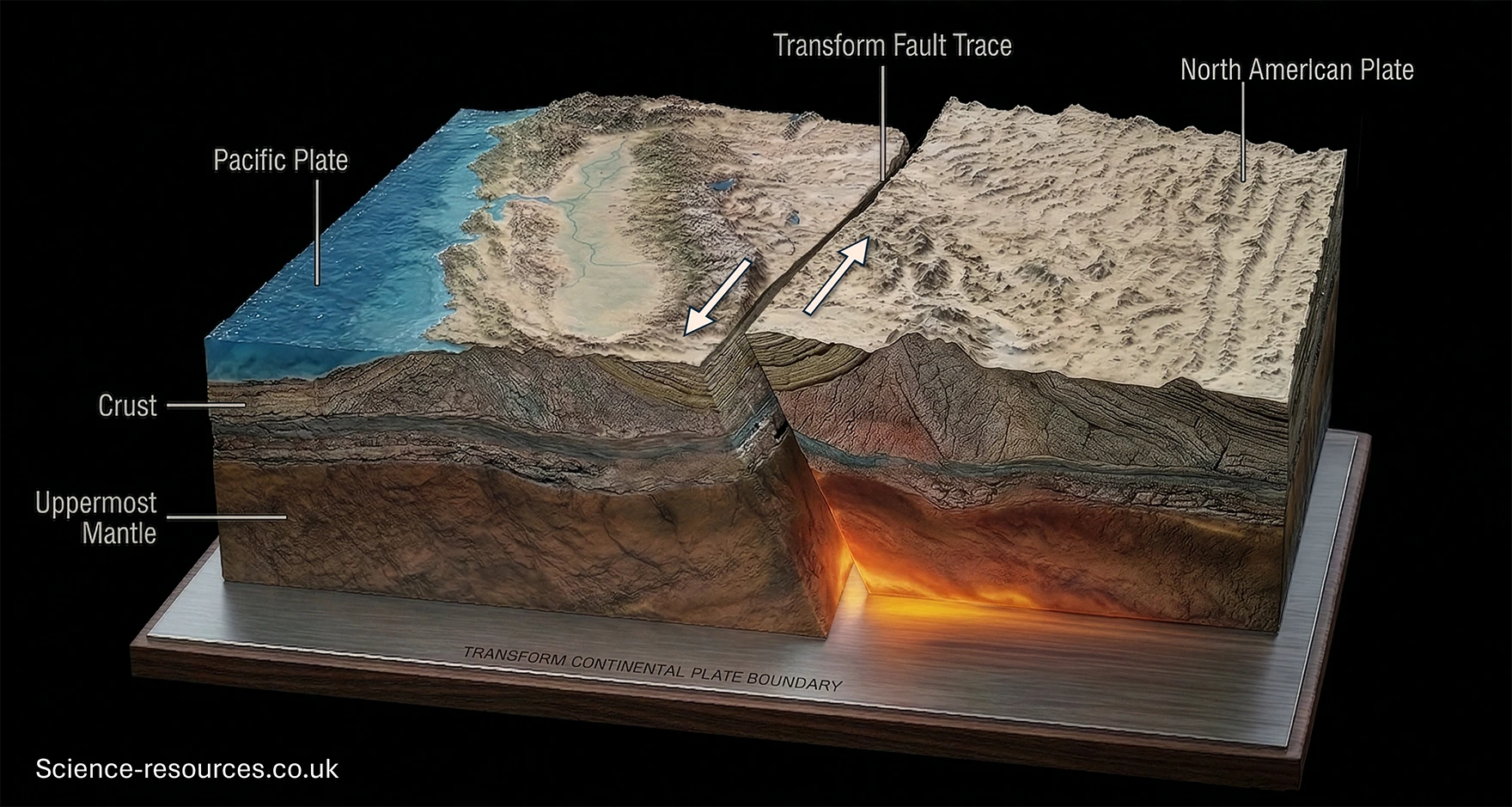
When plates slide past each other this type of movement results.  Here, material is neither created or destroyed.  The best known example of this is the San Andres Fault in California (see animation below).  It marks the boundary between the Pacific plate and the North American plate


A 3D scientific cross‑section model shows a transform plate boundary between two large continental crustal blocks. The model is displayed on a wooden base with the label Transform Continental Plate Boundary along the front edge. The background is black, making the geological structure stand out clearly.
The block on the left is labelled Pacific Plate, showing a textured landscape with a coastline, blue ocean water, and varied terrain. The block on the right is labelled North American Plate, displaying a dry, rugged landscape with detailed ridges and valleys. A clear vertical fracture divides the two plates, forming a sharply defined fault zone.
At the surface, a bold line marks the Transform Fault Trace, with two large white arrows indicating horizontal movement: one arrow pointing forward on the left plate and the other pointing backward on the right plate. This shows the side‑by‑side sliding motion characteristic of a transform boundary.
Below the surface, the diagram reveals three distinct layers: a thin upper layer labelled Crust, a thicker brown‑textured layer labelled Uppermost Mantle, and deeper glowing orange regions indicating heat from below. The two crustal blocks are offset along the fault, visually emphasising the horizontal displacement.
The overall model illustrates how two tectonic plates grind past one another along a transform fault, affecting both the surface landscape and the underlying geological structure. Cross-section diagram of a transform plate boundary


These plates of rock don't glide smoothly past each other, they catch on each other and as the forces build up they suddenly jerk.  This sudden jerking only lasts a few seconds, but brings devastation in a built-up and heavily populated areas. The city of San Francisco sits along side this type of fault line. It was completely destroyed in 1906 and was again hit by a powerful tremor in 1991.  This could happen again any time.


These days in earthquake zones, developers try to build earthquake-proof buildings which are designed to withstand small amount of shaking.  In poorer countries, earthquakes usually cause much devastation where they have badly constructed properties, overcrowding and inadequate rescue services.


You may also be interested in:


SITES

Title

URL

VolcanoWorld

http://volcano.und.nodak.edu

MTU's Volcanoes Page

http://www.geo.mtu.edu/volcanoes

USGS Cascades Volcanoes Observatory

http://vulcan.wr.usgs.gov

Global Volcanism Network

http://www.volcano.si.edu/gvp/

USGS Volcanoes Site

http://volcanoes.usgs.gov


🌍 Knowledge Check: Plate Boundaries

Test your knowledge of how tectonic plates interact at different types of boundaries.

1. At which type of boundary do tectonic plates move away from each other?

2. What is created at a destructive boundary when the oceanic plate is forced downwards?

3. Why do volcanoes NOT usually form at conservative plate boundaries?

4. What happens when plates become "stuck" at a conservative boundary?

5. Which type of volcano is commonly found at constructive boundaries?

Click to Reveal Answers
1. Constructive (Plates move apart, allowing new crust to form).
2. An ocean trench (Formed where the oceanic plate subducts under the continental plate).
3. No rising magma (Plates only slide past each other without creating gaps or melting).
4. Pressure builds up (The release of this stored energy causes earthquakes).
5. Shield volcanoes (Formed by magma rising to fill the gap between plates).


Tags: Plate Tectonics, Earthquakes, Volcanoes, Constructive, Destructive, Conservative, continents moving, earthquake plates map, names of tectonic plates, plate tectonic evidence


© 2012 science-resources.co.uk. All rights reserved | Design by W3layouts