i


Continental Drift


The Earth's Surface 


It is thought that the crust, underneath the oceans as well as the continents, together with the upper part of the mantle is divided into huge 'rafts' called plates.  The movement of the plates will be explained below, by the theory of continental drifts.


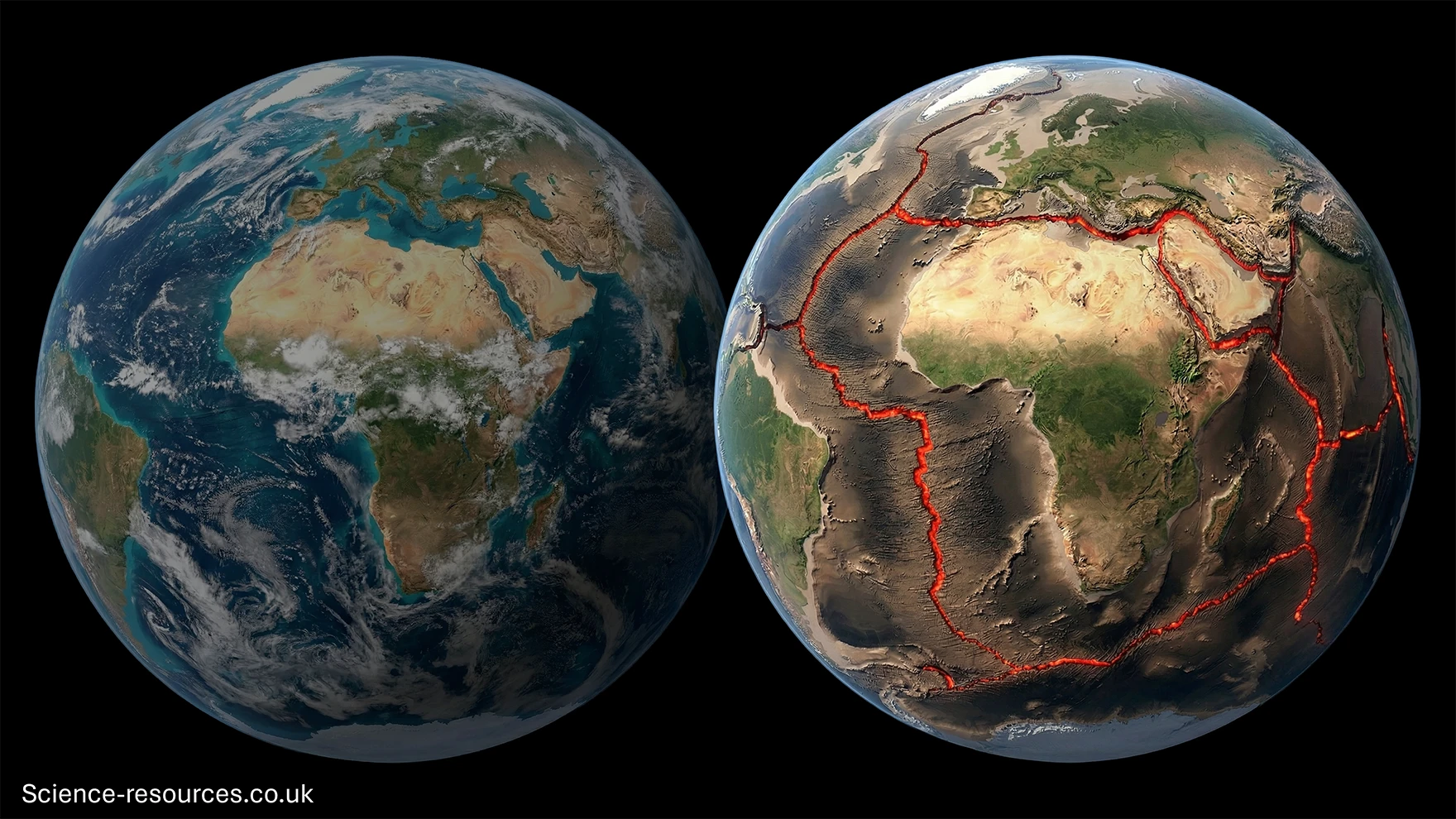
A widescreen image showing two globes of Earth side by side against a black background. Both globes display Africa at the centre, with parts of Europe, the Middle East, and the surrounding oceans visible.
The globe on the left shows Earth with natural satellite imagery only. Continents appear in realistic colours, including sandy deserts across northern Africa, green regions around central Africa, and cloud formations swirling over the Atlantic Ocean. Ocean surfaces show varying shades of blue, and the planet is lit from the upper left, creating gentle shading on the right side.
The globe on the right uses the same satellite base imagery but includes bright red lines marking tectonic plate boundaries. These red lines trace the edges of the African Plate and surrounding plates, running through the Atlantic Ocean, the Mediterranean region, the East African Rift area, and the Indian Ocean. The shading and terrain textures are more pronounced, highlighting mountain ranges, ridges, and ocean floor features.
The two globes together illustrate the difference between a natural, unmarked Earth view and a geological map emphasising global tectonic structure.Side-by-side comparison of Earth with and without tectonic plate boundaries


Amongst these plates there are 8 major ones and assortment of smaller ones.  The major plates include the following:


1. The African plate
2. The Antarctic plate
3. The Indoaustralian plate
4. The Eurasian plate
5. The Nazca plate
6. The North American plate
7. The Pacific plate
8. The South American plate
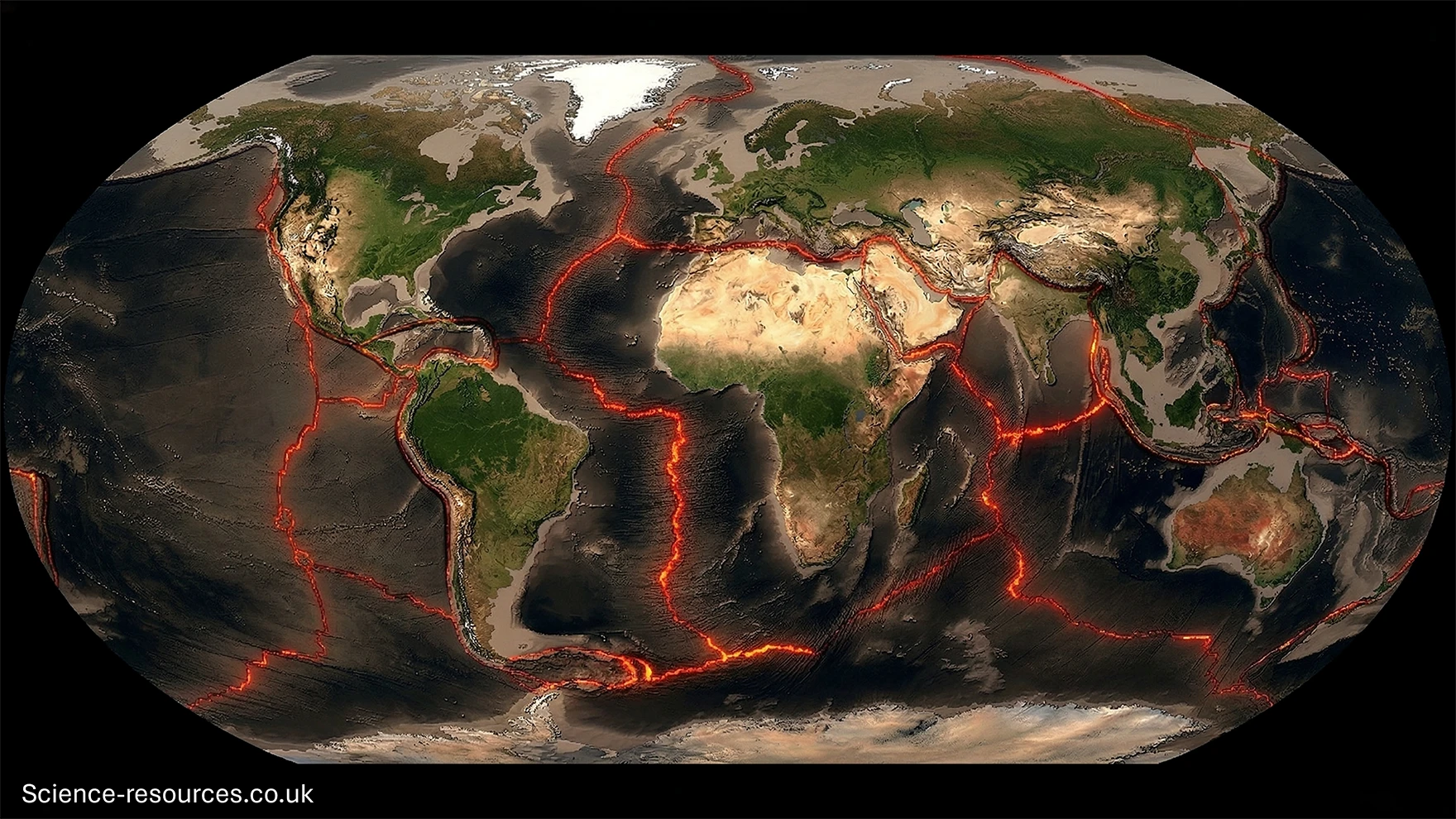
 

The diagrams below indicates the different plates on the world map which shows that the plates are capped by both the oceanic and continental crust.  Most volcanoes are found around and along the plate edges.


A full‑colour, high‑resolution world map showing Earth as a slightly curved, three‑dimensional sphere viewed from space. The continents and oceans are displayed with realistic satellite imagery, including visible landforms, vegetation, deserts, mountain ranges, and ocean floor textures. Overlaying the map is a network of bright red lines that trace the tectonic plate boundaries across the planet. These lines run through the Atlantic Ocean, outline the edges of the Pacific Ocean basin, pass along the western coasts of North and South America, cut through the Mediterranean region, and continue around Africa, Asia, and Australia. The red boundaries highlight major geological features such as mid‑ocean ridges, subduction zones, and transform faults. The background is black space, making the illuminated Earth stand out prominently. The overall image emphasises the structure and distribution of Earth’s tectonic plates across both land and sea.Global map of tectonic plate boundaries


Continental Drift - Plate Tectonics
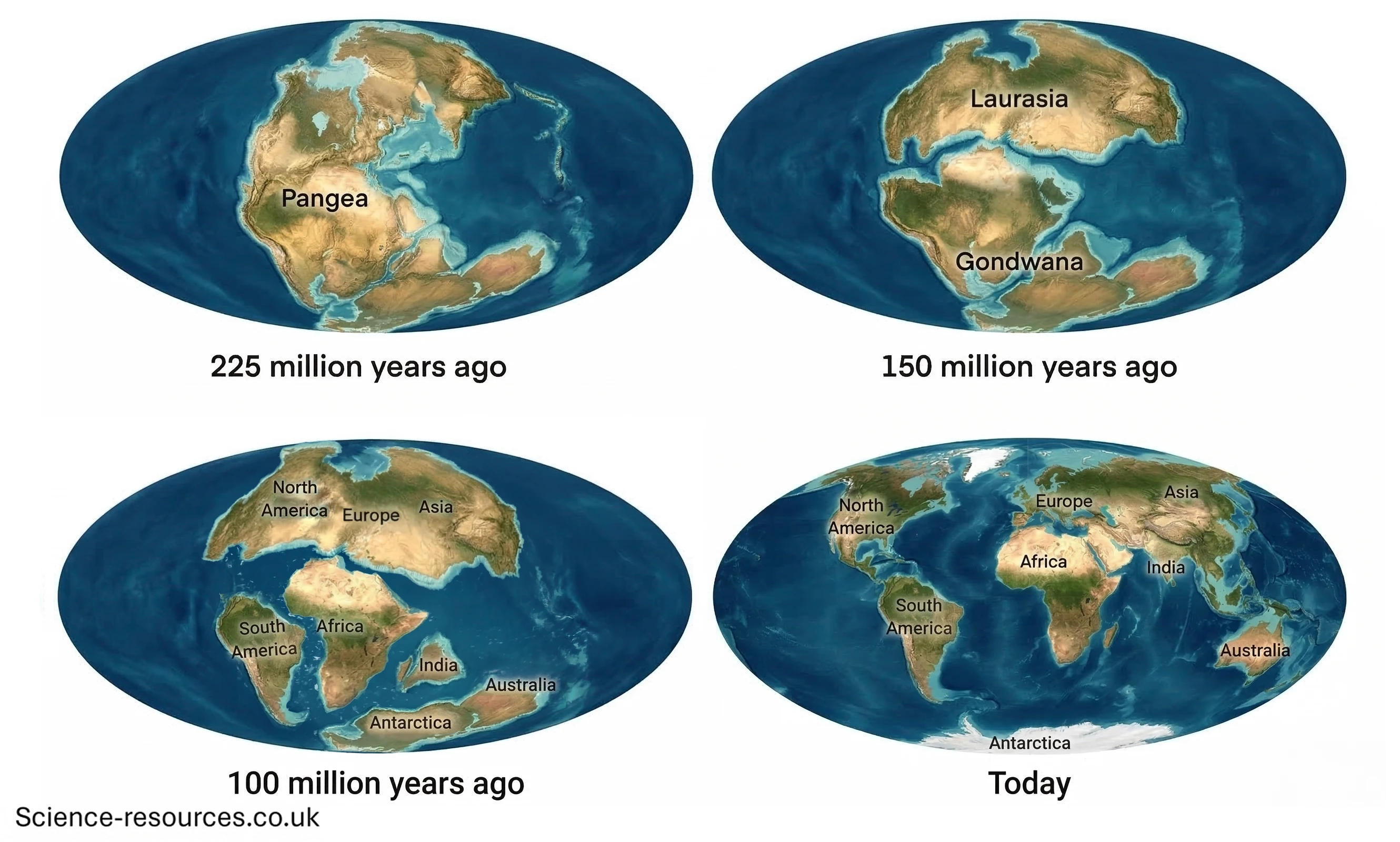
 

A four‑panel diagram showing how Earth’s continents shifted over time.

Top left, labelled “225 million years ago”, shows the supercontinent Pangaea, with all major landmasses joined together in a single block.
Top right, labelled “150 million years ago”, shows the landmass split into Laurasia in the north and Gondwana in the south.
Bottom left, labelled “100 million years ago”, shows the continents beginning to resemble modern positions, with labels such as North America, South America, Europe, Asia, Africa, India, Antarctica and Australia.
Bottom right, labelled “Today”, shows the present‑day global map with the same continents in their current locations.
All four maps are displayed as oval Earth projections against a blue ocean background. Continental Drift from Pangaea to the Modern World


During 1915, German scientist Alfred Wegener put forward this idea of continental drift.  He proposed that today's continents once formed a single landmass, which he named Pangaea (Greek for 'all land').  This 'snapped' into pieces due to the weaknesses in the earth's crust as they were made up of less dense materials.  These 'huge chunks' of land drifted centimeter by centimeter over millions of years until they got to where they are now.  See animation below.


Jigsaw Fit


Continental Drift

Having trouble seeing the video or need subtitles? Click here


So, what evidence is there to prove the existence of the Pangaea?
 

If you look at the present day map of the world, there is an obvious jigsaw fit between Africa and South America.  The other continents can also be fitted in without too much difficulty (see animation above).   The distribution of some fossil plants and animals provides further evidence to support the theory of continental drift.  Matching plant fossils of the same era have been found in rocks in  South America, South Africa, Australia, Antarctica, and India, which strongly suggests that they were all joined once upon a time.  Identical fossils of a freshwater crocodile, Mesosaurus, fold mountain chains and glacial deposits found in both Brazil and South Africa also back the theory.  


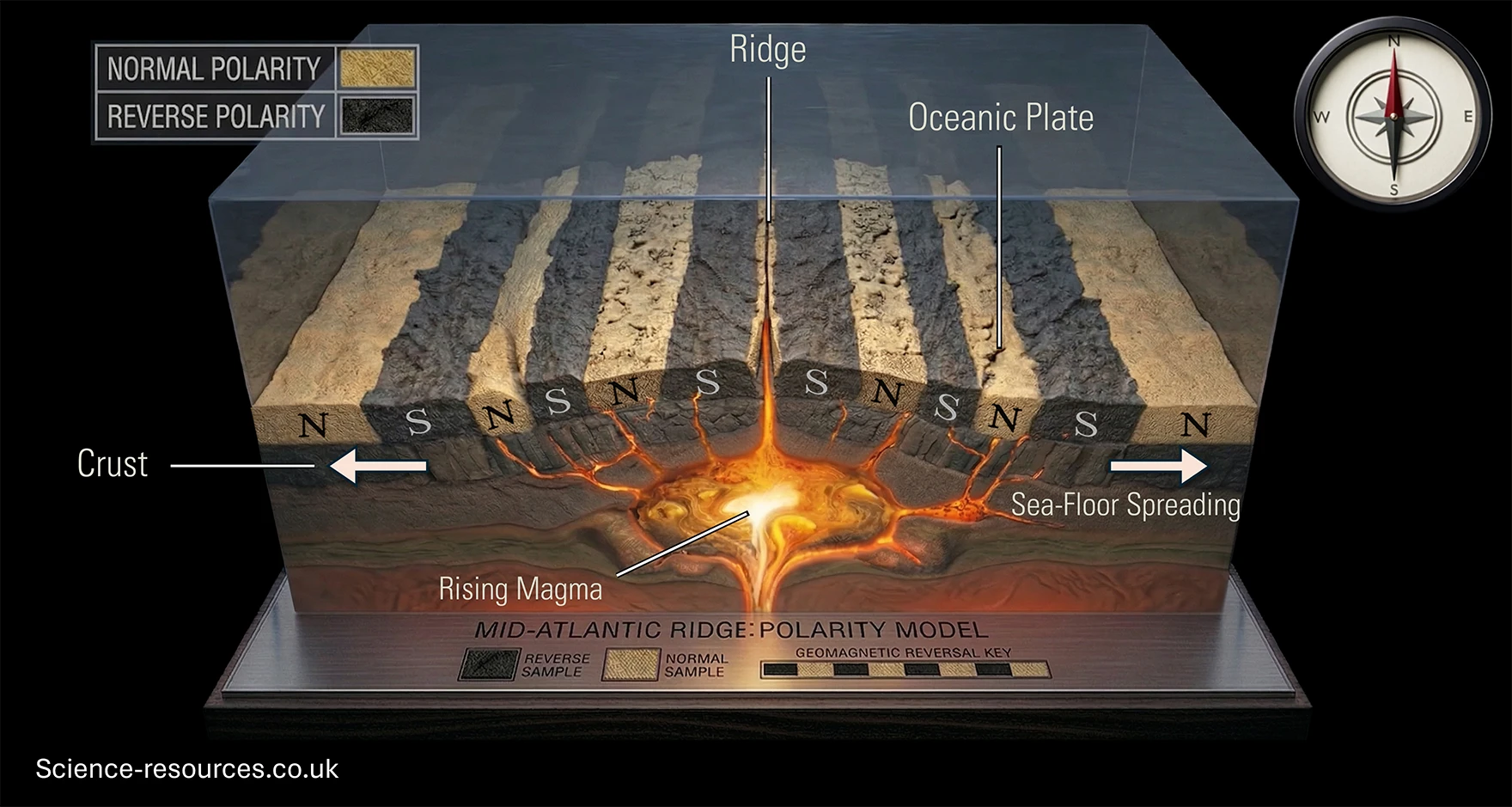
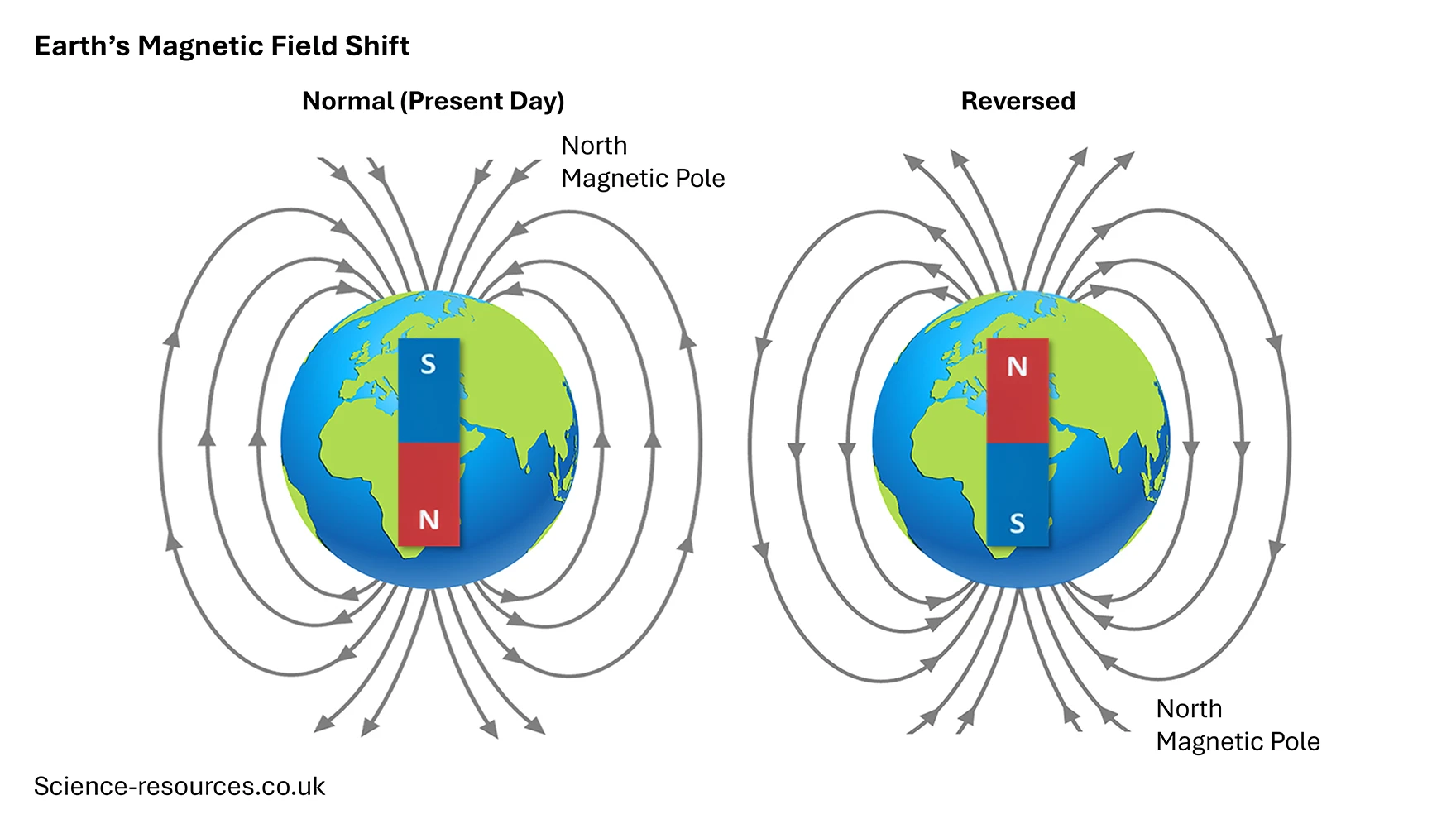
The symmetrical pattern of 'magnetic stripes' found in the rocks on either side of the Mid-Atlantic ridge is the clearest evidence found only recently that indicate the two sides are spreading away from each other (see animations below).


A scientific diagram compares the Earth’s magnetic field in its normal present-day configuration with a reversed polarity state. The illustration shows two globes side by side against a white background.
On the left, the “Normal (Present Day)” Earth is depicted with the geographic continents clearly visible. A vertical bar magnet is positioned through the centre of the globe, with the blue “S” (south magnetic pole) at the top and the red “N” (north magnetic pole) at the bottom. Curved grey magnetic field lines arc outward from the magnetic south near the top of the globe, loop around in symmetrical curves, and converge again at the magnetic north near the bottom. An arrow near the top labels the “North Magnetic Pole”.
On the right, a second Earth is labelled “Reversed”. In this version, the bar magnet is flipped so that the red “N” is at the top and the blue “S” is at the bottom. The grey magnetic field lines reverse direction accordingly, emerging from the top and curving around the planet before entering at the bottom. The “North Magnetic Pole” label is placed near the lower pole of the reversed magnet.
Both diagrams include consistent colour schemes, with blue oceans, green and yellow landmasses, and grey arrows showing the flow of magnetic field lines.

Earth’s magnetic field shift: Normal and reversed polarity diagram


A detailed cross‑section diagram shows a mid‑ocean ridge where new oceanic crust forms. At the centre of the image, a vertical channel of bright orange and yellow rising magma pushes upward through the crust. Above this channel is the ridge, marked with a vertical label. On both sides of the ridge, two oceanic plates move apart, indicated by large horizontal white arrows pointing outward.
The top layer of the diagram displays alternating coloured bands that run parallel to the ridge. These bands represent magnetic polarity reversals. Each band is labelled either N or S, indicating normal or reverse magnetic polarity. A small legend in the upper left corner shows two boxes: one light yellow for normal polarity and one grey for reverse polarity.
Beneath the surface bands, the crust is shown as a brown layer that extends outward on both sides. The lower section of the diagram shows glowing red and orange magma beneath the crust. A label reading Rising Magma points to the central upwelling.
A compass graphic in the top right corner shows cardinal directions with the needle pointing north. Text on the base of the diagram reads Mid‑Ocean Ridge: Magnetic Striping Diagram. Mid-ocean ridge magnetic striping and sea-floor spreading diagram


Mid-Ocean Ridge
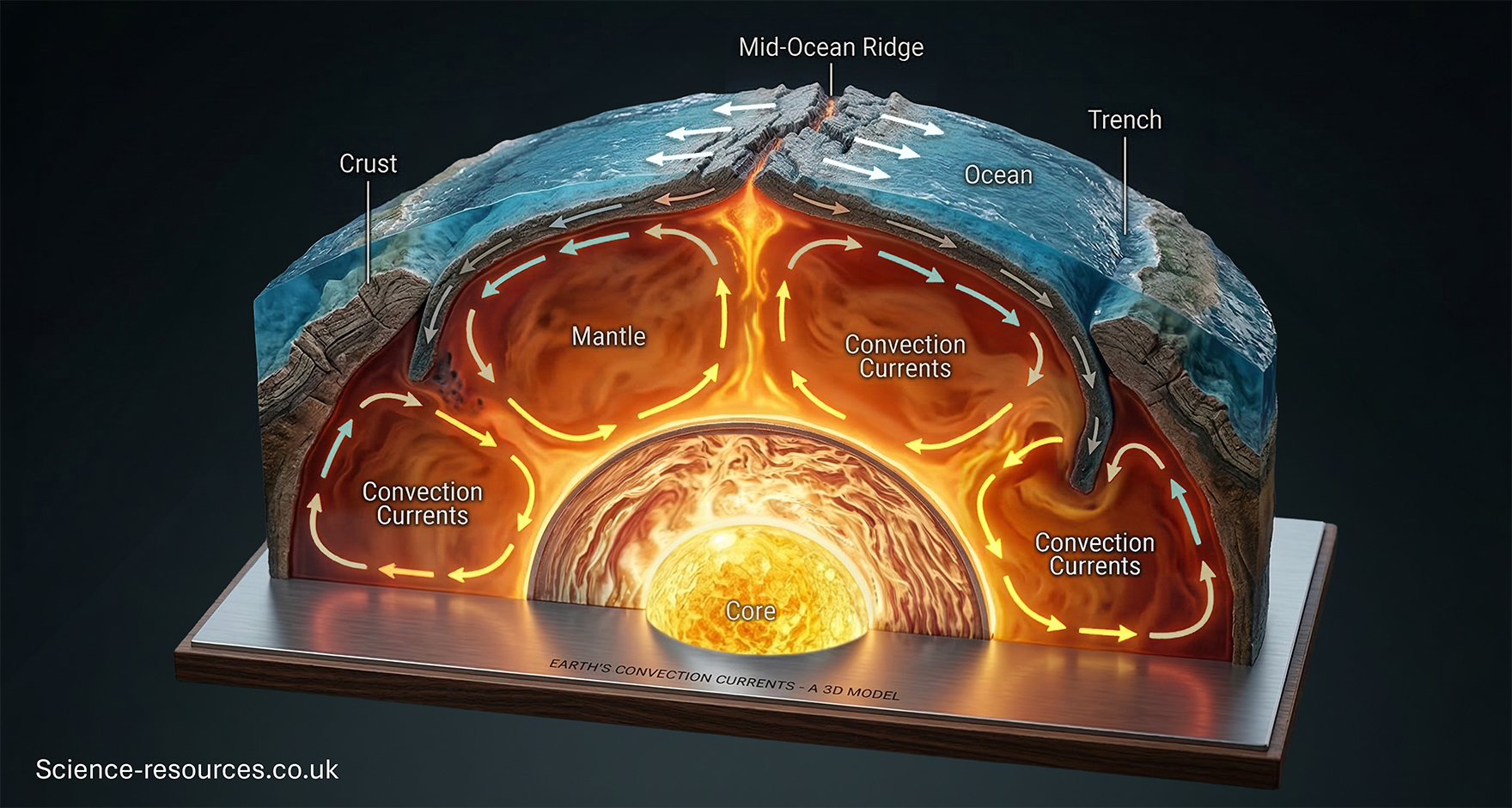
 

A detailed 3D cross‑section model of the Earth displays the crust, ocean, mid‑ocean ridge, trench, mantle, asthenosphere, and core. The upper layer shows blue ocean water and sections of the rocky crust on either side. A raised mid‑ocean ridge appears at the centre with white arrows on the surface indicating the outward movement of tectonic plates. On the right side, the crust dips sharply downward into a deep trench.
Below the crust, the mantle and asthenosphere are shown in glowing orange and red tones. Multiple curved arrows within these layers represent convection currents, forming looping paths: hot mantle material rises from deep regions near the core, moves outward beneath the crust, then sinks back down near the trench. At the bottom, the bright yellow core emits an intense glow, highlighting the heat source that drives the circulating currents. The model rests on a base labelled “Earth’s Convection Currents – A 3D Model”.

The mid-Atlantic ridge


Continue... Plate Boundaries


🌍 Knowledge Check: Continental Drift

Test your understanding of Alfred Wegener's theory and the evidence for the supercontinent Pangea.

1. According to the theory, how long ago did the supercontinent Pangea exist?

2. Which land reptile fossil was found in Antarctica, India, and Africa, suggesting these lands were once joined?

3. Why did Alfred Wegener believe the continents had moved?

4. What was the main reason other scientists rejected Wegener’s theory in the early 1900s?

5. Based on current scientific measurements, how far do continents typically move in one year?

Click to Reveal Answers
1. 300 million years ago (Wegener proposed Pangea existed at this time).
2. Lystrosaurus (This land-dwelling reptile's fossils are spread across these now-distant landmasses).
3. Coastlines fit like jigsaw pieces (The 'jigsaw fit' was one of his primary observations).
4. Could not explain the force (This lack of a mechanism was the primary reason for rejection).
5. 2 to 5 centimetres (Continental movement is extremely slow but measurable).


You may also be interested in:


© 2012 science-resources.co.uk. All rights reserved | Design by W3layouts