Earth and the Sun
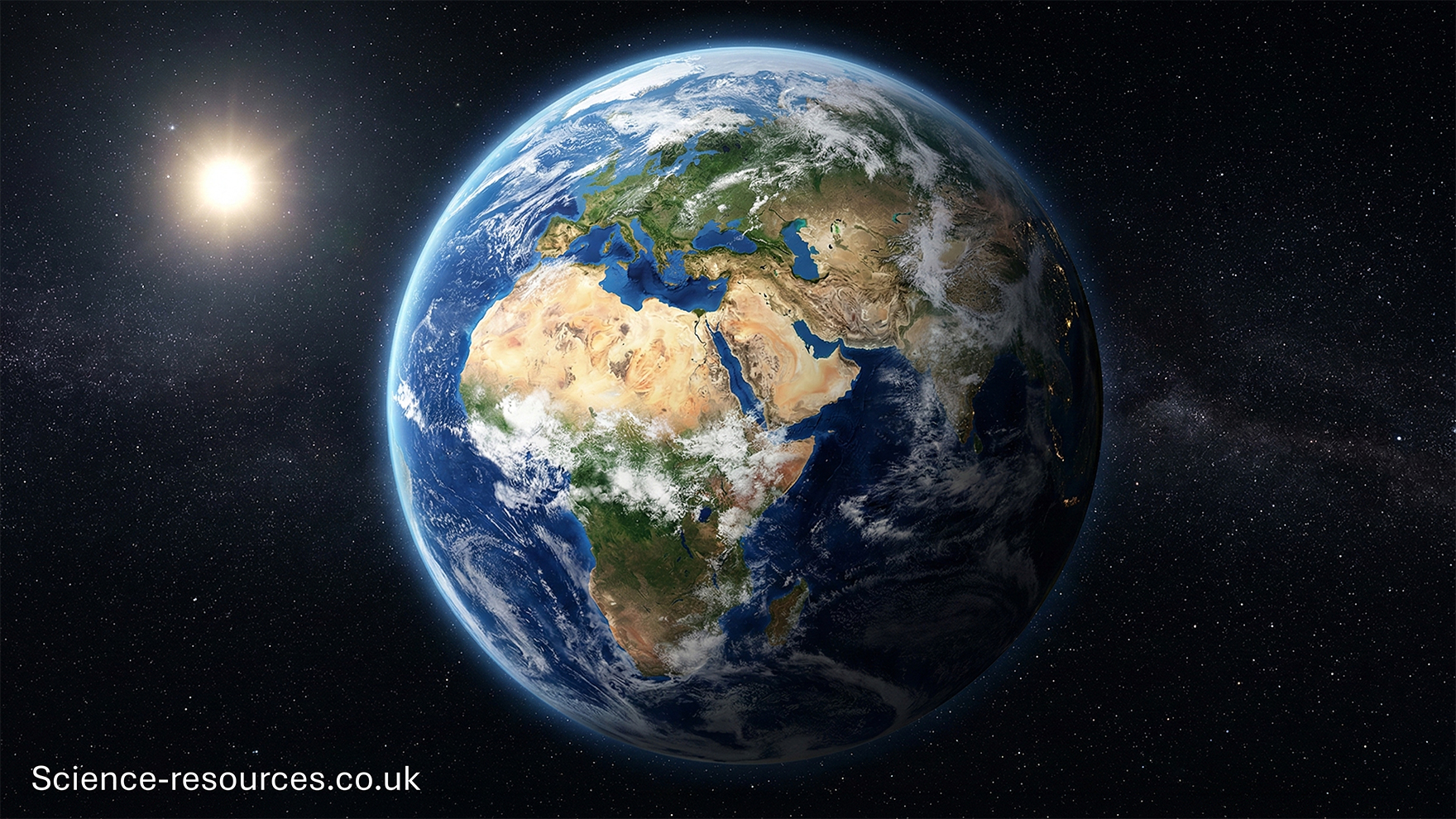
The Sun
Why?
Because the Earth is rotating from West to East.
Why do we have day and night ?
|
Day and night are caused by the Earth spinning on its axis once every 24 hours.
Diagram of Earth's 23.5° axis tilt and rotation
One day is made up of one complete rotation of the Earth. For example, Sunday or a Monday.
|
|

Try this yourself!
Get a torch and a ball to find out why we get night and day.
Point the torch towards the ball and rotateit from left to right west to east)
What Answer - click here.
A year is
the time taken for the Earth to journey once around the Sun. Q. How many days does it take for
the earth to complete one journey round the Sun? Q. How many times does the Earth
spins on its axis while it makes this journey? Q. How many months are there in
one year? Q. The Earth travels in an ellipse.
Why does it not travel in a full circle? Q. Why do we have shorter days during winter and longer days during summer? Q. Is the the Sun higher in the
sky during winter or summer ? Use a lamp (or a torch) and a ball to
investigate how the Earth moves in orbit round the Sun - Hint!.....keep the
tilt of the Earth at the same angle all the time.
Continue... SeasonsWhat is a year ?
Try
this yourself!
Test your understanding of Earth's movement and the cycles of day, night, and seasons. 1. How long does it take for the Earth to complete one full rotation on its axis? 2. At what angle is the Earth's axis tilted relative to its orbit? 3. Which movement of the Earth is responsible for the transition between summer and winter? 4. During which event do we experience nearly equal hours of day and night? 5. Why is it colder in winter than in summer?☀️ Knowledge Check: Earth and the Sun
Click to Reveal Answers
2. 23.5 degrees (This tilt is constant throughout Earth's orbit).
3. Earth's orbit around the Sun combined with its axial tilt (This causes different parts of Earth to lean toward or away from the Sun).
4. The Equinox (Occurring twice a year when the tilt is neither toward nor away from the Sun).
5. The hemisphere is tilted away from the Sun (Sunlight is spread over a larger area and is less intense).
Tags: Earth and Sun, Earth, Sun