Super Blood Moon Eclipse
From Sunday 20th through to Monday 21st January, a rare lunar phenomenon called a ‘super blood moon’ eclipse will delight stargazers across the UK and North America.
For around 5 hours, stargazers, astronomers and enthusiasts alike will be treated with large glowing red moon caused as a result of the Sun being completely blocked out by the Earth.
So, what is so special about a ‘Super Blood Moon’ and when / where can you see it? An eclipse is a celestial event which occurs when a celestial object, such as the Sun or the Moon, is temporarily obscured, either by passing into the shadow of another body or by having another body pass between it and the viewer. What is an eclipse?
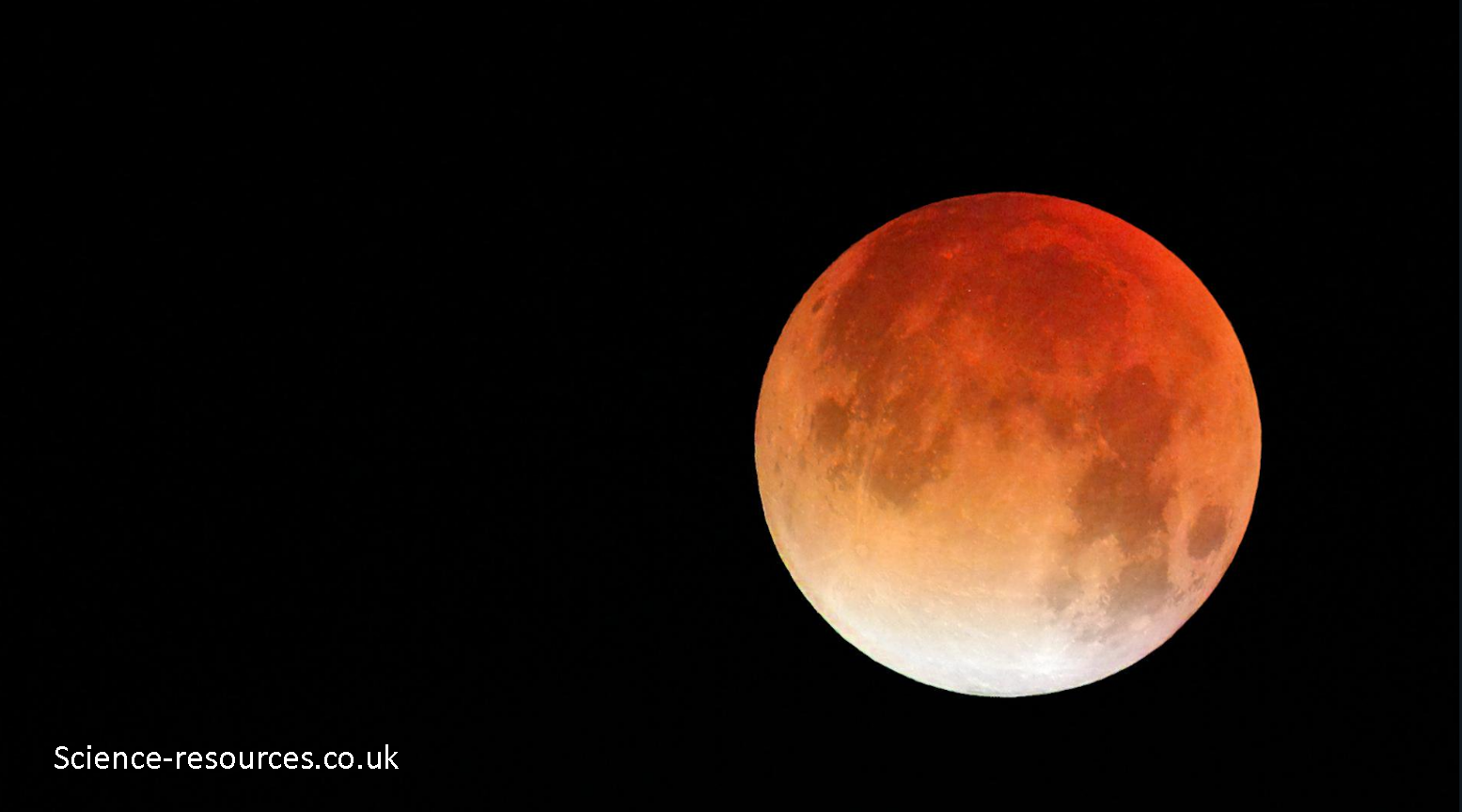
A lunar eclipse occurs when the Moon passes through the Earth's shadow. A lunar eclipse can only occur during a full moon.
What is a lunar eclipse?

Lunar eclipse image courtesy of science-resources.co.uk
What is a 'super blood moon' eclipse?
A ‘Super Blood Moon’ is the combination of two celestial events – a total lunar eclipse and supermoon (when the moon’s elliptical orbit is at its closest point to the Earth).
As the moon enters Earth’s shadow, sunlight scatters causing the moon to glow blood red. During this time, the moon will appear 14 per cent bigger and 30 per cent brighter than normal.
When is the 'super blood moon'?
The peak of the total lunar eclipse will occur around 05.15 (GMT) / 12. 15 (EST) on January 21 whilst Americas and northern and western Europe, the event is set to start just after 2.30am and will last until 7.48am. Some parts Western Africa will be able to catch a glimpse of the event, whilst the rest of Europe and Asia will only see a partial eclipse.
Where to watch the 'super blood moon'
For the best view, find an open, unobstructed space free from light pollution and a clear view of the night’s sky.
When is the next 'super blood moon'?
The next lunar eclipse, after the 21st January, will be on 26th May 2021 and will be visible over North America, South America and East Asia.
You may also be interested in:
Test your understanding of the physics behind this rare astronomical event. 1. During a total lunar eclipse, what specific alignment must occur? 2. What is the name of the dark, central part of Earth's shadow? 3. Why does the Moon appear red instead of going completely dark during a total eclipse? 4. How many degrees is the Moon's orbital plane tilted relative to Earth's orbit? 5. What makes a lunar eclipse a 'SUPER' Blood Moon?🌕 Knowledge Check: Super Blood Moon
Click to Reveal Answers
2. The Umbra (the penumbra is the lighter outer part).
3. Earth's atmosphere bends and scatters red light (Rayleigh scattering).
4. About 5 degrees (this tilt is why eclipses are rare).
5. The moon is at its closest point to Earth (making it appear larger and brighter).