Global Light Pollution & Bortle Map
Instructions: Click anywhere on the interactive map to view light pollution and Bortle class for the selected area.
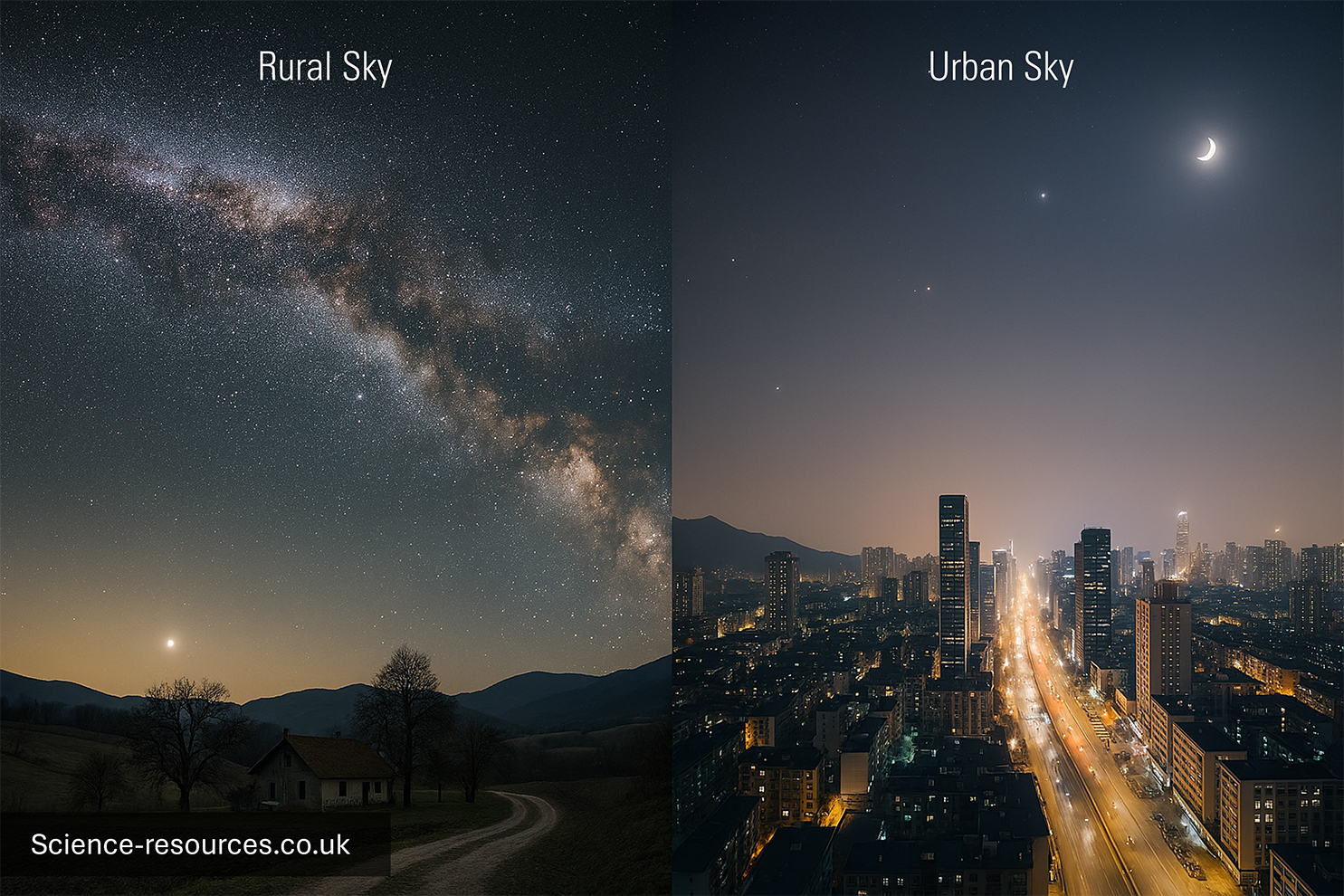
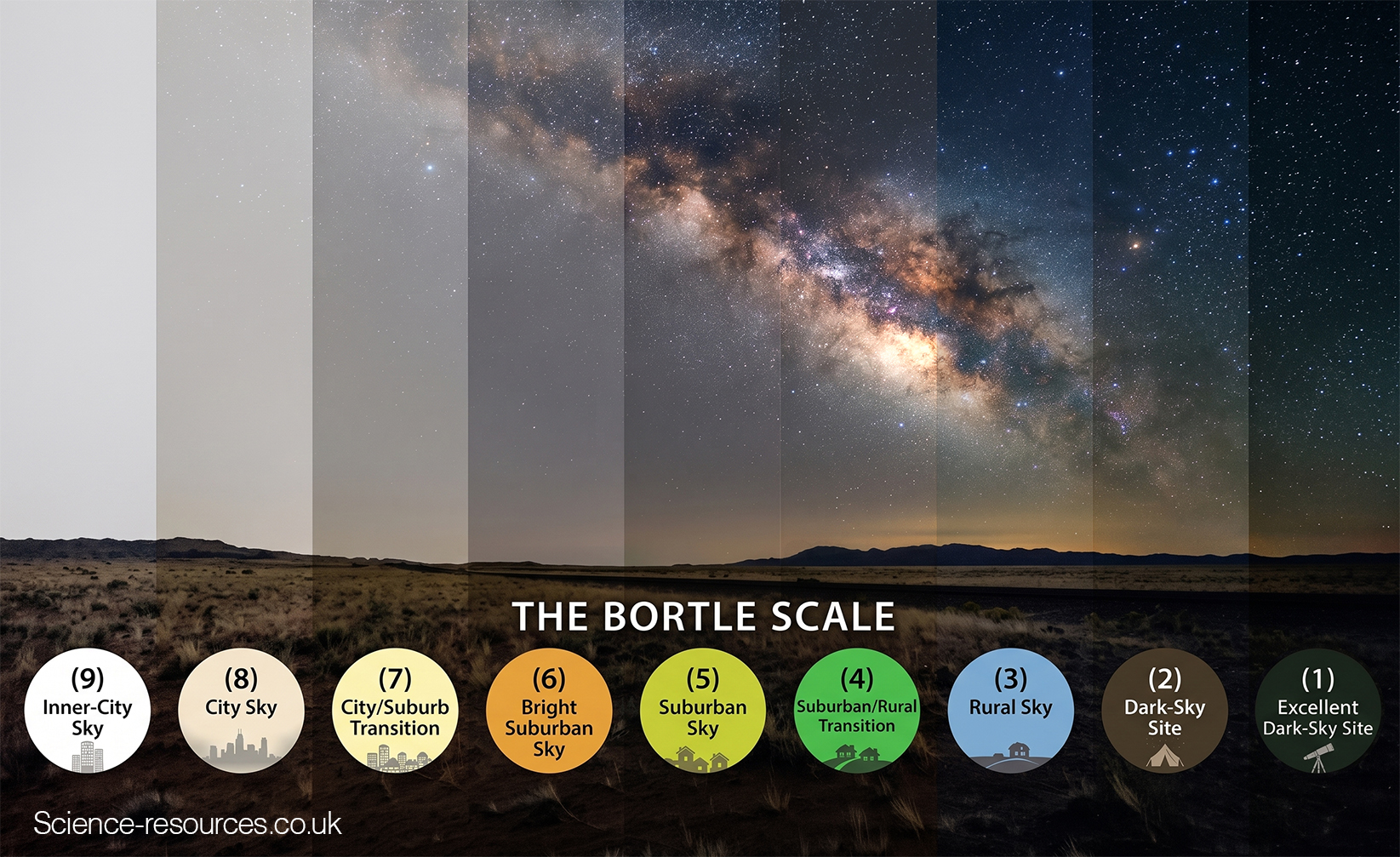
The image below shows how the Moon’s phase affects what we can see in the night sky from Earth. During the New Moon, the Moon is between the Earth and the Sun. The side of the Moon facing Earth is not lit up, so it appears dark in the sky. With no moonlight to brighten the atmosphere, the sky becomes very dark. This allows faint celestial objects such as distant stars, star clusters and the Milky Way to be seen clearly. During the Full Moon, the Earth is between the Sun and the Moon. The entire face of the Moon reflects sunlight back towards Earth. This reflected light spreads through the atmosphere, making the sky much brighter. This effect is called light scattering. Even though the stars are still there, the bright sky makes faint objects harder to see. As a result, fewer stars are visible and features like the Milky Way disappear from view. The image (above) helps show that the Moon does not block stars, but changes how bright the sky is. A bright Moon acts like natural light pollution, similar to street lights in a city. Astronomers and stargazers plan observations around the New Moon so they can see as many celestial objects as possible. The image below shows how light pollution affects what we can see in the night sky and why stars are easier to spot in rural areas than in cities. A side-by-side comparison of the night sky in a rural location and an urban location In rural locations, there are very few artificial lights. With little light shining upwards, the sky stays dark. This darkness allows light from distant stars and galaxies to reach our eyes. As a result, many more stars are visible, and large features such as the Milky Way can be seen clearly. In urban areas, there are many sources of artificial light, including streetlights, buildings, vehicles and advertising signs. Some of this light shines upwards or reflects off clouds and particles in the air. This makes the sky appear brighter, even at night. This effect is known as skyglow, a type of light pollution. Although stars are still present above cities, the bright background sky makes faint stars difficult or impossible to see. Only the brightest stars, planets and the Moon are usually visible. This is why the urban sky in the image shows very few stars and no Milky Way. The difference between urban and rural night skies is not caused by fewer stars above cities, but by increased artificial light. Astronomers prefer dark, rural locations for observatories so they can observe faint celestial objects more clearly. The Bortle Scale is a way of measuring how dark the night sky is by describing how much light pollution is present and what celestial objects can be seen with the naked eye. The Bortle Scale: How light pollution affects what we see in the night sky At Bortle Class 1, the sky is perfectly dark with no light pollution. These locations are very rare and usually far from towns and cities. In these conditions, the Milky Way is bright and detailed, and faint objects such as nebulae and distant galaxies are easy to see. Only the brightest stars stand out because the background sky is so dark. At Classes 2 and 3, which are typical rural or dark-sky sites, there is very little artificial light. The Milky Way is still clearly visible, although slightly fainter than in Class 1. Some light pollution may appear low on the horizon, but many stars and faint objects can still be observed with care. At Class 4, often found in suburban areas, moderate light pollution brightens the sky. The Milky Way is difficult to see and may only be visible faintly on very clear nights. Faint objects such as nebulae and galaxies are much harder to observe. From Class 5 to Class 9, which includes bright suburban, city and inner-city locations, light pollution becomes very strong. Artificial lights scatter in the atmosphere, causing the sky to glow even at night. Only the brightest stars and planets can be seen, and faint objects disappear completely. The Bortle Scale shows why astronomers choose dark locations for observatories and why travelling away from built-up areas allows us to see more of the Universe. To use the Bortle Scale, first find out how dark the night sky is where you live. You can do this by clicking on the 'Find my location' button on our interactive map. Once you know your Bortle Scale rating, you can use it to help plan stargazing. If you are new to observing the night sky, it is best to choose a place with a low Bortle number, such as the countryside, a nature reserve or a area away from streetlights. Darker skies make it much easier to see faint objects like stars, star clusters and the Milky Way. If you are observing from your back garden or other place with lots of light pollution, you can still improve what you see. Turning off nearby lights, using light-pollution filters and observing on moonless nights can all help. The sky is also darker when the Moon is low in the sky or not visible at all. The Bortle Scale is a useful guide, but it is not perfect. Sky darkness can change because of weather, clouds, humidity and air pollution. Calm, clear nights usually give the best viewing conditions. This app visualizes global light pollution using satellite night‑lights data and provides an estimated Bortle scale rating when you click on a location. It helps you understand how dark the night sky might be for astronomy and stargazing. The Bortle Scale is a 9‑level system that describes night sky brightness: Lower numbers mean darker skies and better conditions for observing stars, the Milky Way, and deep‑sky objects. The estimate is based on: The result is an approximation, not a direct measurement. The Bortle Scale is fundamentally observational—it depends on human perception, weather, and local conditions. Satellite data cannot capture all of this, so the app uses practical heuristics to produce realistic, easy‑to‑understand estimates. The confidence score (0–100%) indicates how reliable the estimate is based on available data and assumptions. It reflects data reliability, not scientific certainty. Satellite light‑pollution data is designed primarily for land use. Over open water, there are no permanent light sources, so the app applies fallback rules. These results are useful but less certain and are clearly labeled as approximations. Very sparsely populated regions (such as the Sahara or northern Canada) are often darker than global averages. The app applies regional heuristics so these areas aren’t unfairly brightened or darkened due to data smoothing. At high latitudes (e.g., Scandinavia, Greenland, northern Canada), factors like: can influence perceived sky quality. The app accounts for this with small adjustments to avoid unrealistic results. Alongside the Bortle class, the app describes how visible the Milky Way is likely to be under typical conditions. These descriptions assume clear skies and no Moon interference. Yes—significantly. A bright Moon can make even dark locations appear much brighter. The app shows the current Moon phase to help you judge whether conditions are favorable for observing faint objects like the Milky Way. The Find My Location button: Your location data: The app includes two satellite‑based overlays: Both show real data but emphasize different aspects of night‑time brightness. This app is best used as: For critical observations, always consider: The app uses public satellite night‑lights datasets that represent averaged conditions over time. While they are authoritative, they may not reflect recent local lighting changes. It’s a great starting point, but astrophotography often requires: Use this app to narrow down options, not as the final authority. Think of the app as answering: “What kind of night sky should I reasonably expect here, on a good night?” —not as a guarantee.How the Moon affects the visibility of objects in the night sky
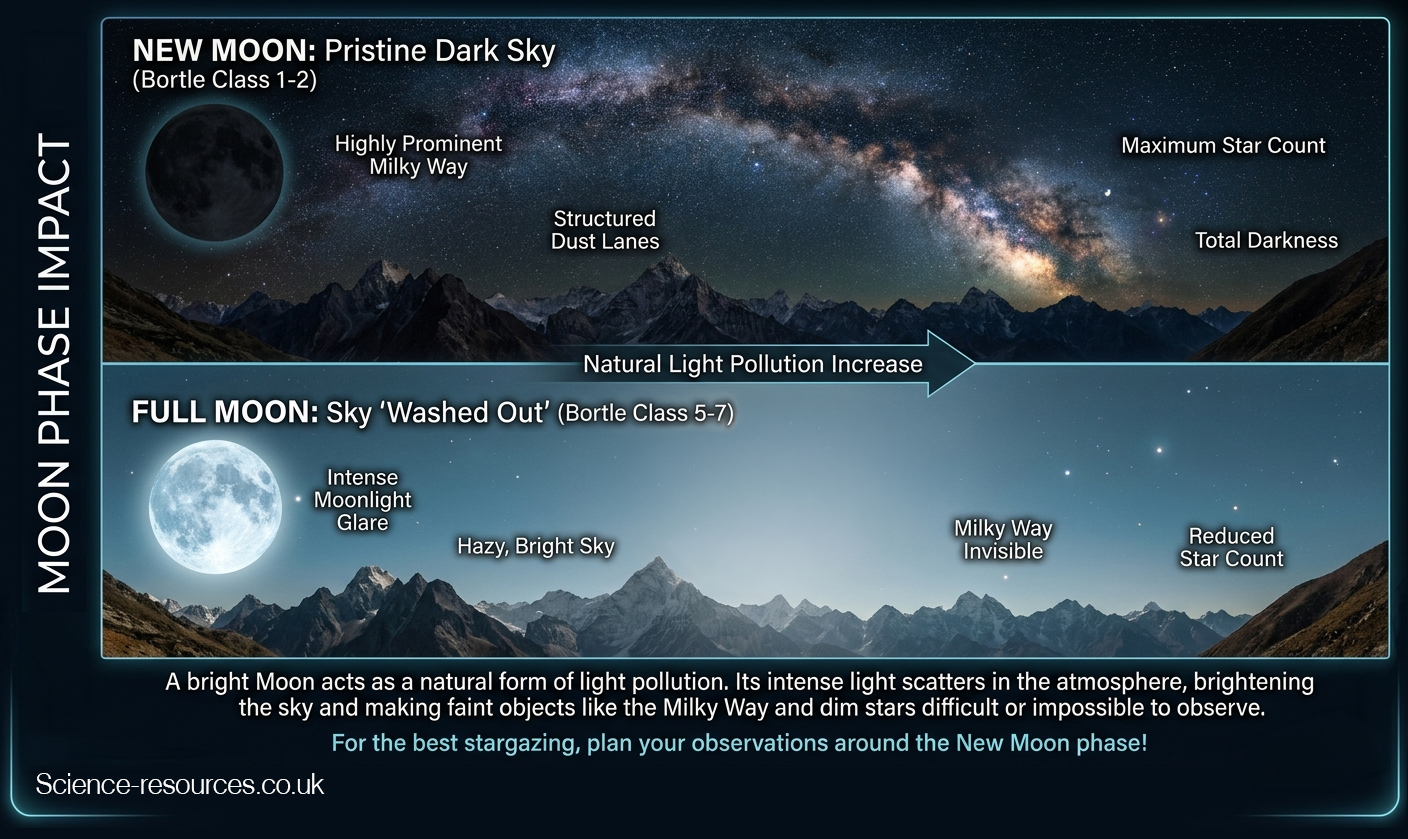 How the Moon changes what we can see in the night sky
Why you can see more stars in the countryside than in the city sky
The Bortle Scale: How light pollution affects what we see in the night sky
How to use the Bortle Scale
Light Pollution & Night Sky Explorer — FAQ
What does this app show?
What is the Bortle Scale?
How is the Bortle class estimated?
Why does the app use approximations?
What does the confidence score mean?
Why is confidence lower over oceans and seas?
How are deserts and remote regions handled?
Why do high‑latitude regions behave differently?
What does “Milky Way visibility” mean?
Bortle Class
Description
Milky Way Visibility
1
Excellent Dark Site
Highly prominent; casts shadows
2
Typical Truly Dark
Very striking; structured clouds
3
Rural Sky
Distinct; some light pollution on horizon
4
Rural/Suburban
Visible, but washed out near horizon
5
Suburban Sky
Barely visible; washed out overhead
6
Bright Suburban
Only visible at zenith; gray sky
7
Suburban/Urban
Invisible to the naked eye
8–9
City / Inner‑City
Completely invisible
Does the Moon affect visibility?
What does the “Find My Location” feature do?
Why does the map look different when I change overlays?
Is this app suitable for planning serious astronomical observations?
Is this data real and up to date?
Can I rely on this for astrophotography?
How should I interpret the results?
You may also be interested in: