i


Earth’s magnetic field


The Earth’s Magnetic Field


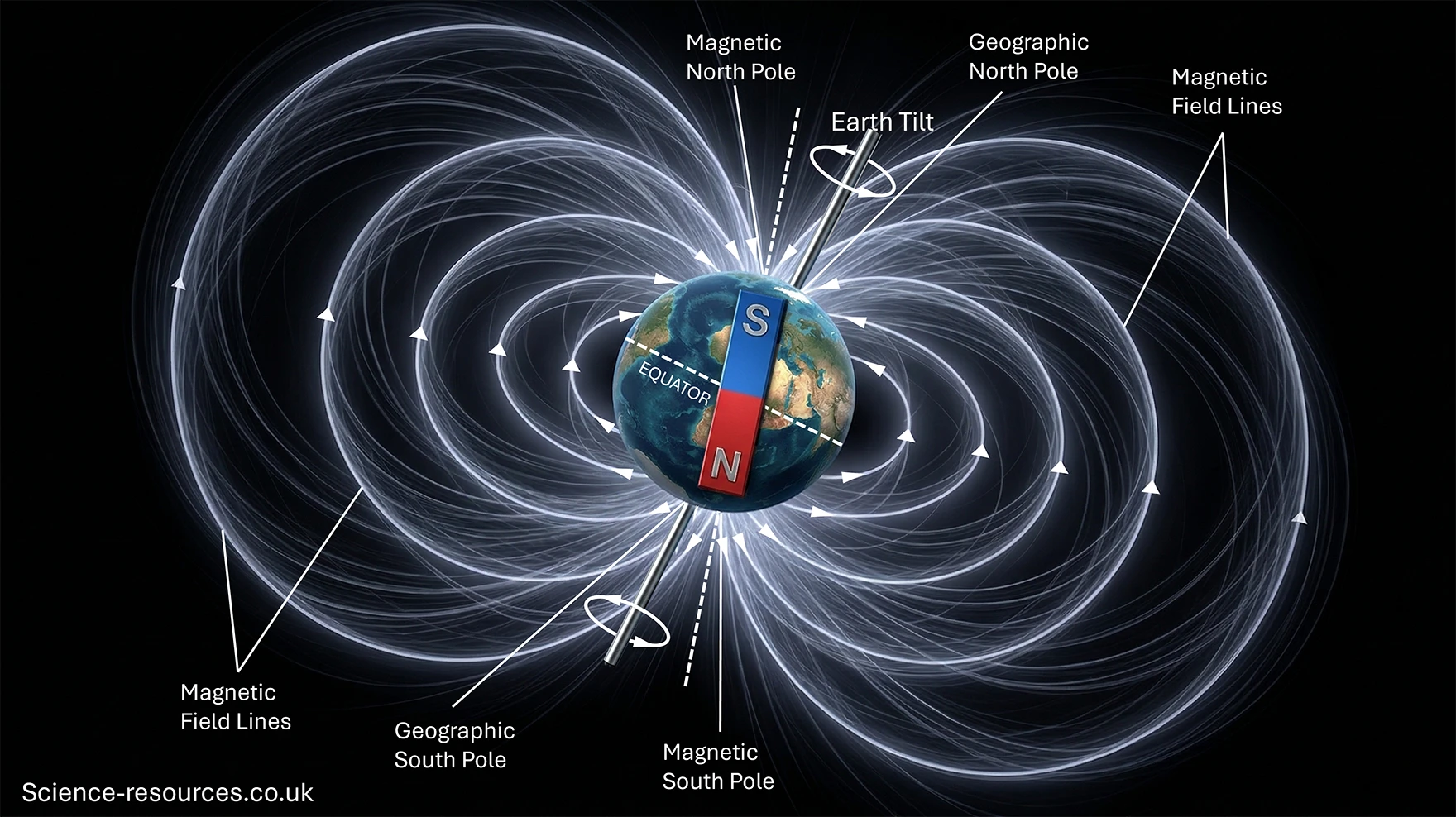
A dark background displays a stylised scientific diagram of Earth’s magnetic field. At the centre of the image is a detailed globe showing continents, cloud patterns, and oceans. A large vertical bar magnet is superimposed through Earth’s centre, with a blue section labelled S at the top and a red section labelled N at the bottom. The word EQUATOR appears horizontally across the middle of the globe.
Surrounding Earth are numerous curved white lines representing magnetic field lines. These lines arc outward from the magnetic south pole near the bottom of the bar magnet and loop around to return near the magnetic north pole at the top. The field lines form symmetrical, overlapping loops that extend far into the space around the planet.
Several labels in white text identify key features. At the top right is Geographic North Pole, while slightly left of it is Magnetic North Pole. Near the bottom of the globe are Geographic South Pole and Magnetic South Pole. On the upper right side, a curved white arrow indicates Earth Tilt. Additional labels reading Magnetic Field Lines appear on both the left and right sides of the diagram, connecting to the curved field lines.
The overall image illustrates how Earth’s magnetic field extends outward into space, the difference between geographic and magnetic poles, and the orientation of the planet’s magnetic dipole.Diagram of Earth’s magnetic field and magnetic poles


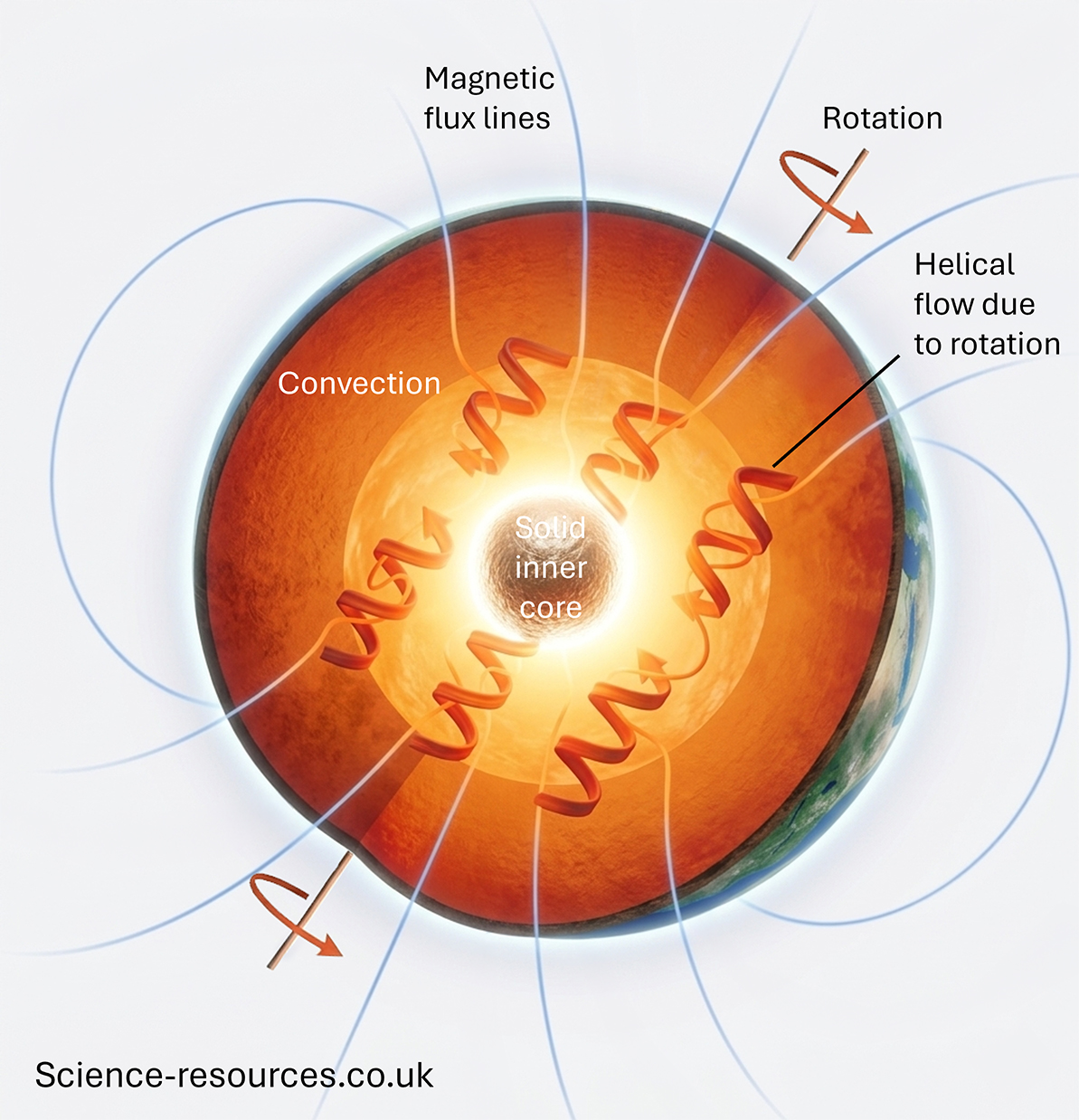
Earth's core contains liquid iron which moves around, due to the circular currents inside the core. Iron is magnetic so the liquid iron causes Earth to have a magnetic field.


A cut‑away diagram of Earth showing the geodynamo process inside the outer core. At the centre is a bright, glowing solid inner core, surrounded by a swirling, orange liquid outer core. Curved red arrows within the outer core represent convection currents of molten metal rising and sinking. Additional twisted, helical red arrows indicate how Earth’s rotation causes the convecting liquid to spiral. Blue curved lines around the outside of the planet represent magnetic flux lines looping from pole to pole. Labels identify key features, including “Convection,” “Helical flow due to rotation,” “Magnetic flux lines,” and “Solid inner core.” The outer edge shows a thin portion of Earth’s mantle and surface.

Earth’s Geodynamo: Convection, Rotation, and Magnetic Field Generation


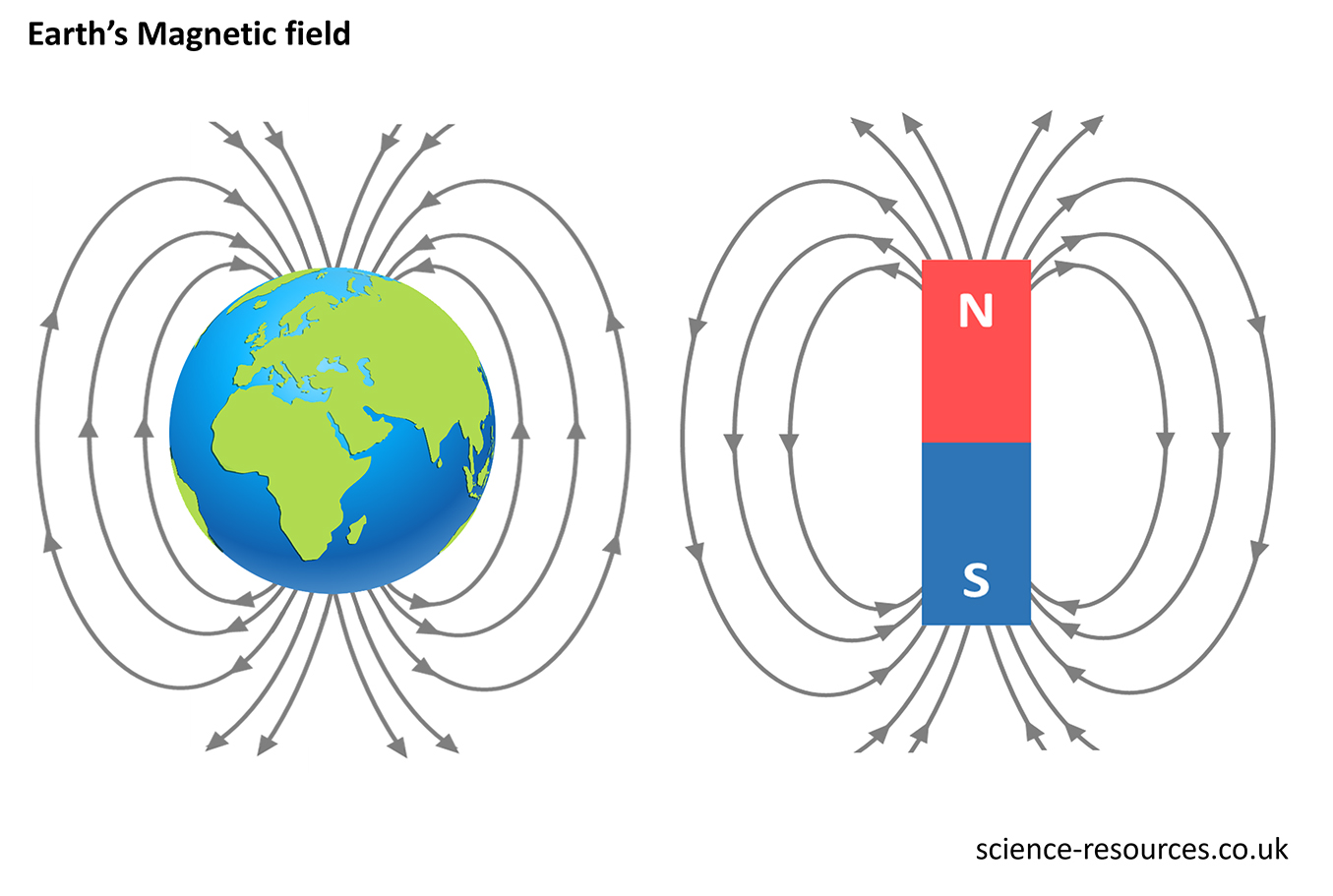
The Earth produces a magnetic field, just like a bar magnet, with the field lines being most concentrated at the poles.
 

The image you sent is a diagram showing Earth’s magnetic field. It compares Earth’s magnetic field to that of a bar magnet. Both have similar shapes and directions of their magnetic fields.


Compasses


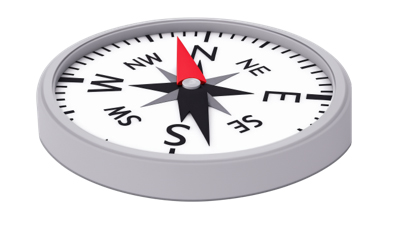
Earth’s magnetic field is useful for navigation. The needle of a compass is a small magnet that can rotate. It turns around until its own magnetic field lines up with the Earth’s magnetic field. This means it always points North.


Image of a compass with the red needle facing North.


We know that opposite poles attract. The north pole of the compass is attracted to Earth’s magnetic South pole. Earth’s magnetic south pole is located near its geographic North pole. As a result, the North pole of a compass will always point towards Earth’s geographic North pole.


Up next: What would Earth be like without its magnetic field?


🌍 Knowledge Check: Earth's Magnetic Field

Based on the lesson, test your understanding of how our planet acts as a magnet.

1. Which material in the Earth's core is responsible for its magnetic field?

2. How does the Earth's magnetic field behave?

3. A compass needle is actually a small:

4. In which direction do the Earth's magnetic field lines run?

5. True or False: The magnetic North Pole is in exactly the same place as the geographical North Pole.

Click to Reveal Answers
1. Iron (The core contains large amounts of iron).
2. Like a giant bar magnet (It behaves as if a bar magnet runs through the center).
3. Magnet (The compass needle is a small magnet that aligns with field lines).
4. South Pole to North Pole (Field lines flow from magnetic South to magnetic North).
5. False (The magnetic North Pole and geographical North Pole are in different locations).


Summary:


  • The Earth's core contains liquid iron which moves around.
  • Iron is magnetic so the liquid iron causes Earth to have a magnetic field.


© 2012 science-resources.co.uk. All rights reserved | Design by W3layouts