Generative AI Notification: Some elements of this image have been created or enhanced using AI technology. To find out how we create all our prehistoric animals, click here.
Last updated: 4th August 2025
Extinct Animals: Megalania
Discover the ancient "giant ripper lizard" of Australia—the largest land lizard to have ever existed, which hunted during the Ice Age.
Megalania (Giant Ancient Roamer)
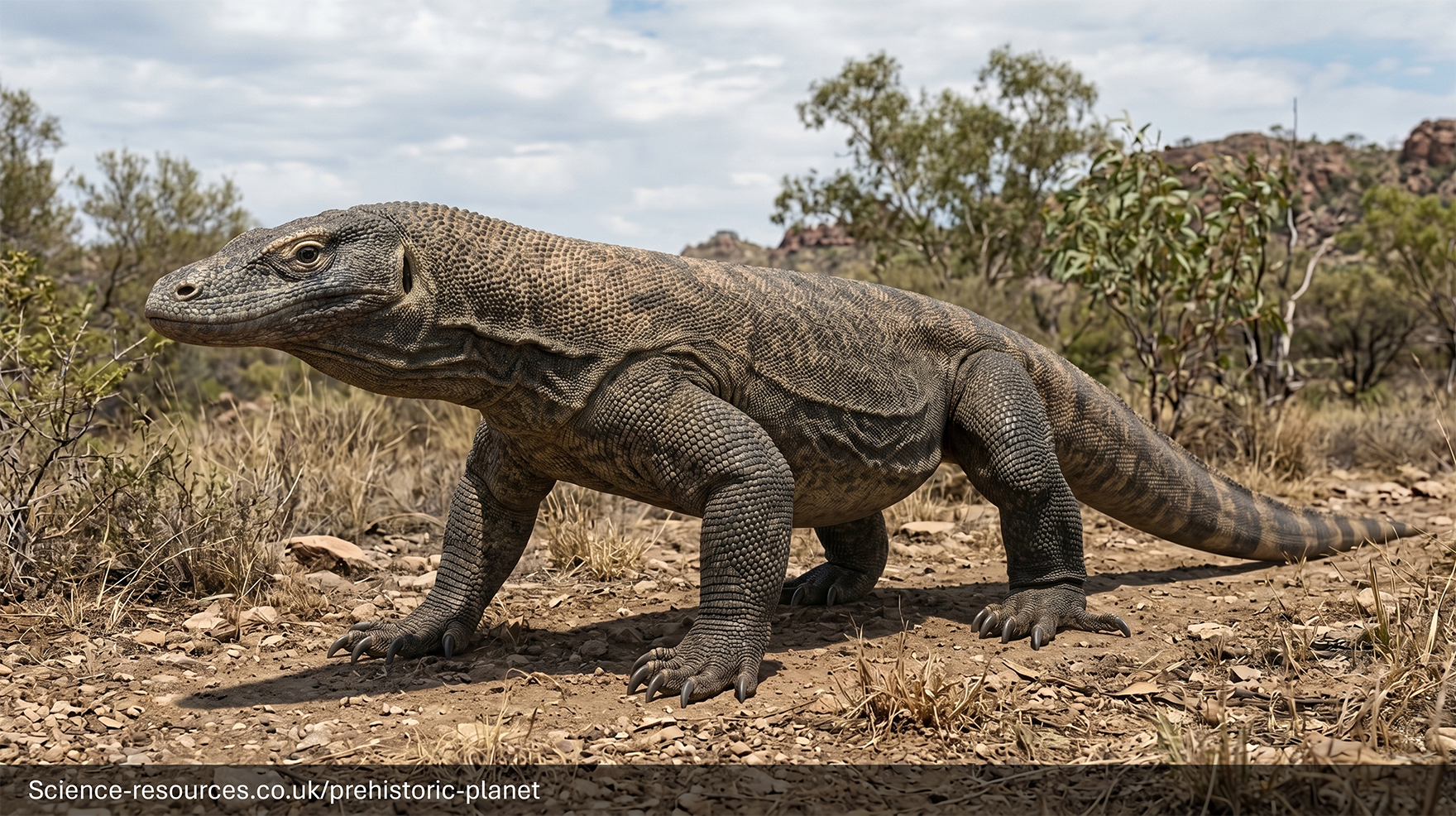 Megalania
What is Megalania?
Megalania was a truly monstrous reptile that lived in Australia thousands of years ago. It was a giant species of monitor lizard, making it a direct but much larger relative of today’s Komodo dragon and the Australian goanna. As the ultimate cold-blooded apex predator of its ecosystem, Megalania rules the ancient grasslands by ambushing large mammals and birds.
How big were Megalania?
Megalania was the biggest lizard known to science. While scientists debate its exact size because complete skeletons are rare, it is estimated to have grown between 5.5 to 7 metres long from its nose to its long tail. It could weigh up to 600 kilograms or more—making it roughly three to four times heavier than a modern Komodo dragon!
What did Megalania eat?
Megalania was an aggressive carnivore. It was easily large enough to hunt down Australia’s prehistoric giant animals (megafauna). Its favorite meals included the Diprotodon, giant flightless birds, and massive marsupials. It had a mouth packed with sharp, curved, serrated teeth that acted like steak knives to tear through tough hides.
Megalania appearance
- A long, heavily-armoured lizard body close to the ground, supported by four powerful legs.
- A massive, broad skull containing curved, backwards-pointing teeth with serrated edges.
- Tough skin covered in small, bony plates called osteoderms that acted like chainmail armor.
- A large, muscular tail and a long, forked tongue used to smell prey from miles away.
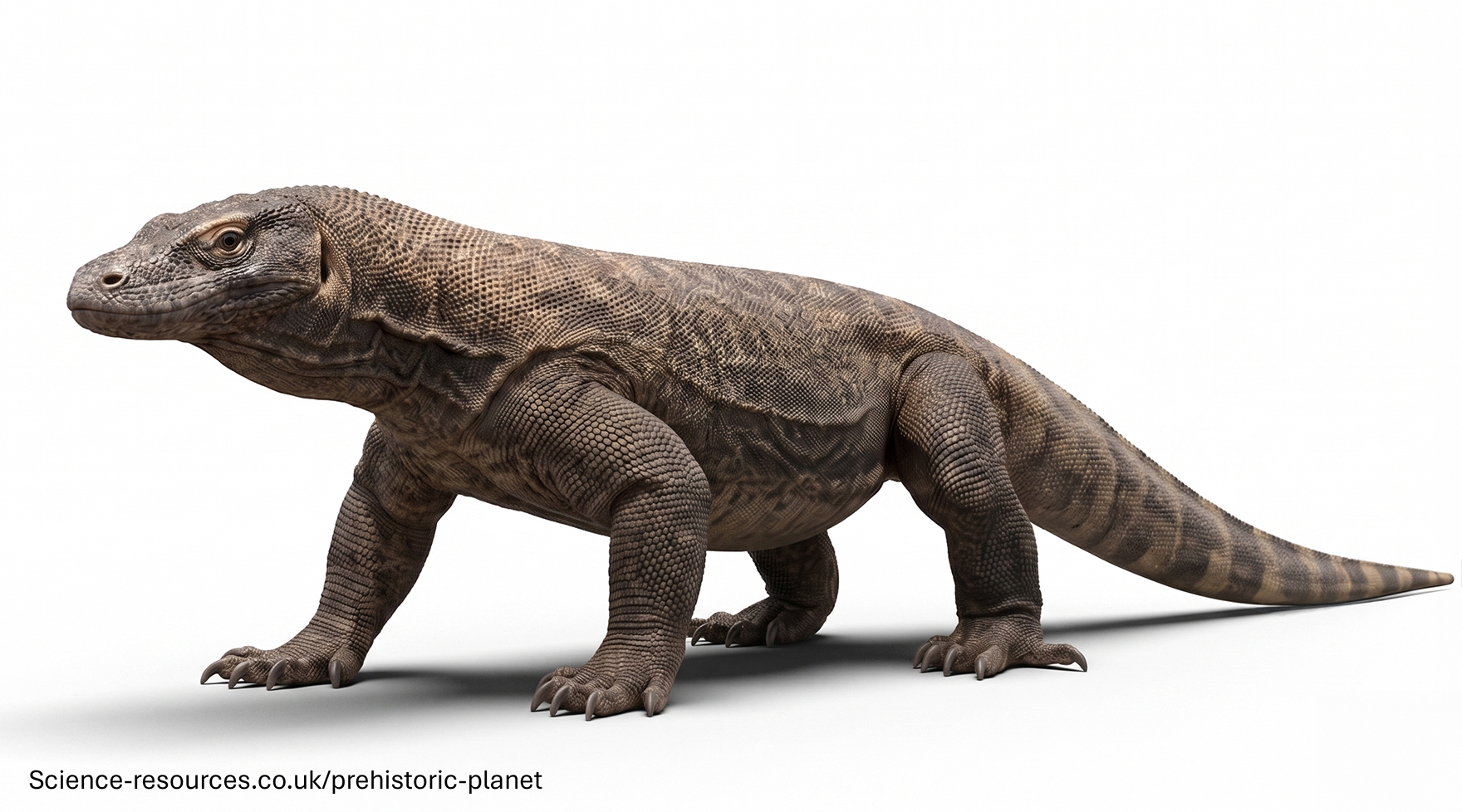
Where did Megalania live?
Fossils of Megalania have been discovered across eastern and southern Australia. They preferred open woodlands, dry shrublands, and river valleys where they could blend into the tall grasses and bush to wait quietly for passing prey animals.
When did Megalania live?
Megalania lived during the Pleistocene Epoch, appearing around 1.5 million years ago. They disappeared about 40,000 years ago. Just like Thylacoleo, they lived at the same time as the early Indigenous populations of Australia, who had to be very careful to avoid this giant reptile.
Interesting facts
- Its scientific name Varanus priscus translates to "ancient giant roamer," but its original name Megalania means "giant ripper lizard."
- Scientists believe Megalania may have been venomous! Like its living relative, the Komodo dragon, it likely had venom glands in its lower jaw to help weaken its prey.
- Because it was cold-blooded, it didn't need to eat as often as modern lions or tigers, but when it did eat, it could swallow massive chunks of meat whole.
- It belonged to the genus Varanus, meaning it is the closest cousin to the goanna lizards you can still see climbing trees in Australia today.
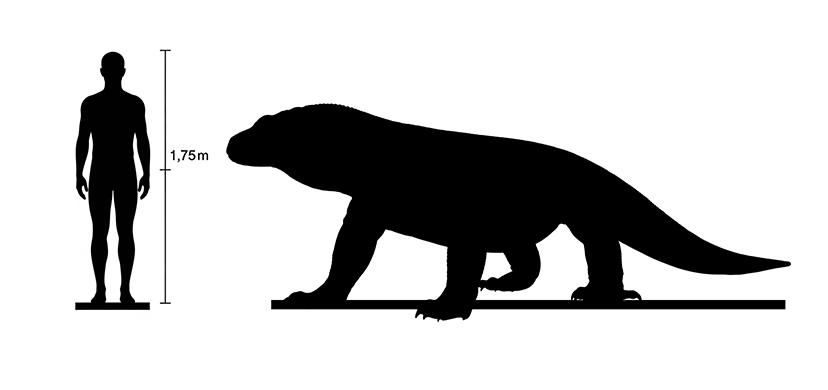
Megalania Facts
Pronounced: Meg-uh-LAY-nee-uh
Name Means: "Giant Ripper Lizard"
Length: Up to 5.5 to 7 metres (18 to 23 feet) long
Height: Around 1.2 metres (4 feet) tall at the hip
Weight: Up to 600 kilograms (1,320 pounds) or more
Diet: Carnivore (Meat-eater)
Time: Lived from about 1.5 million years ago to 40,000 years ago
Fossils Found: Australia (especially Queensland and New South Wales)
Which family of animals did Megalania belong to?
They belonged to the family Varanidae (monitor lizards). This is the exact same lizard family that modern monitor lizards, goannas, and Komodo dragons belong to today.
What other animals lived at the same time as Megalania?
They lived alongside giant short-faced kangaroos, the marsupial lion Thylacoleo, giant horned turtles (Meiolania), and early human hunters.
Megalania FAQ
Q1: What were Megalania?
A1. Megalania is an extinct reptile that holds the title for the largest land lizard to ever live. It looked like a gigantic goanna or Komodo dragon.
Q2. Was Megalania a dinosaur?
A2. No, Megalania was a true lizard, not a dinosaur. It lived during the Ice Age, millions of years after the dinosaurs died out.
Q3. How fast could Megalania run?
A3. Because of its heavy body and short legs, it wasn't built for long-distance running. However, like modern monitor lizards, it could likely sprint in fast, explosive bursts to ambush prey.
Q4. Did Megalania have venom?
A4. Highly likely! Modern research shows that monitor lizards have venom glands. A bite from Megalania would cause a severe drop in blood pressure, causing prey to faint.
Q5. How do scientists know how big it was?
A5. Scientists compare fossil vertebrae (backbones) and jaw bones to modern monitor lizards to calculate how long and heavy the complete animal would have been.
Q6. Did Megalania lay eggs?
A6. Yes. Just like modern monitor lizards, female Megalania would have laid soft-shelled eggs in hidden nests in the ground.
Q7. What was Megalania's skin like?
A7. It had rough, scaly skin. Inside the skin were thousands of tiny bones called osteoderms, which formed a built-in layer of armor plating to protect it from other predators.
Q8. Did early humans encounter Megalania?
A8. Yes. Aboriginal people arrived in Australia well before Megalania went extinct. Stories of giant, terrifying lizards in traditional folklore may be based on real encounters.
Q9. Why did Megalania go extinct?
A9. They disappeared around 40,000 years ago due to a changing climate that turned the land much drier, destroying the habitats of the large megafauna they relied on for food.
Q10. Where can I see Megalania fossils?
A10. Important fossil collections of Megalania teeth and bones are kept in Australian museums, including the Queensland Museum in Brisbane.
You may also be intrested in:
- Extinct Animals: A-Z
- Dinosaurs: A-Z
Tags: How big were Megalania, Megalania, where did Megalania live, how tall were Megalania, what does Megalania mean, Megalania facts
Previous: Mastodon
Up next: Megaloceros
© 2012 science-resources.co.uk. All rights reserved | Design by W3layouts
Extinct Animals: Megalania
Discover the ancient "giant ripper lizard" of Australia—the largest land lizard to have ever existed, which hunted during the Ice Age.
Megalania (Giant Ancient Roamer)
Megalania
What is Megalania?
Megalania was a truly monstrous reptile that lived in Australia thousands of years ago. It was a giant species of monitor lizard, making it a direct but much larger relative of today’s Komodo dragon and the Australian goanna. As the ultimate cold-blooded apex predator of its ecosystem, Megalania rules the ancient grasslands by ambushing large mammals and birds.
How big were Megalania?
Megalania was the biggest lizard known to science. While scientists debate its exact size because complete skeletons are rare, it is estimated to have grown between 5.5 to 7 metres long from its nose to its long tail. It could weigh up to 600 kilograms or more—making it roughly three to four times heavier than a modern Komodo dragon!
What did Megalania eat?
Megalania was an aggressive carnivore. It was easily large enough to hunt down Australia’s prehistoric giant animals (megafauna). Its favorite meals included the Diprotodon, giant flightless birds, and massive marsupials. It had a mouth packed with sharp, curved, serrated teeth that acted like steak knives to tear through tough hides.
Megalania appearance
- A long, heavily-armoured lizard body close to the ground, supported by four powerful legs.
- A massive, broad skull containing curved, backwards-pointing teeth with serrated edges.
- Tough skin covered in small, bony plates called osteoderms that acted like chainmail armor.
- A large, muscular tail and a long, forked tongue used to smell prey from miles away.
Where did Megalania live?
Fossils of Megalania have been discovered across eastern and southern Australia. They preferred open woodlands, dry shrublands, and river valleys where they could blend into the tall grasses and bush to wait quietly for passing prey animals.
When did Megalania live?
Megalania lived during the Pleistocene Epoch, appearing around 1.5 million years ago. They disappeared about 40,000 years ago. Just like Thylacoleo, they lived at the same time as the early Indigenous populations of Australia, who had to be very careful to avoid this giant reptile.
Interesting facts
- Its scientific name Varanus priscus translates to "ancient giant roamer," but its original name Megalania means "giant ripper lizard."
- Scientists believe Megalania may have been venomous! Like its living relative, the Komodo dragon, it likely had venom glands in its lower jaw to help weaken its prey.
- Because it was cold-blooded, it didn't need to eat as often as modern lions or tigers, but when it did eat, it could swallow massive chunks of meat whole.
- It belonged to the genus Varanus, meaning it is the closest cousin to the goanna lizards you can still see climbing trees in Australia today.
Megalania Facts
Pronounced: Meg-uh-LAY-nee-uh
Name Means: "Giant Ripper Lizard"
Length: Up to 5.5 to 7 metres (18 to 23 feet) long
Height: Around 1.2 metres (4 feet) tall at the hip
Weight: Up to 600 kilograms (1,320 pounds) or more
Diet: Carnivore (Meat-eater)
Time: Lived from about 1.5 million years ago to 40,000 years ago
Fossils Found: Australia (especially Queensland and New South Wales)
Which family of animals did Megalania belong to?
They belonged to the family Varanidae (monitor lizards). This is the exact same lizard family that modern monitor lizards, goannas, and Komodo dragons belong to today.
What other animals lived at the same time as Megalania?
They lived alongside giant short-faced kangaroos, the marsupial lion Thylacoleo, giant horned turtles (Meiolania), and early human hunters.
Megalania FAQ
Q1: What were Megalania?
A1. Megalania is an extinct reptile that holds the title for the largest land lizard to ever live. It looked like a gigantic goanna or Komodo dragon.
Q2. Was Megalania a dinosaur?
A2. No, Megalania was a true lizard, not a dinosaur. It lived during the Ice Age, millions of years after the dinosaurs died out.
Q3. How fast could Megalania run?
A3. Because of its heavy body and short legs, it wasn't built for long-distance running. However, like modern monitor lizards, it could likely sprint in fast, explosive bursts to ambush prey.
Q4. Did Megalania have venom?
A4. Highly likely! Modern research shows that monitor lizards have venom glands. A bite from Megalania would cause a severe drop in blood pressure, causing prey to faint.
Q5. How do scientists know how big it was?
A5. Scientists compare fossil vertebrae (backbones) and jaw bones to modern monitor lizards to calculate how long and heavy the complete animal would have been.
Q6. Did Megalania lay eggs?
A6. Yes. Just like modern monitor lizards, female Megalania would have laid soft-shelled eggs in hidden nests in the ground.
Q7. What was Megalania's skin like?
A7. It had rough, scaly skin. Inside the skin were thousands of tiny bones called osteoderms, which formed a built-in layer of armor plating to protect it from other predators.
Q8. Did early humans encounter Megalania?
A8. Yes. Aboriginal people arrived in Australia well before Megalania went extinct. Stories of giant, terrifying lizards in traditional folklore may be based on real encounters.
Q9. Why did Megalania go extinct?
A9. They disappeared around 40,000 years ago due to a changing climate that turned the land much drier, destroying the habitats of the large megafauna they relied on for food.
Q10. Where can I see Megalania fossils?
A10. Important fossil collections of Megalania teeth and bones are kept in Australian museums, including the Queensland Museum in Brisbane.
Tags: How big were Megalania, Megalania, where did Megalania live, how tall were Megalania, what does Megalania mean, Megalania facts
Previous: Mastodon
Up next: Megaloceros
© 2012 science-resources.co.uk. All rights reserved | Design by W3layouts