Generative AI Notification: Some elements of this image have been created or enhanced using AI technology. To find out how we create all our prehistoric animals, click here.
Last updated: 4th August 2025
Extinct Animals: Thylacoleo
Discover the ancient "marsupial lion" of Australia with bolt-cutter teeth and giant retractable thumb claws that lived during the Ice Age.
Thylacoleo (Pouched Lion)
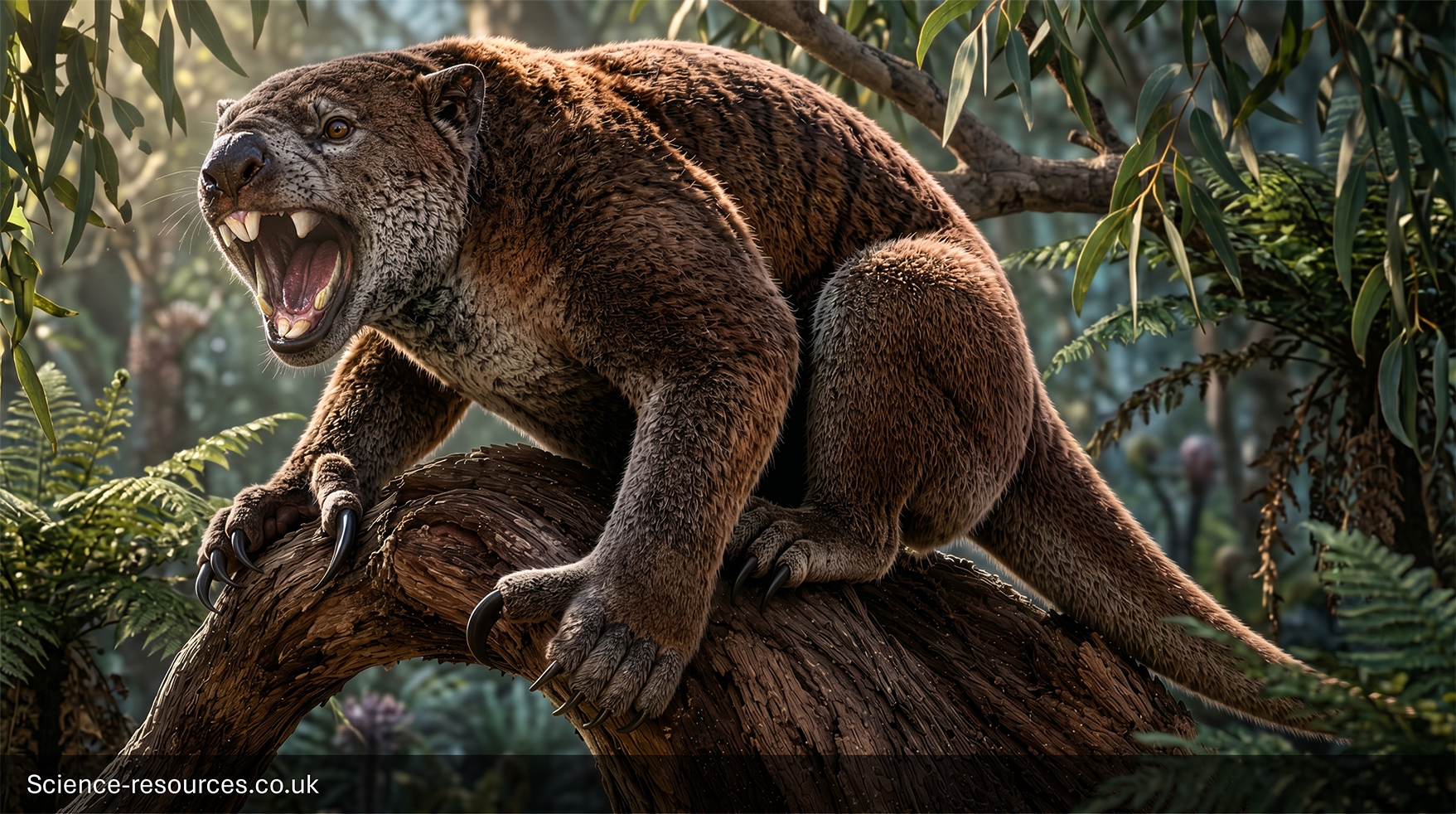 Thylacoleo
What is Thylacoleo?
Thylacoleo, commonly known as the marsupial lion, was the largest meat-eating mammal ever to live in Australia. Despite its common name, it was not a true cat. It was actually a marsupial, meaning mothers carried their tiny babies in a pouch, just like modern kangaroos, koalas, and wombats do today! It was an apex predator (an animal at the top of the food chain) with a bite force stronger than any living mammal of its size.
How big were Thylacoleo?
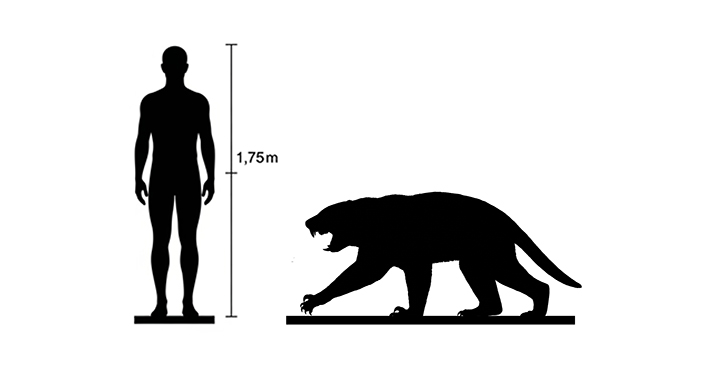
Thylacoleo was a heavily-built animal with a stocky, muscular frame. It grew to be about 75 centimetres tall at the shoulder and around 1.5 metres long from its nose to the tip of its tail. It weighed between 100 and 130 kilograms, making it roughly the same size as a modern female African lion or a very large jaguar.
What did Thylacoleo eat?
Thylacoleo was a strict carnivore (meat-eater). It hunted large prehistoric animals that roamed the Australian bush, including giant kangaroos and Diprotodon (a giant wombat-like creature the size of a car). Instead of long canine fangs like a lion, it used large, sharp front teeth to catch prey, and massive, blade-like cheek teeth that worked exactly like bolt-cutters to slice easily through flesh and bone.
Thylacoleo appearance
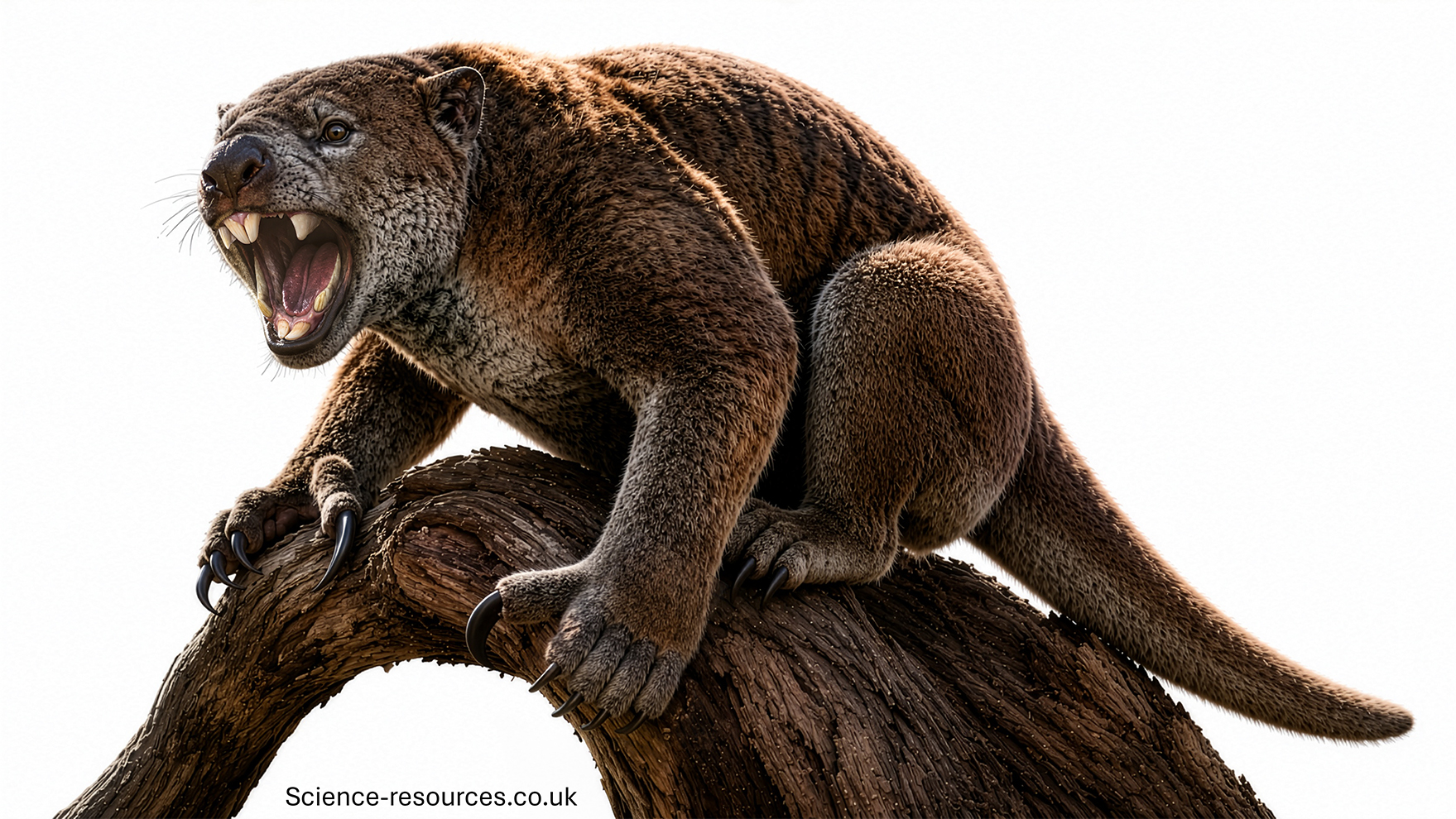
- A low, stocky body with incredibly powerful shoulders and front legs for wrestling prey.
- Large, strong jaws built for crushing and holding on to struggling animals.
- Giant, curved "thumb" claws that could slide in and out (retractable), used to grapple with prey and climb trees.
- A thick, heavy tail that helped it balance when standing up on its hind legs.
Where did Thylacoleo live?
Fossils of Thylacoleo have been found all across Australia. They lived in a wide variety of habitats, including open woodlands, forest borders, and shrubby grasslands. Scientists have also found many of their bones inside deep caves, which suggests they may have used caves as dens to raise their young or to ambush passing prey.
When did Thylacoleo live?
Thylacoleo lived during the Pleistocene Epoch, appearing about 2 million years ago. They went extinct around 40,000 years ago. This means they lived at the exact same time as the first Indigenous Australians, who likely encountered them in the wilderness.
Interesting facts
- Its closest living relatives today are actually herbivores: the wombat and the koala! Over millions of years, its ancestors switched from eating plants to eating meat.
- Scientists calculate that pound-for-pound, Thylacoleo had the strongest bite of any mammal predator to ever exist—a 100kg Thylacoleo had a bite as powerful as a 250kg African lion!
- Its hind paws had "opposable" toes (like human thumbs), which helped it grip trunks and branches, making it an excellent tree climber.
- Ancient Aboriginal rock art found in Western Australia features paintings that closely match the striped back and shape of Thylacoleo, showing humans saw them alive.
Thylacoleo Facts
Pronounced: THY-lah-coh-lee-oh
Name Means: "Pouched Lion"
Length: Around 1.5 metres (5 feet) long
Height: Around 75 centimetres (2.5 feet) at the shoulder
Weight: Between 100 to 130 kilograms (220 to 285 pounds)
Diet: Carnivore (Meat-eater)
Time: Lived from about 2 million years ago to 40,000 years ago
Fossils Found: Australia (including the Nullarbor Plain and Queensland)
Which family of animals did Thylacoleo belong to?
They belonged to the extinct family Thylacoleonidae (the marsupial lions). They were members of the Diprotodontia order, a large group of marsupials that includes kangaroos and wombats.
What other animals lived at the same time as Thylacoleo?
They shared Australia with a variety of massive "Megafauna," including Diprotodon, giant short-faced kangaroos, Megalania (a venomous goanna lizard longer than a car), and early human populations.
Thylacoleo FAQ
Q1: What were Thylacoleo?
A1. Thylacoleo is an extinct meat-eating mammal from Australia. It is called the "marsupial lion" because it was a fierce predator that carried its babies in a pouch.
Q2. Were Thylacoleo related to African lions?
A2. No. True lions are placental mammals, while Thylacoleo was a marsupial. They looked similar only because they both evolved to do the same job of hunting large prey.
Q3. How did Thylacoleo hunt?
A3. Scientists think Thylacoleo ambushed its prey from trees or rocks, dropping down to grapple with its powerful front legs and giant thumb claws before delivering a fatal bite.
Q4. Did Thylacoleo have sharp fangs?
A4. Surprisingly, no! It didn't have large canine teeth. Instead, it used giant, specially modified incisors (front teeth) and scissor-like cheek teeth to hunt.
Q5. Where are Thylacoleo fossils found?
A5. Their fossils are found throughout mainland Australia, especially in limestone caves where their skeletons were perfectly preserved over thousands of years.
Q6. Could Thylacoleo climb trees?
A6. Yes! Their powerful arms, flexible ankles, and large retractable claws made them excellent climbers, similar to modern leopards.
Q7. What color was Thylacoleo?
A7. We cannot know for certain from fossils, but ancient Aboriginal cave art portrays them with distinct stripes along their back, which would have helped them hide in the bush.
Q8. Did humans ever see a Thylacoleo?
A8. Yes. First Nations Australians arrived in Australia around 65,000 years ago, meaning they lived alongside Thylacoleo for thousands of years before the animal went extinct.
Q9. Why did Thylacoleo go extinct?
A9. They likely went extinct due to a changing climate that dried out the land, reducing the forests they relied on to hunt, alongside changes to the environment caused by human activity.
Q10. How do scientists know it had a strong bite?
A10. Paleontologists use computer models to test the skull structure and muscle attachments of the fossilized jaws, revealing how much force the jaw could produce.
You may also be intrested in:
- Extinct Animals: A-Z
- Dinosaurs: A-Z
Tags: How big were Thylacoleo, Thylacoleo, where did Thylacoleo live, how tall were Thylacoleo, what does Thylacoleo mean, Thylacoleo facts
Previous: Stegodon
Up next: Titanoboa
© 2012 science-resources.co.uk. All rights reserved | Design by W3layouts
Extinct Animals: Thylacoleo
Discover the ancient "marsupial lion" of Australia with bolt-cutter teeth and giant retractable thumb claws that lived during the Ice Age.
Thylacoleo (Pouched Lion)
Thylacoleo
What is Thylacoleo?
Thylacoleo, commonly known as the marsupial lion, was the largest meat-eating mammal ever to live in Australia. Despite its common name, it was not a true cat. It was actually a marsupial, meaning mothers carried their tiny babies in a pouch, just like modern kangaroos, koalas, and wombats do today! It was an apex predator (an animal at the top of the food chain) with a bite force stronger than any living mammal of its size.
How big were Thylacoleo?
Thylacoleo was a heavily-built animal with a stocky, muscular frame. It grew to be about 75 centimetres tall at the shoulder and around 1.5 metres long from its nose to the tip of its tail. It weighed between 100 and 130 kilograms, making it roughly the same size as a modern female African lion or a very large jaguar.
What did Thylacoleo eat?
Thylacoleo was a strict carnivore (meat-eater). It hunted large prehistoric animals that roamed the Australian bush, including giant kangaroos and Diprotodon (a giant wombat-like creature the size of a car). Instead of long canine fangs like a lion, it used large, sharp front teeth to catch prey, and massive, blade-like cheek teeth that worked exactly like bolt-cutters to slice easily through flesh and bone.
Thylacoleo appearance
- A low, stocky body with incredibly powerful shoulders and front legs for wrestling prey.
- Large, strong jaws built for crushing and holding on to struggling animals.
- Giant, curved "thumb" claws that could slide in and out (retractable), used to grapple with prey and climb trees.
- A thick, heavy tail that helped it balance when standing up on its hind legs.
Where did Thylacoleo live?
Fossils of Thylacoleo have been found all across Australia. They lived in a wide variety of habitats, including open woodlands, forest borders, and shrubby grasslands. Scientists have also found many of their bones inside deep caves, which suggests they may have used caves as dens to raise their young or to ambush passing prey.
When did Thylacoleo live?
Thylacoleo lived during the Pleistocene Epoch, appearing about 2 million years ago. They went extinct around 40,000 years ago. This means they lived at the exact same time as the first Indigenous Australians, who likely encountered them in the wilderness.
Interesting facts
- Its closest living relatives today are actually herbivores: the wombat and the koala! Over millions of years, its ancestors switched from eating plants to eating meat.
- Scientists calculate that pound-for-pound, Thylacoleo had the strongest bite of any mammal predator to ever exist—a 100kg Thylacoleo had a bite as powerful as a 250kg African lion!
- Its hind paws had "opposable" toes (like human thumbs), which helped it grip trunks and branches, making it an excellent tree climber.
- Ancient Aboriginal rock art found in Western Australia features paintings that closely match the striped back and shape of Thylacoleo, showing humans saw them alive.
Thylacoleo Facts
Pronounced: THY-lah-coh-lee-oh
Name Means: "Pouched Lion"
Length: Around 1.5 metres (5 feet) long
Height: Around 75 centimetres (2.5 feet) at the shoulder
Weight: Between 100 to 130 kilograms (220 to 285 pounds)
Diet: Carnivore (Meat-eater)
Time: Lived from about 2 million years ago to 40,000 years ago
Fossils Found: Australia (including the Nullarbor Plain and Queensland)
Which family of animals did Thylacoleo belong to?
They belonged to the extinct family Thylacoleonidae (the marsupial lions). They were members of the Diprotodontia order, a large group of marsupials that includes kangaroos and wombats.
What other animals lived at the same time as Thylacoleo?
They shared Australia with a variety of massive "Megafauna," including Diprotodon, giant short-faced kangaroos, Megalania (a venomous goanna lizard longer than a car), and early human populations.
Thylacoleo FAQ
Q1: What were Thylacoleo?
A1. Thylacoleo is an extinct meat-eating mammal from Australia. It is called the "marsupial lion" because it was a fierce predator that carried its babies in a pouch.
Q2. Were Thylacoleo related to African lions?
A2. No. True lions are placental mammals, while Thylacoleo was a marsupial. They looked similar only because they both evolved to do the same job of hunting large prey.
Q3. How did Thylacoleo hunt?
A3. Scientists think Thylacoleo ambushed its prey from trees or rocks, dropping down to grapple with its powerful front legs and giant thumb claws before delivering a fatal bite.
Q4. Did Thylacoleo have sharp fangs?
A4. Surprisingly, no! It didn't have large canine teeth. Instead, it used giant, specially modified incisors (front teeth) and scissor-like cheek teeth to hunt.
Q5. Where are Thylacoleo fossils found?
A5. Their fossils are found throughout mainland Australia, especially in limestone caves where their skeletons were perfectly preserved over thousands of years.
Q6. Could Thylacoleo climb trees?
A6. Yes! Their powerful arms, flexible ankles, and large retractable claws made them excellent climbers, similar to modern leopards.
Q7. What color was Thylacoleo?
A7. We cannot know for certain from fossils, but ancient Aboriginal cave art portrays them with distinct stripes along their back, which would have helped them hide in the bush.
Q8. Did humans ever see a Thylacoleo?
A8. Yes. First Nations Australians arrived in Australia around 65,000 years ago, meaning they lived alongside Thylacoleo for thousands of years before the animal went extinct.
Q9. Why did Thylacoleo go extinct?
A9. They likely went extinct due to a changing climate that dried out the land, reducing the forests they relied on to hunt, alongside changes to the environment caused by human activity.
Q10. How do scientists know it had a strong bite?
A10. Paleontologists use computer models to test the skull structure and muscle attachments of the fossilized jaws, revealing how much force the jaw could produce.
Tags: How big were Thylacoleo, Thylacoleo, where did Thylacoleo live, how tall were Thylacoleo, what does Thylacoleo mean, Thylacoleo facts
Previous: Stegodon
Up next: Titanoboa
© 2012 science-resources.co.uk. All rights reserved | Design by W3layouts