Last updated: 24th January 2026
Before Dinosaurs: Amphibians & Reptiles
Early Amphibians and Reptiles – Pioneers of Life on Land
Long before dinosaurs appeared, Earth was home to an incredible variety of early amphibians and reptiles. These animals helped shape the transition from water to land, developing new ways of moving, breathing and surviving in changing environments. Some were lumbering plant‑eaters, others were agile predators, and a few looked so strange that scientists are still debating exactly how they lived.
Why Early Amphibians and Reptiles Matter
These unusual creatures helped shape the evolution of modern vertebrates. Amphibians like Ichthyostega and Diplocaulus show the early stages of life moving from water to land, while reptiles such as Scutosaurus and Tanystropheus represent experiments in new body forms and behaviours. Together, they reveal how adaptable early life on land truly was and how these pioneers paved the way for the rise of dinosaurs, mammals and eventually humans.
Quick links
Meet the Early Amphibians and Reptiles
Here are some of the most fascinating early amphibians and reptiles from this early era:
Ichthyostega: One of the First Land‑Walking Tetrapods
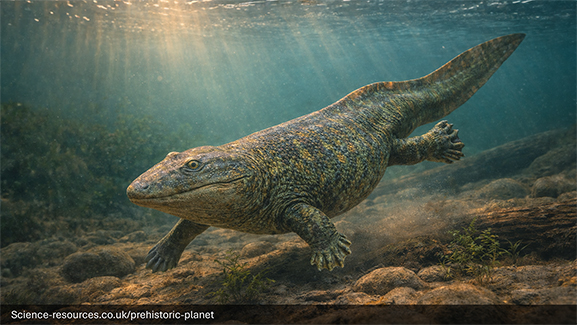
Ichthyostega lived during the late Devonian period and is one of the earliest animals known to have true limbs. It still had strong ties to the water, with a fish‑like tail and ribs that helped it breathe air. Ichthyostega didn’t walk like modern amphibians, instead, it likely used its sturdy front limbs to haul itself across muddy banks, making it a key figure in the story of life’s move onto land.
Diplocaulus: The Boomerang‑Headed Amphibian
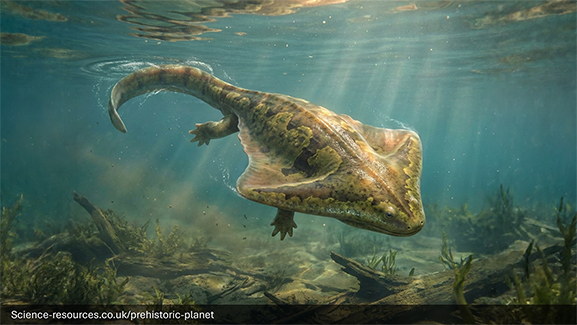
Diplocaulus was a small Permian amphibian famous for its boomerang‑shaped head. These long, curved skull “horns” may have helped it glide through water or make it harder for predators to swallow. Diplocaulus lived in rivers and ponds, feeding on small fish and insects. Its unusual shape makes it one of the most recognisable early amphibians.

Mesosaurus was a small prehistoric reptile that lived about 280 million years ago, long before dinosaurs, during the early Permian period.
Scutosaurus: The Armoured Plant-Eater
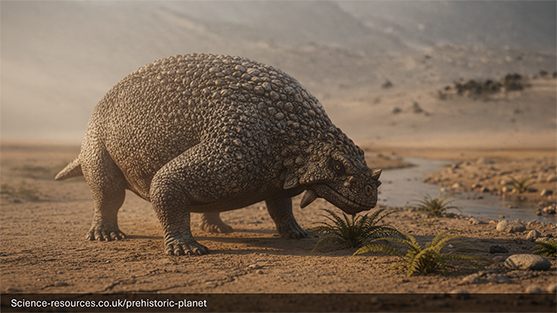
Scutosaurus was a large reptile from the late Permian, covered in thick bony plates that protected it from predators. It had a wide, heavy body and strong legs to support its weight as it moved across dry landscapes. As a herbivore, Scutosaurus fed on tough, low-growing plants and its armour likely helped it survive attacks from powerful predators like Inostrancevia.
Tanystropheus: The Reptile With the Super‑Long Neck
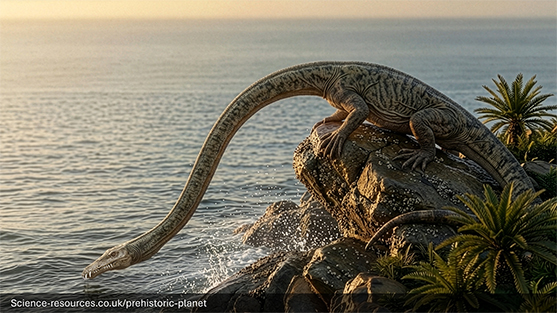
Tanystropheus had one of the most extraordinary body plans of any prehistoric reptile. Its neck was three times as long as its body, made up of extremely elongated vertebrae. Scientists think it lived near coastlines, using its long neck to catch fish while keeping most of its body underwater. Despite its strange proportions, Tanystropheus was a successful and widespread reptile during the Triassic period.
You may also be intrested in:
- Extinct Animals: A-Z
- Dinosaurs: A-Z
Tags: Amphibians and reptiles, prehistoric amphibians, prehistoric reptiles, early tetrapods, Ichthyostega, Hylonomus, before dinosaurs, Palaeozoic Era.
© 2012 science-resources.co.uk. All rights reserved | Design by W3layouts
Before Dinosaurs: Amphibians & Reptiles
Early Amphibians and Reptiles – Pioneers of Life on Land
Long before dinosaurs appeared, Earth was home to an incredible variety of early amphibians and reptiles. These animals helped shape the transition from water to land, developing new ways of moving, breathing and surviving in changing environments. Some were lumbering plant‑eaters, others were agile predators, and a few looked so strange that scientists are still debating exactly how they lived.
Why Early Amphibians and Reptiles Matter
These unusual creatures helped shape the evolution of modern vertebrates. Amphibians like Ichthyostega and Diplocaulus show the early stages of life moving from water to land, while reptiles such as Scutosaurus and Tanystropheus represent experiments in new body forms and behaviours. Together, they reveal how adaptable early life on land truly was and how these pioneers paved the way for the rise of dinosaurs, mammals and eventually humans.
Quick links
Meet the Early Amphibians and Reptiles
Here are some of the most fascinating early amphibians and reptiles from this early era:
Ichthyostega: One of the First Land‑Walking Tetrapods
Ichthyostega lived during the late Devonian period and is one of the earliest animals known to have true limbs. It still had strong ties to the water, with a fish‑like tail and ribs that helped it breathe air. Ichthyostega didn’t walk like modern amphibians, instead, it likely used its sturdy front limbs to haul itself across muddy banks, making it a key figure in the story of life’s move onto land.
Diplocaulus: The Boomerang‑Headed Amphibian
Diplocaulus was a small Permian amphibian famous for its boomerang‑shaped head. These long, curved skull “horns” may have helped it glide through water or make it harder for predators to swallow. Diplocaulus lived in rivers and ponds, feeding on small fish and insects. Its unusual shape makes it one of the most recognisable early amphibians.
Mesosaurus was a small prehistoric reptile that lived about 280 million years ago, long before dinosaurs, during the early Permian period.
Scutosaurus: The Armoured Plant-Eater
Scutosaurus was a large reptile from the late Permian, covered in thick bony plates that protected it from predators. It had a wide, heavy body and strong legs to support its weight as it moved across dry landscapes. As a herbivore, Scutosaurus fed on tough, low-growing plants and its armour likely helped it survive attacks from powerful predators like Inostrancevia.
Tanystropheus: The Reptile With the Super‑Long Neck
Tanystropheus had one of the most extraordinary body plans of any prehistoric reptile. Its neck was three times as long as its body, made up of extremely elongated vertebrae. Scientists think it lived near coastlines, using its long neck to catch fish while keeping most of its body underwater. Despite its strange proportions, Tanystropheus was a successful and widespread reptile during the Triassic period.
Tags: Amphibians and reptiles, prehistoric amphibians, prehistoric reptiles, early tetrapods, Ichthyostega, Hylonomus, before dinosaurs, Palaeozoic Era.
© 2012 science-resources.co.uk. All rights reserved | Design by W3layouts