Last updated: 24th January 2026
Before Dinosaurs: Triassic Period
Life During the Triassic Period
The Triassic period (around 252–201 million years ago) marks the start of the Mesozoic Era, often called the Age of Reptiles. It began just after the largest mass extinction in Earth’s history, when most species had disappeared. At first, life was slow to recover, but over millions of years, the Triassic became a time of incredible evolutionary change.
During the Triassic, the supercontinent Pangaea still existed, creating huge stretches of dry land and extreme climates. Deserts were common, but along coastlines and rivers, life began to diversify again. Early reptiles took advantage of the empty ecosystems, evolving into many new forms.
One of the biggest developments was the rise of the first dinosaurs. These early dinosaurs were generally small and fast, not yet the giant species we usually imagine. Alongside them lived pseudosuchians, the ancestors of modern crocodiles, many of which were powerful predators.
Another important event was the appearance of the first mammals. These early mammals were small, shrew‑like creatures that mostly lived in the shadows of larger reptiles, but they represented a crucial branch of life that would later flourish.
In the oceans, large marine reptiles such as ichthyosaurs and nothosaurs took over as top predators, while ammonites and corals began to recover and thrive once more.
The Triassic period ended with another extinction event, which cleared the way for dinosaurs to become the dominant land animals in the Jurassic. Despite its dramatic beginning and end, the Triassic was a vital period that set the stage for the world of dinosaurs, and for the rise of modern animals.
Quick links
Triassic Period (252–201 Ma)
Key features:
Recovery from the Great Dying; early reptiles diversify; dinosaurs appear at the end.
- Tanystropheus: Middle Triassic marine reptile with extremely elongated neck.
- Coelacanth: Survives the end Permian extinction into Triassic seas.
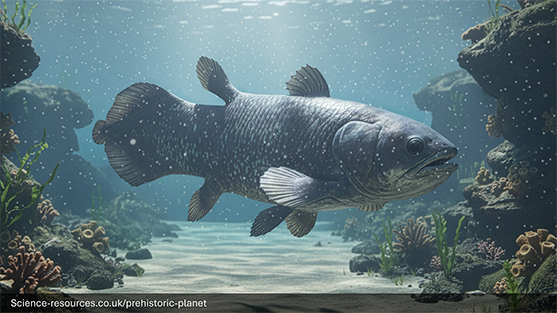
Coelacanths are ancient lobe‑finned fish that first appeared hundreds of millions of years ago. Thought extinct until the 20th century, they possess limb‑like fins and a distinctive tail, offering insights into early vertebrate evolution.
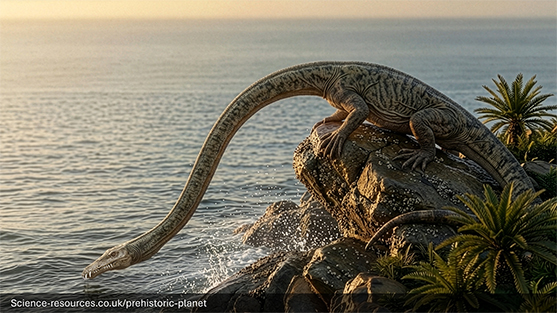
Tanystropheus was a Triassic reptile known for its impossibly long neck—longer than its body and tail combined. It likely used this extended reach to catch fish and squid from the shoreline while keeping its body on land.
You may also be intrested in:
- Extinct Animals: A-Z
- Dinosaurs: A-Z
Tags: Triassic Period, first dinosaurs, early reptiles, Pangaea, prehistoric life, Mesozoic Era.
© 2012 science-resources.co.uk. All rights reserved | Design by W3layouts
Before Dinosaurs: Triassic Period
Life During the Triassic Period
The Triassic period (around 252–201 million years ago) marks the start of the Mesozoic Era, often called the Age of Reptiles. It began just after the largest mass extinction in Earth’s history, when most species had disappeared. At first, life was slow to recover, but over millions of years, the Triassic became a time of incredible evolutionary change.
During the Triassic, the supercontinent Pangaea still existed, creating huge stretches of dry land and extreme climates. Deserts were common, but along coastlines and rivers, life began to diversify again. Early reptiles took advantage of the empty ecosystems, evolving into many new forms.
One of the biggest developments was the rise of the first dinosaurs. These early dinosaurs were generally small and fast, not yet the giant species we usually imagine. Alongside them lived pseudosuchians, the ancestors of modern crocodiles, many of which were powerful predators.
Another important event was the appearance of the first mammals. These early mammals were small, shrew‑like creatures that mostly lived in the shadows of larger reptiles, but they represented a crucial branch of life that would later flourish.
In the oceans, large marine reptiles such as ichthyosaurs and nothosaurs took over as top predators, while ammonites and corals began to recover and thrive once more.
The Triassic period ended with another extinction event, which cleared the way for dinosaurs to become the dominant land animals in the Jurassic. Despite its dramatic beginning and end, the Triassic was a vital period that set the stage for the world of dinosaurs, and for the rise of modern animals.
Quick links
Triassic Period (252–201 Ma)
Key features:
Recovery from the Great Dying; early reptiles diversify; dinosaurs appear at the end.
- Tanystropheus: Middle Triassic marine reptile with extremely elongated neck.
- Coelacanth: Survives the end Permian extinction into Triassic seas.
Coelacanths are ancient lobe‑finned fish that first appeared hundreds of millions of years ago. Thought extinct until the 20th century, they possess limb‑like fins and a distinctive tail, offering insights into early vertebrate evolution.
Tanystropheus was a Triassic reptile known for its impossibly long neck—longer than its body and tail combined. It likely used this extended reach to catch fish and squid from the shoreline while keeping its body on land.
Tags: Triassic Period, first dinosaurs, early reptiles, Pangaea, prehistoric life, Mesozoic Era.
© 2012 science-resources.co.uk. All rights reserved | Design by W3layouts