Last updated: 24th January 2026
Before Dinosaurs: Ordovician Period
Life During the Ordovician Period
After the burst of new life in the Cambrian period, the Ordovician period (around 485–443 million years ago) saw Earth’s oceans become even richer and more varied. Although life still hadn’t made it onto land, the seas were full of activity, with ecosystems becoming more complex than ever before.
During the Ordovician, many groups of animals expanded and diversified. Trilobites, which were already common, shared the seas with new types of brachiopods, molluscs, and the early relatives of starfish and sea urchins. Coral reefs also began to grow, creating underwater habitats buzzing with life.
Some of the most impressive creatures of the Ordovician were the orthocones, straight‑shelled relatives of modern squids and octopuses. Some of these could grow several metres long, making them some of the top predators in the ocean.
But the Ordovician wasn’t just a time of growth. Toward its end, Earth experienced one of the first major mass extinctions, caused by dramatic changes in climate and sea levels. This event wiped out many species, but it also opened the door for new forms of life in later periods.
Exploring the Ordovician helps scientists understand how early marine ecosystems developed and how life adapts to major changes in Earth’s environment.
Quick links
Ordovician Period (485–444 Ma)
Key features:
Great Ordovician Biodiversification Event; expansion of marine life.
- Trilobites: Still abundant and diverse.
- Endoceras: One of the largest predators of its time.
- Early eurypterids (sea scorpions)
- Earliest coelacanth.
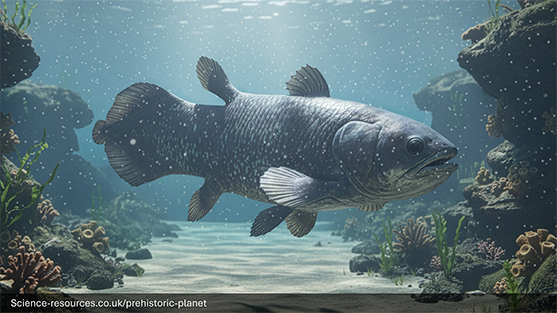
Coelacanths are ancient lobe‑finned fish that first appeared hundreds of millions of years ago. Thought extinct until the 20th century, they possess limb‑like fins and a distinctive tail, offering insights into early vertebrate evolution.
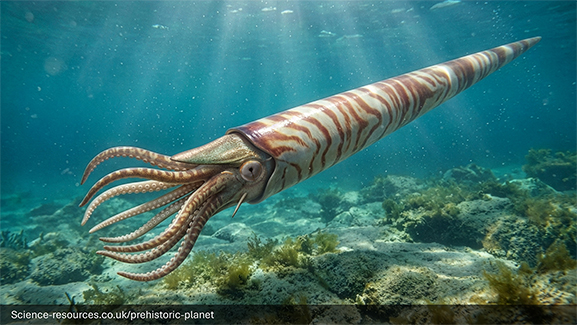
Endoceras was a giant Ordovician cephalopod with a long, straight shell that made it one of the top predators of its time. Using jet propulsion and sharp beak-like jaws, it hunted trilobites and other ancient sea creatures in the deep oceans.
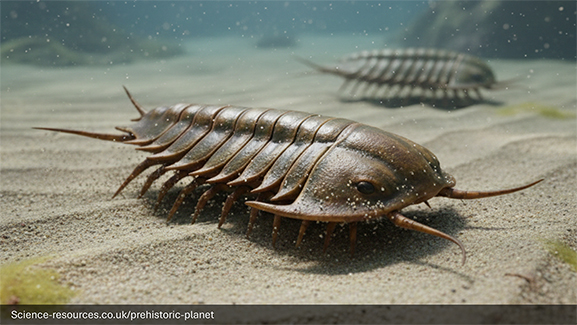
Trilobite was a hard-shelled arthropod that lived long before dinosaurs, known for its segmented body and compound eyes. It crawled along the seafloor of ancient oceans, feeding on detritus and small prey, and became one of the most diverse and widespread animals of the Paleozoic.
You may also be intrested in:
- Extinct Animals: A-Z
- Dinosaurs: A-Z
Tags: Ordovician Period, Ordovician life, prehistoric oceans, early marine animals, trilobites, first fish, before dinosaurs, Palaeozoic Era
© 2012 science-resources.co.uk. All rights reserved | Design by W3layouts
Before Dinosaurs: Ordovician Period
Life During the Ordovician Period
After the burst of new life in the Cambrian period, the Ordovician period (around 485–443 million years ago) saw Earth’s oceans become even richer and more varied. Although life still hadn’t made it onto land, the seas were full of activity, with ecosystems becoming more complex than ever before.
During the Ordovician, many groups of animals expanded and diversified. Trilobites, which were already common, shared the seas with new types of brachiopods, molluscs, and the early relatives of starfish and sea urchins. Coral reefs also began to grow, creating underwater habitats buzzing with life.
Some of the most impressive creatures of the Ordovician were the orthocones, straight‑shelled relatives of modern squids and octopuses. Some of these could grow several metres long, making them some of the top predators in the ocean.
But the Ordovician wasn’t just a time of growth. Toward its end, Earth experienced one of the first major mass extinctions, caused by dramatic changes in climate and sea levels. This event wiped out many species, but it also opened the door for new forms of life in later periods.
Exploring the Ordovician helps scientists understand how early marine ecosystems developed and how life adapts to major changes in Earth’s environment.
Quick links
Ordovician Period (485–444 Ma)
Key features:
Great Ordovician Biodiversification Event; expansion of marine life.
- Trilobites: Still abundant and diverse.
- Endoceras: One of the largest predators of its time.
- Early eurypterids (sea scorpions)
- Earliest coelacanth.
Coelacanths are ancient lobe‑finned fish that first appeared hundreds of millions of years ago. Thought extinct until the 20th century, they possess limb‑like fins and a distinctive tail, offering insights into early vertebrate evolution.
Endoceras was a giant Ordovician cephalopod with a long, straight shell that made it one of the top predators of its time. Using jet propulsion and sharp beak-like jaws, it hunted trilobites and other ancient sea creatures in the deep oceans.
Trilobite was a hard-shelled arthropod that lived long before dinosaurs, known for its segmented body and compound eyes. It crawled along the seafloor of ancient oceans, feeding on detritus and small prey, and became one of the most diverse and widespread animals of the Paleozoic.
You may also be intrested in:
- Extinct Animals: A-Z
- Dinosaurs: A-Z
Tags: Ordovician Period, Ordovician life, prehistoric oceans, early marine animals, trilobites, first fish, before dinosaurs, Palaeozoic Era
© 2012 science-resources.co.uk. All rights reserved | Design by W3layouts