Last updated: 24th January 2026
Before Dinosaurs: Devonian Period
Life During the Devonian Period
The Devonian period (around 419–359 million years ago) is often called the “Age of Fishes”, and for good reason. During this time, fish dominated Earth’s oceans, rivers and lakes, becoming more diverse and powerful than ever before.
The seas were filled with an incredible variety of fish. Armoured placoderms, including the huge predator Dunkleosteus, roamed the waters with jaws strong enough to crush almost anything. Meanwhile, early sharks began to appear, alongside bony fish that are ancestors of many modern species.
But the Devonian wasn’t just important for life underwater, it also marked a major step in the conquest of land. Plants developed stronger stems and grew much taller, forming some of the first forests. These early forests created shade, roots and more complex soils, helping reshape Earth’s landscapes.
The biggest breakthrough came when some fish evolved limbs strong enough to support them in shallow water. These early tetrapods, the first four‑limbed animals, began to explore the land, even though they still depended on water. Their arrival marked a key moment in the evolution of amphibians, reptiles, birds and mammals.
Toward the end of the Devonian, the world faced a series of environmental changes that led to several extinction events. Despite this, the period remains one of the most important in Earth’s history, as life took bold new steps both in the water and on land.
Devonian Period (419–359 Ma)
The Age of Fishes:
- Dunkleosteus: Armoured apex predator.
- Stethacanthus: Early “anvil headed” shark.
- Helicoprion (earliest records): Strange tooth whorl shark.
- Tiktaalik: Transitional “fishapod” bridging fish and tetrapods.
- Ichthyostega: One of the earliest clearly terrestrial tetrapods.
- Coelacanth: Continues to diversify.
- Trilobites: Significantly decline.
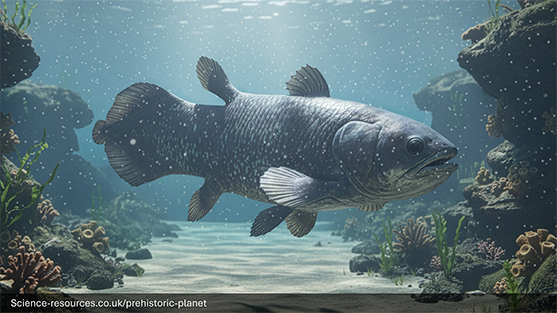
Coelacanths are ancient lobe‑finned fish that first appeared hundreds of millions of years ago. Thought extinct until the 20th century, they possess limb‑like fins and a distinctive tail, offering insights into early vertebrate evolution.
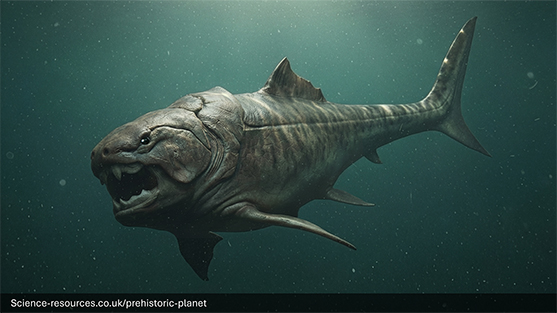
Dunkleosteus was a gigantic armoured fish of the Late Devonian, armed with powerful jaw plates capable of slicing prey with incredible force. As one of the largest placoderms, it dominated ancient seas as a fearsome apex predator.
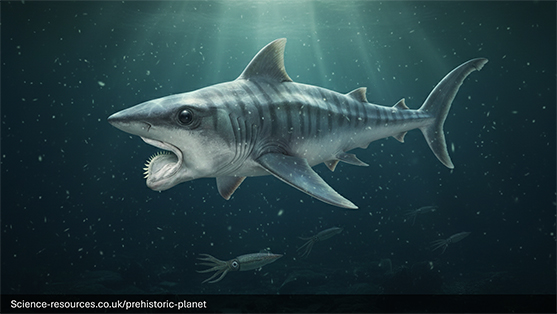
Helicoprion was a shark‑like fish famous for its bizarre spiral of teeth, known as a ‘tooth whorl’. Living in Permian oceans, it probably used this curled blade to slice soft‑bodied prey such as squid‑like creatures.
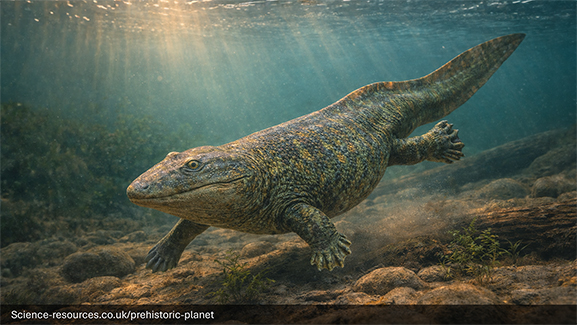
Ichthyostega was an early, four-limbed vertebrate that lived long before dinosaurs, known for its sturdy limbs and fish-like tail. It inhabited shallow swamps and waterways of the Late Devonian, where it helped mark the transition from aquatic life to life on land..
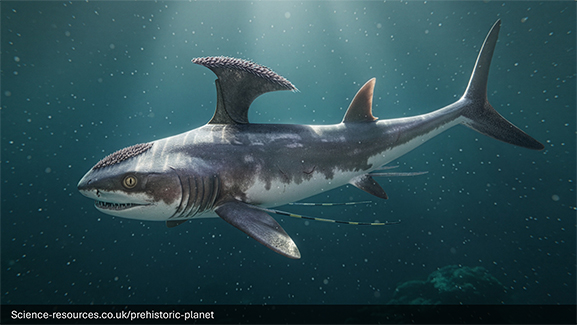
Stethacanthus was an early shark that lived long before dinosaurs, known for its distinctive anvil-shaped dorsal fin covered in tooth-like denticles. It swam through Devonian and Carboniferous seas, where this unusual fin may have played a role in display or defense.
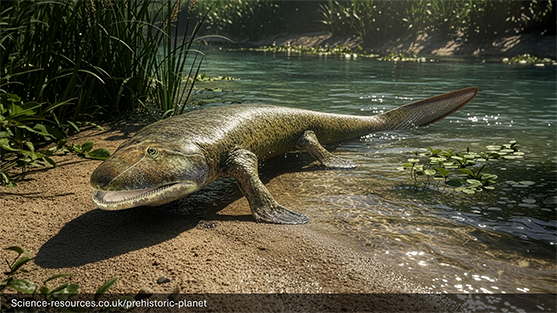
Tiktaalik was a remarkable Devonian fish‑tetrapod transitional creature, sporting both fins and early limb‑like bones. Its flat skull, mobile neck, and robust front fins allowed it to prop itself up in shallow water or even haul onto muddy riverbanks. This blend of aquatic and terrestrial features marks Tiktaalik as a pivotal step in the evolutionary shift from water to land.
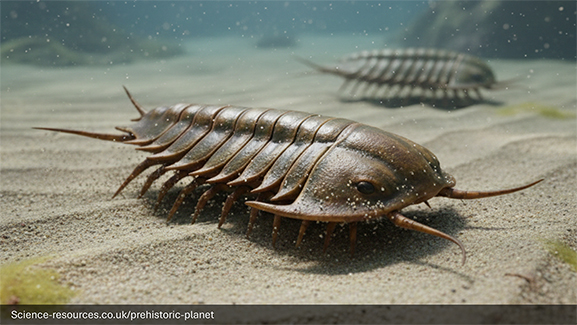
Trilobite was a hard-shelled arthropod that lived long before dinosaurs, known for its segmented body and compound eyes. It crawled along the seafloor of ancient oceans, feeding on detritus and small prey, and became one of the most diverse and widespread animals of the Paleozoic.
You may also be intrested in:
- Extinct Animals: A-Z
- Dinosaurs: A-Z
Tags: Devonian Period, Age of Fishes, first forests, early amphibians, prehistoric fish, before dinosaurs, Palaeozoic Era.
© 2012 science-resources.co.uk. All rights reserved | Design by W3layouts
Before Dinosaurs: Devonian Period
Life During the Devonian Period
The Devonian period (around 419–359 million years ago) is often called the “Age of Fishes”, and for good reason. During this time, fish dominated Earth’s oceans, rivers and lakes, becoming more diverse and powerful than ever before.
The seas were filled with an incredible variety of fish. Armoured placoderms, including the huge predator Dunkleosteus, roamed the waters with jaws strong enough to crush almost anything. Meanwhile, early sharks began to appear, alongside bony fish that are ancestors of many modern species.
But the Devonian wasn’t just important for life underwater, it also marked a major step in the conquest of land. Plants developed stronger stems and grew much taller, forming some of the first forests. These early forests created shade, roots and more complex soils, helping reshape Earth’s landscapes.
The biggest breakthrough came when some fish evolved limbs strong enough to support them in shallow water. These early tetrapods, the first four‑limbed animals, began to explore the land, even though they still depended on water. Their arrival marked a key moment in the evolution of amphibians, reptiles, birds and mammals.
Toward the end of the Devonian, the world faced a series of environmental changes that led to several extinction events. Despite this, the period remains one of the most important in Earth’s history, as life took bold new steps both in the water and on land.
Devonian Period (419–359 Ma)
The Age of Fishes:
- Dunkleosteus: Armoured apex predator.
- Stethacanthus: Early “anvil headed” shark.
- Helicoprion (earliest records): Strange tooth whorl shark.
- Tiktaalik: Transitional “fishapod” bridging fish and tetrapods.
- Ichthyostega: One of the earliest clearly terrestrial tetrapods.
- Coelacanth: Continues to diversify.
- Trilobites: Significantly decline.
Coelacanths are ancient lobe‑finned fish that first appeared hundreds of millions of years ago. Thought extinct until the 20th century, they possess limb‑like fins and a distinctive tail, offering insights into early vertebrate evolution.
Dunkleosteus was a gigantic armoured fish of the Late Devonian, armed with powerful jaw plates capable of slicing prey with incredible force. As one of the largest placoderms, it dominated ancient seas as a fearsome apex predator.
Helicoprion was a shark‑like fish famous for its bizarre spiral of teeth, known as a ‘tooth whorl’. Living in Permian oceans, it probably used this curled blade to slice soft‑bodied prey such as squid‑like creatures.
Ichthyostega was an early, four-limbed vertebrate that lived long before dinosaurs, known for its sturdy limbs and fish-like tail. It inhabited shallow swamps and waterways of the Late Devonian, where it helped mark the transition from aquatic life to life on land..
Stethacanthus was an early shark that lived long before dinosaurs, known for its distinctive anvil-shaped dorsal fin covered in tooth-like denticles. It swam through Devonian and Carboniferous seas, where this unusual fin may have played a role in display or defense.
Tiktaalik was a remarkable Devonian fish‑tetrapod transitional creature, sporting both fins and early limb‑like bones. Its flat skull, mobile neck, and robust front fins allowed it to prop itself up in shallow water or even haul onto muddy riverbanks. This blend of aquatic and terrestrial features marks Tiktaalik as a pivotal step in the evolutionary shift from water to land.
Trilobite was a hard-shelled arthropod that lived long before dinosaurs, known for its segmented body and compound eyes. It crawled along the seafloor of ancient oceans, feeding on detritus and small prey, and became one of the most diverse and widespread animals of the Paleozoic.
You may also be intrested in:
- Extinct Animals: A-Z
- Dinosaurs: A-Z
Tags: Devonian Period, Age of Fishes, first forests, early amphibians, prehistoric fish, before dinosaurs, Palaeozoic Era.
© 2012 science-resources.co.uk. All rights reserved | Design by W3layouts