Last updated: 24th January 2026
Before Dinosaurs: Silurian Period
Life During the Silurian Period
The Silurian period (around 443–419 million years ago) marks a major turning point in Earth’s history. After the mass extinction at the end of the Ordovician, life slowly recovered, and the natural world began to look more like the planet we know today.
For the first time, life started to move onto land. Early plants such as Cooksonia grew in damp areas near the water’s edge. These plants were tiny, only a few centimetres tall, but they were incredibly important. They helped create the first simple soils and paved the way for future life on land.
The oceans were still the centre of activity. Sea levels rose, creating warm, shallow seas filled with coral reefs. New groups of fish appeared, including jawless fish and the first fish with jaws, giving rise to many of the fish we see today. The Silurian seas also hosted sea scorpions known as eurypterids, some of which could grow longer than a human arm and were among the top predators of their time.
The Silurian period may seem calm compared to the dramatic events before and after it, but it was a crucial stage in the history of life. The first land plants and early animals began shaping the environments that would eventually support forests, insects, amphibians, and much later, humans.
Quick links
Silurian Period (444–419 Ma)
Key features:
Stabilisation after Ordovician extinction; flourishing of reef ecosystems.
- Eurypterids: Common and diverse; dominant aquatic predators.
- Trilobites: Continue but start to decline during the Siluruan Period.
- Early vertebrates: Jawless and early jawed fishes expand.
- Coelacanth: Continue through Silurian.
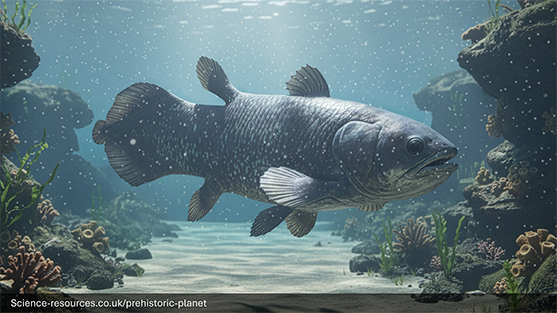
Coelacanths are ancient lobe‑finned fish that first appeared hundreds of millions of years ago. Thought extinct until the 20th century, they possess limb‑like fins and a distinctive tail, offering insights into early vertebrate evolution.
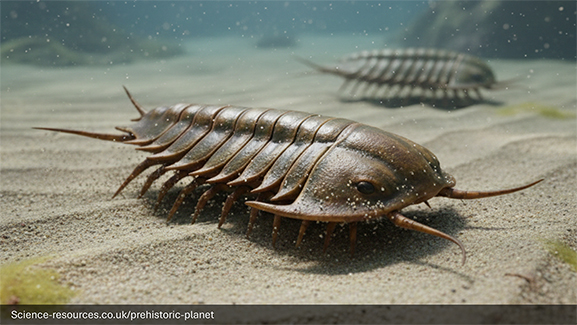
Trilobite was a hard-shelled arthropod that lived long before dinosaurs, known for its segmented body and compound eyes. It crawled along the seafloor of ancient oceans, feeding on detritus and small prey, and became one of the most diverse and widespread animals of the Paleozoic.
You may also be intrested in:
- Extinct Animals: A-Z
- Dinosaurs: A-Z
Tags: Silurian Period, Silurian life, first land plants, early fish, eurypterids, sea scorpions, before dinosaurs, Palaeozoic Era.
© 2012 science-resources.co.uk. All rights reserved | Design by W3layouts
Before Dinosaurs: Silurian Period
Life During the Silurian Period
The Silurian period (around 443–419 million years ago) marks a major turning point in Earth’s history. After the mass extinction at the end of the Ordovician, life slowly recovered, and the natural world began to look more like the planet we know today.
For the first time, life started to move onto land. Early plants such as Cooksonia grew in damp areas near the water’s edge. These plants were tiny, only a few centimetres tall, but they were incredibly important. They helped create the first simple soils and paved the way for future life on land.
The oceans were still the centre of activity. Sea levels rose, creating warm, shallow seas filled with coral reefs. New groups of fish appeared, including jawless fish and the first fish with jaws, giving rise to many of the fish we see today. The Silurian seas also hosted sea scorpions known as eurypterids, some of which could grow longer than a human arm and were among the top predators of their time.
The Silurian period may seem calm compared to the dramatic events before and after it, but it was a crucial stage in the history of life. The first land plants and early animals began shaping the environments that would eventually support forests, insects, amphibians, and much later, humans.
Quick links
Silurian Period (444–419 Ma)
Key features:
Stabilisation after Ordovician extinction; flourishing of reef ecosystems.
- Eurypterids: Common and diverse; dominant aquatic predators.
- Trilobites: Continue but start to decline during the Siluruan Period.
- Early vertebrates: Jawless and early jawed fishes expand.
- Coelacanth: Continue through Silurian.
Coelacanths are ancient lobe‑finned fish that first appeared hundreds of millions of years ago. Thought extinct until the 20th century, they possess limb‑like fins and a distinctive tail, offering insights into early vertebrate evolution.
Trilobite was a hard-shelled arthropod that lived long before dinosaurs, known for its segmented body and compound eyes. It crawled along the seafloor of ancient oceans, feeding on detritus and small prey, and became one of the most diverse and widespread animals of the Paleozoic.
You may also be intrested in:
- Extinct Animals: A-Z
- Dinosaurs: A-Z
Tags: Silurian Period, Silurian life, first land plants, early fish, eurypterids, sea scorpions, before dinosaurs, Palaeozoic Era.
© 2012 science-resources.co.uk. All rights reserved | Design by W3layouts