Last updated: 24th January 2026
Before Dinosaurs: When They Lived
Life Before Dinosaurs: The
Palaeozoic Era
Long before the first dinosaurs ever walked the Earth, our planet was already full of extraordinary life. From strange armoured fish to giant dragonfly‑like insects, the world looked nothing like it does today. The periods before the dinosaurs, known collectively as the Palaeozoic Era, cover more than 300 million years of dramatic change, evolution and extinction.
During these early periods, life made some of its most important breakthroughs. In the seas, the earliest complex animals evolved, including trilobites, sea scorpions and the first fish. Later, plants and animals began to move onto land, transforming Earth’s surface with the first forests, insects and amphibians. Reptiles eventually appeared too, some of which would later give rise to the dinosaurs themselves.
The Palaeozoic world was shaped by shifting continents, rising and falling sea levels, and several major extinction events. Each period, from the Cambrian Explosion to the lush Carboniferous swamps and the dry, challenging landscapes of the Permian, helped set the stage for the dinosaurs that would follow.
Exploring the time before the dinosaurs reveals how life evolved, adapted and survived on a changing planet and helps us understand the origins of many modern animals, including our own distant ancestors.
Quick links
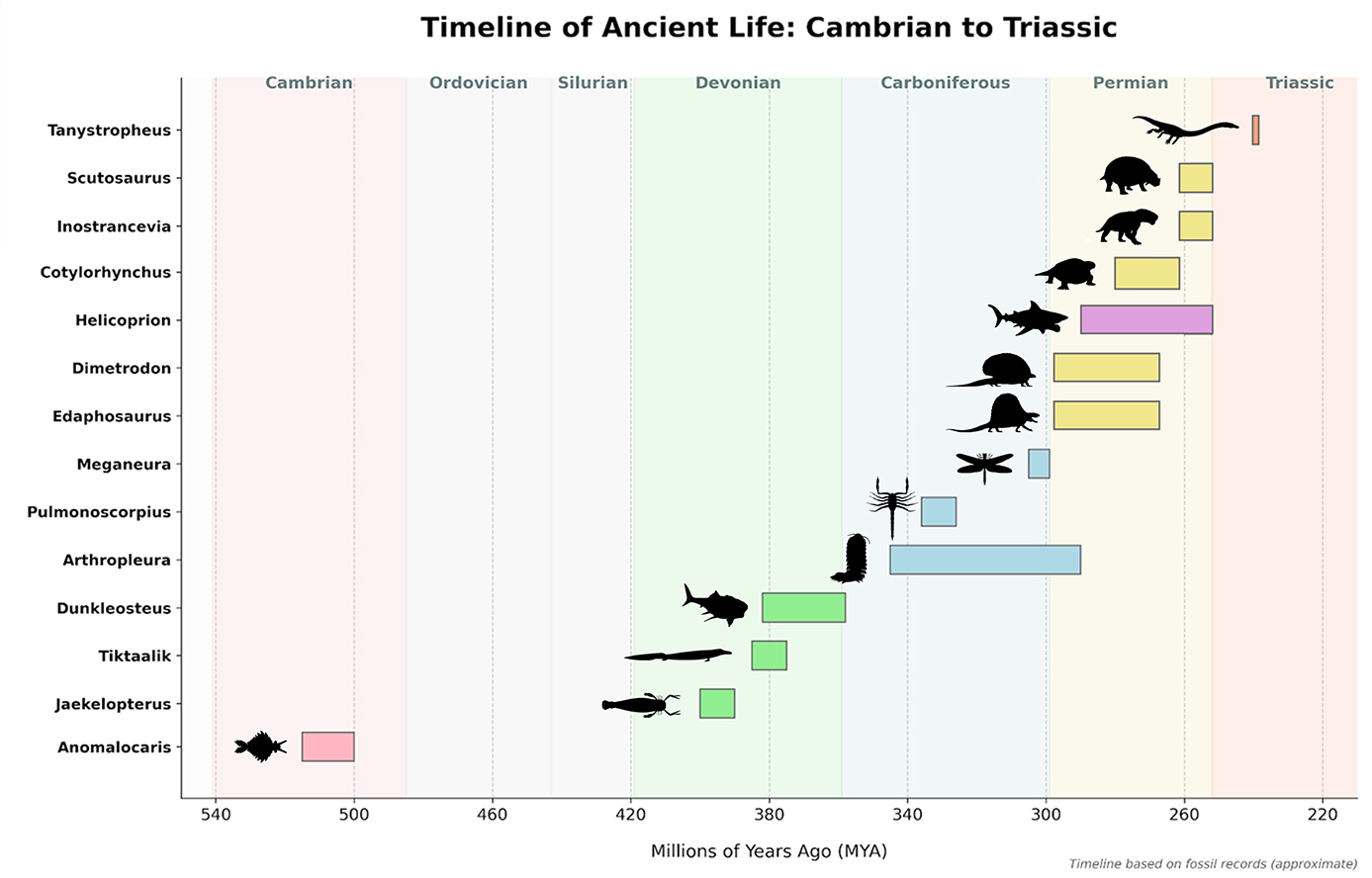 Timeline of prehistoric life before Dinosaurs (Cambrian to Triassic)
Cambrian
Imagine a world with no trees, no animals on land, and no plants covering the ground. Over 500 million years ago, during the Cambrian period, Earth looked completely different from today. Almost all life lived in the oceans, and these seas were bursting with strange and fascinating creatures.
The Cambrian period is famous for a huge burst of evolution known as the Cambrian Explosion. During this time, life became far more complex. Many of the major animal groups we recognise today, such as arthropods, first appeared.
If you could dive into a Cambrian sea, you’d see trilobites, Anomalocaris and Opabinia. This period laid the foundations for all complex life that followed.
Ordovician
The Ordovician period (485–443 million years ago) saw Earth’s oceans become richer and more varied. Although life still hadn’t reached land, the seas were full of brachiopods, molluscs and early echinoderms. Coral reefs began to grow, and giant orthocones dominated as top predators.
The period ended in one of Earth’s first major mass extinctions, caused by dramatic climate change.
Silurian
The Silurian (443–419 million years ago) marks a major turning point. Life recovered after the Ordovician extinction, and the first plants such as Cooksonia began to colonise land.
In the oceans, jawless fish and early jawed fish thrived, and eurypterids (sea scorpions) were major predators.
Devonian
Known as the ‘Age of Fishes’, the Devonian (419–359 million years ago) saw fish dominate oceans and rivers. Armoured placoderms such as Dunkleosteus thrived, and sharks became more common.
On land, early forests appeared, and the first tetrapods began moving onto land.
Carboniferous
The Carboniferous (359–299 million years ago) was warm and humid, with vast swampy forests that later formed coal. Giant insects thrived due to high oxygen levels.
The first reptiles evolved, along with diverse sharks and marine life.
Permian
The Permian (299–252 million years ago) saw Pangaea form and synapsids like Dimetrodon dominate. Plants adapted to drier climates, and oceans supported ammonites and early sharks.
The period ended in the largest mass extinction in Earth’s history.
Triassic
After the Permian extinction, life slowly recovered. Early dinosaurs and mammals appeared, while marine reptiles dominated the seas.
The Triassic ended with another extinction, clearing the way for dinosaurs in the Jurassic.
You may also be intrested in:
- Extinct Animals: A-Z
- Dinosaurs: A-Z
Tags: Cambrian,
Ordovician, Silurian, Devonian, Carboniferous, Permian, Triassic,
Palaeozoic Era, Paleozoic Era facts, prehistoric Earth, before dinosaurs, early life on Earth, Cambrian Ordovician Silurian Devonian Carboniferous Permian Triassic.
© 2012 science-resources.co.uk. All rights reserved | Design by W3layouts
Before Dinosaurs: When They Lived
Life Before Dinosaurs: The Palaeozoic Era
Long before the first dinosaurs ever walked the Earth, our planet was already full of extraordinary life. From strange armoured fish to giant dragonfly‑like insects, the world looked nothing like it does today. The periods before the dinosaurs, known collectively as the Palaeozoic Era, cover more than 300 million years of dramatic change, evolution and extinction.
During these early periods, life made some of its most important breakthroughs. In the seas, the earliest complex animals evolved, including trilobites, sea scorpions and the first fish. Later, plants and animals began to move onto land, transforming Earth’s surface with the first forests, insects and amphibians. Reptiles eventually appeared too, some of which would later give rise to the dinosaurs themselves.
The Palaeozoic world was shaped by shifting continents, rising and falling sea levels, and several major extinction events. Each period, from the Cambrian Explosion to the lush Carboniferous swamps and the dry, challenging landscapes of the Permian, helped set the stage for the dinosaurs that would follow.
Exploring the time before the dinosaurs reveals how life evolved, adapted and survived on a changing planet and helps us understand the origins of many modern animals, including our own distant ancestors.
Quick links
Timeline of prehistoric life before Dinosaurs (Cambrian to Triassic)
Cambrian
Imagine a world with no trees, no animals on land, and no plants covering the ground. Over 500 million years ago, during the Cambrian period, Earth looked completely different from today. Almost all life lived in the oceans, and these seas were bursting with strange and fascinating creatures.
The Cambrian period is famous for a huge burst of evolution known as the Cambrian Explosion. During this time, life became far more complex. Many of the major animal groups we recognise today, such as arthropods, first appeared.
If you could dive into a Cambrian sea, you’d see trilobites, Anomalocaris and Opabinia. This period laid the foundations for all complex life that followed.
Ordovician
The Ordovician period (485–443 million years ago) saw Earth’s oceans become richer and more varied. Although life still hadn’t reached land, the seas were full of brachiopods, molluscs and early echinoderms. Coral reefs began to grow, and giant orthocones dominated as top predators.
The period ended in one of Earth’s first major mass extinctions, caused by dramatic climate change.
Silurian
The Silurian (443–419 million years ago) marks a major turning point. Life recovered after the Ordovician extinction, and the first plants such as Cooksonia began to colonise land.
In the oceans, jawless fish and early jawed fish thrived, and eurypterids (sea scorpions) were major predators.
Devonian
Known as the ‘Age of Fishes’, the Devonian (419–359 million years ago) saw fish dominate oceans and rivers. Armoured placoderms such as Dunkleosteus thrived, and sharks became more common.
On land, early forests appeared, and the first tetrapods began moving onto land.
Carboniferous
The Carboniferous (359–299 million years ago) was warm and humid, with vast swampy forests that later formed coal. Giant insects thrived due to high oxygen levels.
The first reptiles evolved, along with diverse sharks and marine life.
Permian
The Permian (299–252 million years ago) saw Pangaea form and synapsids like Dimetrodon dominate. Plants adapted to drier climates, and oceans supported ammonites and early sharks.
The period ended in the largest mass extinction in Earth’s history.
Triassic
After the Permian extinction, life slowly recovered. Early dinosaurs and mammals appeared, while marine reptiles dominated the seas.
The Triassic ended with another extinction, clearing the way for dinosaurs in the Jurassic.
Tags: Cambrian, Ordovician, Silurian, Devonian, Carboniferous, Permian, Triassic, Palaeozoic Era, Paleozoic Era facts, prehistoric Earth, before dinosaurs, early life on Earth, Cambrian Ordovician Silurian Devonian Carboniferous Permian Triassic.
© 2012 science-resources.co.uk. All rights reserved | Design by W3layouts